
Featured Quizzes
User Quizzes
Create Quiz
Data and Charts
Word Search
Flash Cards
Badges and Games
About JetPunk
Message Board
Dark Mode
Texas Waste Water Treatment Ch#08 Activated Sludge Process - Statistics
General Stats
- This quiz has been taken 89 times
- The average score is 18 of 30
Answer Stats
| Question | Answer | % Correct |
|---|---|---|
| The purpose of return activated sludge is to reseed the biological reactor with treatment microorganisms. | True | 100%
|
| Which of the following are the activated sludge process parameters an operator can change directly? | Aeration, waste, AND return sludge rates | 92%
|
| Temperature has no effect on the activity of microorganisms in the activated sludge process because wastewater is always warm. | False | 92%
|
| The reason for wasting solids from an activated sludge system is to remove excess biological solids, inert solids, and old or dead microorganisms. | True | 92%
|
| The 30-minute settling test gives the operator a visual check on sludge quality. | True | 92%
|
| The return activated sludge flow is indicated by what letter? | 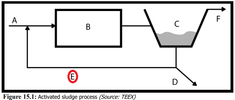 | 83%
|
| Dissolved Oxygen(DO) levels in activated sludge plants should be kept at the 2–4 mg/L level with 1 mg/L minimum. | True | 83%
|
| In the extended aeration process, air blowers or aerators normally run continuously to provide the oxygen needed unless the plant is small and underloaded organically. | True | 83%
|
| Good activated sludge is gray and settles rapidly, leaving a clear supernatant. | False | 75%
|
| Oxygen levels, wasting rates, sludge quality, return rates, and aerator solids levels are important control parameters for activated sludge plants. | True | 75%
|
| Air requirements in an activated sludge process are governed by the organic loading on the plant. | True | 75%
|
| Rising sludge and gas bubbles can be caused by denitrification in the final clarifier. | True | 75%
|
| The clarifier is indicated by what letter? | 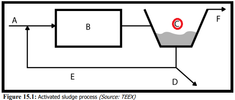 | 67%
|
| Which of the following causes sludge bulking? | All of the above | 67%
|
| An advantage of the sequential batch reactor process is that it only requires one tank and no separate clarifier to perform its task. | True | 67%
|
| Complete mix plants will not handle shock loads as well as other activated sludge modifications. | False | 58%
|
| Which of the following happens when the return sludge rate is too low? | There will be insufficient organisms to treat the waste load entering the aeration basin AND the sludge blanket in the secondary clarifier could become too high | 58%
|
| The clarifier should concentrate the mixed liquor solids at least two times. | True | 58%
|
| Testing of mixed liquor indicates the MLSS is 2,000 mg/L, and the settling test shows that a 1,000 mL sample settles to 250 mL after 30 minutes. What is the SVI and sludge quality? | 125 and good | 50%
|
| A conventional activated sludge process has primary clarifiers that remove about l0%–20% of the organic load. | False | 50%
|
| During start-up, your aeration tank produces excessive amounts of billowing white foam. This can be corrected by ________. | seeding the process with sufficient good quality sludge | 50%
|
| What is the relationship between the F/M ratio and the MCRT for a particular plant when the aerator detention time is a constant value? | When one increases the other decreases | 50%
|
| An airlift sludge return pump should be turned on each morning to return activated sludge to the aeration tank. | False | 42%
|
| Dissolved Oxygen(DO) should be kept at very high levels in the aeration tank. | False | 42%
|
| An advantage of the extended aeration process is that less aeration tank capacity is needed than with conventional activated sludge. | False | 42%
|
| A complete mix activated sludge plant has a fast settling sludge and high amounts of pin floc leaving the clarifier. One way to correct this problem is to ________. | increase the F/M ratio by wasting more | 42%
|
| F/M ratio, sludge age, and settling tests provide valuable operating information to determine proper plant oxygen levels. | False | 25%
|
| The endogenous growth phase occurs when there is more food than the microorganisms can consume. | False | 25%
|
| Sludge bulking in an activated sludge plant can be easily corrected. | False | 17%
|
| An old, over-oxidized sludge at an underloaded plant produces mixed liquor solids that do which of the following? | Settle rapidly leaving a turbid supernatant | 17%
|
No matching quizzes found
Score Distribution
Percent of People with Each Score
Percentile by Number Answered
Your Score History
You have not taken this quiz
New and Popular