
Featured Quizzes
User Quizzes
Create Quiz
Data and Charts
Word Search
Badges and Games
About JetPunk
Message Board
Random Quiz
Dark Mode
Biology Exam Review
I'm using this to study
Rate:
Last updated: June 26, 2023
You have not attempted this quiz yet.
More quiz info >>
| First submitted | June 24, 2023 |
| Times taken | 13 |
| Average score | 30.7% | Report this quiz | Report |
10:00
The quiz is paused. You have remaining.
Copied!
Scoring
You scored / = %
This beats or equals
% of test takers
also scored 100%
The average score is
Your high score is
Your fastest time is
Keep scrolling down for answers and more stats ...
1. What is nondisjunction?
The failure of chromosomes crossing over during meiosis
The failure of homologous chromosomes separating during meiosis
When homologous chromosomes move to opposite poles of the cell during anaphase 1
When bacteria fails conjugation
2. What do sphincters do?
Help stomach with physical digestion
Tighten to close a passage in the body
Produce enzymes for the stomach
Connect organs together
3. A white allele and black allele are both codominant. What colour would be expressed if both of these alleles are inherited.
Neither white or black
Random shade of white or black
White and Black
Gray
4. What kind of cell is a virus?
Prokaryotic
Viruses are not cells
Viruses can be eukaryotic or prokaryotic
Eukaryotic
5. What do protists and bacteria have in common?
Both are eukaryotes
Can be multicellular
Can reproduce through binary fission
Have cellulose in their cell walls
6. What organelle breaks down waste with enzymes?
Ribosomes
Rough ER
Lysosomes
Golgi
7. Out of the following three plant tissues, which one is in between the other two?
Dermal tissue
Vascular tissue
Ground tissue
Gator out!!!
8. What is not a part of blood?
White blood cells
Water
Platelets
Plasma
9. Which of the following is not a bacteria shape?
Spiral
Round
Square
Rod
10. Who presented the idea of acquired characteristics?
Charles Darwin
Baron Georges Cuvier
Jean-Baptiste Lamarck
Isaac Newton
11. What does the law of segregation state?
For heterozygotes, one trait conceals the prescence of the other trait
Alles of two genes get sorted independently
Alles are randomly swapped during crossing over in meiosis
Only one of the two alleles for each gene is distributed to each gamete
12. What is peristalsis?
Contraction/relaxation of esophageal muscles
Contraction/relaxation of intercostal muscles
Contraction/relaxation of diaphragm
Contraction/relaxation of muscles in intestine
13. Which two terms have DIFFERENT definitions?
Bacilli and rod
Staphylo and clusters
Strepto and chain
Coccus and spiral
14. What is the difference between homologous and analogous?
Opposite to the other option
Homologous means same structure but different function, analogous means same function but different evolutionary origin
15. A person has type A blood. What are all the blood types that can they receive blood donations from?
Just type O
O and B
O and A
O and AB
16. What is the order of valves that blood passes through first in the heart to valves that blood passes through last in the heart?
Aortic valve, pulmonary valve, mitral valve, tricuspid valve
Aortic valve, mitral valve, pulmonary valve, tricuspid valve
Tricuspid valve, mitral valve, pulmonary valve, aortic valve
Tricuspid Valve, pulmonary valve, mitral valve, aortic valve
17. What organelle produces, modifies, and transports protein?
Smooth ER
Rough ER
Golgi
Lysosomes
18. If an organism's haploid number is 6, what is the diploid number?
8
6
12
3
19. Which of the following is INCORRECT?
Trypsin breaks down protein and is found in the pancreas
Maltase breaks down carbs and is found in the small intestine
Peptidase breaks down protein is found in the small intestine
Amylase breaks down carbs and is found in the stomach
20. Dumb king Phillip...
...came over for tasty soup
...came over for lunch
...came over for good spaghetti
...came over for delicious sandwiches
21. What are the names of the two sphincters in the stomach?
Intestigeal and plyoric
Upper and lower
Esophageal and plyoric
Esophageal and intestigeal
22. Which of the following is true about animal-like protists?
They are heterotrophs
All of the other options
Plasmodium (a sporozoan) is an animal-like protist
They move around with pseudopods, cilia, or flagella
23. What organelle provides shape and transports materials?
Cytoskeleton
Amyloplast
Cell wall
Vesicle
24. What is the ideal structure for gas exchange (why are the alveoli and capillaries so effective)?
Large surface area
Round structure
Small space
One cell thick
25. What does a paramecium (protist) use to move around?
None of the other options
Cillia
Pseduopods
Flagella
26. What enzyme is found and produced in the mouth?
Insulin
Pepsin
Chyme
Lipase
27. What does not support endosymbiotic theory?
Some organelles are double membraned
Some organelles divide in a similar way to bacteria
Some organelles contain their own DNA and ribosomes
Some organelles are present in eukaryotes and prokaryotes
28. Which of the following is a structural adaptation?
Migration
Distinct modes of communication
Camoflage
Hibernation
29. Coyotes move to an area and the number of white rabbits drop drastically. The next generation of rabbits is brown. What is this an example of?
Founder effect
Migration
Bottleneck effect
Natural selection
30. In what form do plants store food?
Bolus
Glycogen
Starch
Fat
31. Veins carry...
...deoxygenated blood towards the heart
...deoxygenated blood away from the heart
...blood away from the heart
...blood towards the heart
32. What is the morphological species concept?
Species must have unique chemical processes and functions
Species must be an irreducible group that originated from a common ancestor
Species must be a unique cluster of cells
Species must be able to produce fertile offspring
33. Humans are an example of _ because our anus is the first opening in the embryo.
Deuterostomes
Protostomes
Coeloms
Autotrophs
34. What type(s) of organisms have cellulose in their cell wall?
Protists
Plants
Plants and protists
Neither
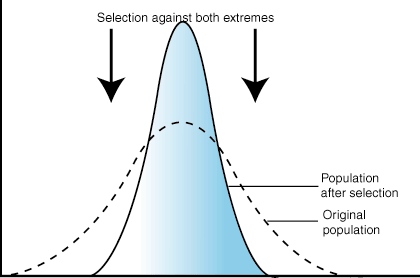
35. Which of the following shows disruptive selection?
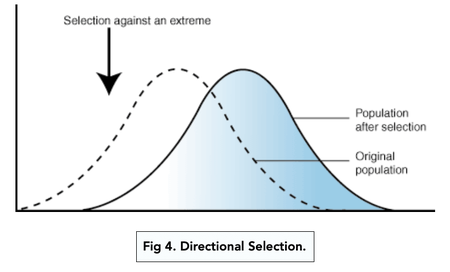
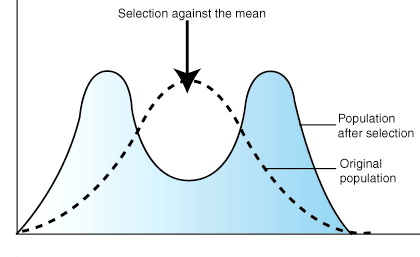
36. A cell has 8 chromosomes in G1 phase before DNA replication. In meiosis, how many chromosomes will the daughter cells have after telophase 1 and after telophase 2?
4 chromosomes, then 4 chromosomes
4 chromosomes, then 2 chromosomes
8 chromosomes, then 4 chromosomes
8 chromosomes, then 8 chromosomes
37. Where is lipase NOT produced?
Pancreas
Stomach
Small Intestine
Mouth
38. Movement of alleles from one generation to another is called...
...genetic drift
...migration
...mutation
...gene flow
39. Which of the following shows stabilizing selection?
40. What enzyme found in the mouth breaks down carbohydrates?
Trypsin
Amylase
Lipase
Pepsin
41. What is the middle part of the small intestine?
Jejunum
Duodenum
Rectum
Ilium
42. What organelle stores waste, nutrients, and water?
Rough ER
Amyloplast
Golgi
Vacuole
43. What blood type can donate blood to all other blood types?
B
O
A
AB
44. What does the smooth endoplasmic reticulum do?
Contains DNA for the cell
Makes ribosome for the cell
Detoxifies and removes toxic material from the cell
Makes proteins for the cell
45. What is a similarity between the lysogenic and lytic cycle of viruses?
Virus floats inside of the host cell
Virus attaches to the host cell
Virus injects RNA into the host cell
Virus replicates
46. What are the hair-like projections that line the inside of the small intestine?
Duodenum
Cillia
Lipase
Villi
47. What do ALL organisms have in common?
Have membrane bound nucleus
Contain DNA
Multicellular
Can move around
48. Which is NOT a method bacteria use to swap DNA
Conjugation
Conjuction
Transformation
Transduction
49. What are plasmids?
Strands that help chromosomes move around in meiosis
Protective strands that form from an unfavourable environment
Circular DNA strands found in bacteria
Long strands of DNA found in the nucleus
50. What type of dominance causes an organism to express a mixture of alleles?
Incomplete Dominance
Codominance
Complete Dominance
None of the other options
51. What does DNA stand for?
Denucleic Acid
Deoxyribonucleic Acid
Deoxygenetic Acid
Deriboxynucleic Acid
52. What is allopatric speciation?
Physical separation between a species
Variation in frequency of different genotypes from a population
Speciation caused by a catastrophe
Nature favouring certain traits over others
53. What does a cladogram (phylogenetic tree) show?
Birth order of induviduals
Classification of organisms
The number of taxonomic ranks
The evolutionary relationships between species
54. What are vestigial structures?
The structures for embryos across different species
Left over body parts that have lost their purpose through evolution
Body parts that look similar to parts on other species but aren't the same
Fossils of a species ancestors
55. What is found in the cell wall of bacteria?
Cellulose
Peptidoglycon
Chitin
Glycogen
56. What are the DNA base pairings?
A and C, G and T
None of the other options
A and G, C and T
A and T, C and G
57. What type of body cavity is an inside structure?
Exoskeleton
Hydrostatic
Shell
Endoskeleton
58. Which of the following is not looked at when classifying animals?
Body systems
Autotroph or heterotroph
Embryonic development
Symmetry
59. Why are Y-linked traits more rare than X-linked traits?
Y-linked traits can only be expressed in males
Y chromosomes have less DNA
Most traits come from females, who have two X chromosomes
Chaimo is lame-o
60. Which of the following is an example of an open circulatory system?
Blood is pumped straight into organism's body cavity
Capillaries exchange materials between blood and tissue cells
Blood is contained in vessels
Blood is kept separate from interstitial fluid
61. What are the four bases for DNA?
Adenine, cytosine, guanine, thyamine
Adesine, cytosine, guamine, thyamine
Adenine, cytomine, guamine, thyamine
Adesine, cytomine, guanine, thyamine
62. What parts of the respiratory system are listed in order from where oxygen passes through first to where oxygen passes through last?
Trachea, bronchus, bronchioles, alveoli
Trachea, bronchioles, bronchus, alveoli
Bronchus, bronchioles, trachea, alveoli
Bronchus, trachea, bronchioles, alveoli
63. A snake has adapted to have poisonous venom. This is an example of...
...a physiological adaptation
...a reproductive adaptation
...a behavioral adaptation
...a structural adaptation
64. What phase does crossing over occur in meiosis?
Prophase 2
Prophase 1
Metaphase 1
Metaphase 2
65. What is NOT evidence used to show the relationship/classification of organisms?
DNA evidence
Physiological evidence
Biological evidence
Anatomical evidence
66. Which of the following is NOT evidence of evolution?
DNA
Anatomical evidence
Fossils
Morphological evidence
67. X-linked dominant disorders are most common in...
Only males are affected
Both males and females equally
Males
Females
68. Which of the following are ancestors of plants?
Euglenoids
Green algae
All of the other options
Brown algae
69. What organelle packages protein and other materials for storage and waste?
Rough ER
Golgi
Vesicle
Vacuole
70. Change in allele frequencies due to chance events is called:
Evoulution
Natural Selection
Founder Effect
Genetic Drift
71. If a disorder skips a generation, the disorder is...
X-linked
Recessive
Y-linked
Dominant
72. Other than crossing over, how do gametes become genetically unique during meiosis?
Conjugation
Independent assortment
Natural selection
Crossing over is the only way gametes become genetically unique
73. Which of the following happens in the lytic cycle of viruses?
Virus first attaches to the host cell
Virus injects DNA into host
Virus causes host cell to explode after using it for replication
Virus relies on the host's energy to survive
74. What is the name of the idea that evolution occurs in spurts rather than a linear process?
Disruptive selection
Punctuated Equalibrium
Gradualism
Bottleneck effect
75. What part of the plant carries water up to other plant parts?
Dermal tissue
Xylum
Meristems
Phloem
Save Your Stats
Your Next Quiz

There are 15 countries that start with the letter C. How many can you name?

Which U.S. states had the highest murder rates in 2024?

Answer these questions with a single digit from 0 to 9. But be careful! Three wrong answers ends the quiz.

Drag the flag onto the correct country. Careful, though! One wrong move and the game ends.
Comments
No comments yet
New and Popular