
Featured Quizzes
User Quizzes
Create Quiz
Data and Charts
Word Search
Flash Cards
Badges and Games
About JetPunk
Message Board
Dark Mode

Progressively Harder Math Multiple Choice
Can you answer these progressively harder multiple choice questions about math?
A calculator is not recommended or necessary for this quiz
If I made any mistakes, please add a comment about it!
Some formatting is weird.
May be updated in the future, but at the moment I do not feel confident putting any more difficult questions here.
Rate:
Last updated: January 5, 2026
You have not attempted this quiz yet.
More quiz info >>
| First submitted | April 14, 2025 |
| Times taken | 89 |
| Average score | 56.3% | Report this quiz | Report |
25:00
The quiz is paused. You have remaining.
Copied!
Scoring
You scored / = %
This beats or equals
% of test takers
also scored 100%
The average score is
Your high score is
Your fastest time is
Keep scrolling down for answers and more stats ...
1. What is 1 + 1?
2
0
2. What is 64 - 31?
27
23
33
3. What is 11 * 12?
132
121
144
4. What is the simplest form of 81/39?
Dividing both numbers by three gives the simplified answer of 27/13.
27/13
81/39
9/4
21/9
5. What is (-5 * -6) -7?
-5 * -6 equals 30, as the negatives cancel. Then, 30 - 7 equals 23.
-37
-23
23
37
6. What is 225/19, rounded to the hundredths place?
11.50
13.16
13.22
11.84
7. What is 8/5 divided by 12/7, simplified to the simplest form?
Division is equal to multiplying by a reciprocal, so 8/5 divided by 12/7 is the same as 8/5 multiplied by 7/12. Then, just multiply across, 8 * 7 = 56, 5 * 12 = 60. Finally, divide 4 out of both to simplify, leaving 14/15.
96/35
2/3/5/7
14/15
5/3
8. Solve for x in the following: 5(x + 2) = 8
First, distribute, resulting in 5x + 10 = 8. Then, subtract 10 from both sides, leaving 5x = -2. Finally, divide by 5, leaving x = -2/5.
-2/5
5/2
-5/2
2/5
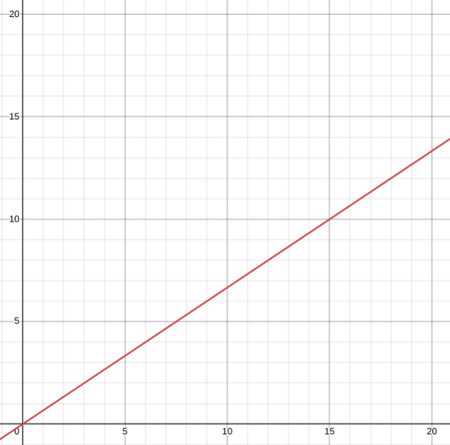
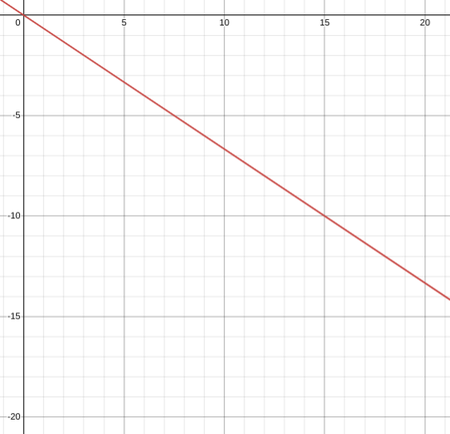
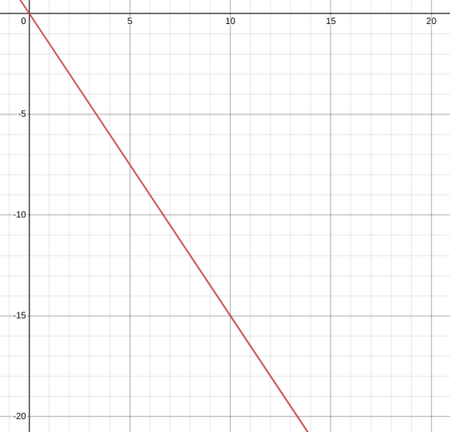
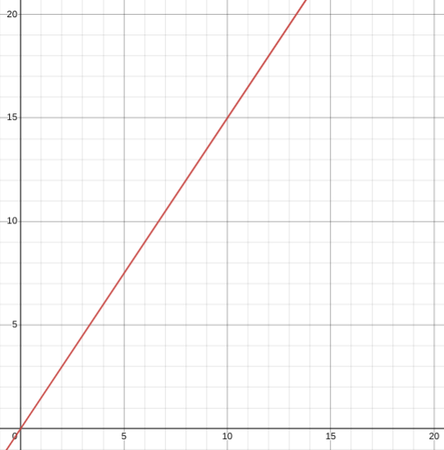
9. Which of the following graphs has a slope of 2/3?
The slope can be determined for any graph without a y-intercept by dividing y-distance by x-distance for any point on the graph. On the correct answer, (3, 2) is a point, which results in a slope of 2/3.
10. The circumference of a circle is 14π. What is the arc length of a sector formed by a 60° angle?
The ratio of arc length to circumference is directly proportional to the ratio of degrees in the angle to total degrees. Therefore, where arc length is s, 14π/s = 360/60, which simplifies to s = 7π/3.
7π/3
7π/6
7π
7π/12
14π/3
14π
11. Bob is trying to sell his triangular carpet. He discovered that the price of carpet at a local store is $2.02 per square foot, and he wants to sell it at the same price. The lengths of the sides are 8, 5, and 5 feet. How much should he sell the carpet for?
Since two of the sides are equal, the triangle is isosceles. Therefore, the third side, 8, is perpendicular to and bisected by the height of the triangle. This creates two congruent right triangles, both of which have the side of 4 and the hypotenuse of 5. Therefore, the missing side, the height, is 3 by the Pythagorean Theorem. Then, according the the triangle area formula, the entire carpet has an area of (3)(8)(1/2), which simplifies to 12. Then, 12 times $2.02 per square foot is $24.24.
$48.48
$20.20
$40.40
$24.24
$80.80
$72.72
12. What is the first derivative of x10 + 16x7 - 4x2 - 1 + x-2?
The power rule allows finding derivatives by multiplying the coefficient of each term by the exponent of the term, then subtracting one from the exponent. Do note that constants are multiplied by x0, and therefore are eliminated when using the power rule. Then, applying the power rule to each individual term results in 10x9 + 112x6 - 8x - 2x-3.
10x9 + 112x6 - 8x - 1 - 2x-3
10x9 + 112x6 - 8x - 2x-3
11x9 + 23x6 - 7x
x11/11 + 2x8 - 4x3/3 - 1 - x-1/2
x11/11 + 2x8 - 4x3/3 - x-1/2
x11/11 + 2x8 - 4x3/3 + ln(-2x)
11x9 + 23x6 - 7x - 1
x11/11 + 2x8 - 4x3/3 + ln(-2x) - 1
13. For the rational function x + 1/x2 - 1, what are/is the vertical asymptote(s) and hole(s)?
When factored, this rational function is x + 1/(x + 1)(x - 1).Then, it shares the common factor (x + 1) in both the numerator and the denominator, which, when set equal to zero, equals -1. Therefore, there is a hole at x = -1. Then, the remaining factor in the denominator is (x - 1), which when set to zero results in the vertical asymptote of x = 1.
There are no vertical asymptotes or holes
VA: x = 1, Hole: x = -1
VA: x = -1, Hole: x = 1
VA: x = 1, x = -1 Holes: None
VA: x = 1, Holes: None
VA: None, Holes: x = 1
14. Multiply the matrices seen in the first answer choice.
Each column in the first matrix is multiplied by its corresponding row in the second matrix. 0 * 4 = 0, -5 * 1 = -5, 11 * -2 = -22. 0 + -5 + -22 = -27.
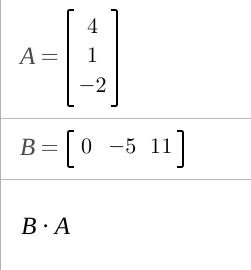
0
-27
16
39
1
-18
15. What is the limit of x3 + 5x2 + 2x - 8/x2 + 2x - 8 as x approaches -4?
First, the rational function must be factored into the form (x + 4)(x - 1)(x + 2)/(x + 4)(x - 2). Then, (x + 4) cancels out, leaving (x - 1)(x + 2)/(x - 2). Plugging in -4 results in -5/3, therefore the limit is -5/3.
-5/3
There is no limit
2
1
3/5
-1/2
-4
16. Convert 5etan-1(3/4)i from exponential form to standard form.
e to an imaginary power rotates a radius of 1 around the complex plane. In this case, the power is the arctangent of 3/4, which indicates that the angle is the same as a right triangle with the ratio of 3 : 4 from its opposite side to its adjacent side. On the complex plane, this results in 4/5 + 3/5i. Multiplied by the 5 in front of the e, this gives the final answer of 4 + 3i. Alternatively, from a purely formulaic perspective, eθi = cos(θ) + i * sin(θ), in which case substitution yields the same answer.
4 + 3i
3 + 4i
60i
.6165π
.3122π
6i
12i
√2
Save Your Stats
Your Next Quiz

Beat the clock by answering these fifty randomly-generated multiplication problems.

For each question, select the numbered tiles which satisfy the statement.

These questions can be answered with the number 5, 6, 7, or 8. Can you get them all?

We did it! One billion quizzes taken! Try to guess these answers that have something to do with the number 1 billion.
4 Comments
Lynxjjh
+2
Level 70
Jul 17, 2025
For question 10, 14π/6 and 7π/3 are the same answer. Fun quiz!
BashfultheCat
+1
Level 53
Jul 26, 2025
Oops, it should be fixed now. Thanks!
zachoj
+2
Level 82
Dec 29, 2025
For question 15, the limit is 0. You either made a sign error in the question or in the solution - one can just evaluate the function at -4 to compute the limit.
BashfultheCat
+1
Level 53
Jan 5, 2026
There was indeed a sign error; the denominator was x^2 - 2x - 8 instead of x^2 + 2x - 8. It should be correct now, thanks for letting me know.
Math Quizzes