

The Five Levels of RISK Player
First published: Thursday December 4th, 2025
Report this blog
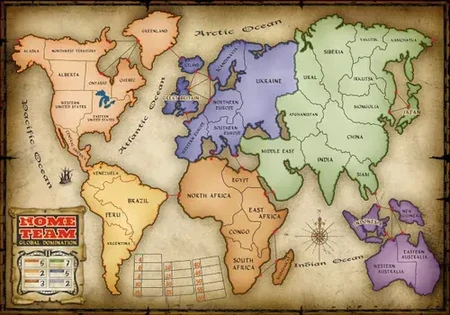
Today I wanted to analyze one of my favorite board games, the morally bankrupt game of imperialism known as Risk. If you couldn’t tell by my quizzes, I love Risk, and I know many of you do as well. As a small child, I used to play a lot of chess, and so I’ve always loved strategy-based board games. Imagine my excitement when I got my first copy of Risk at the age of 11. It was part of what sparked my interest in geography. Now lately, I’ve seen certain kinds of videos keep popping up in my YouTube Recommended and certain kinds of articles, such as 7 Levels of Rap Music/Pop. This has inspired me to make a blog based on my observations when playing, called The 5 Levels of Risk Player. Odds are, you fall into one of these categories.
Now, first things first: this is just my personal experience. No matter if you’re a level 1 or 2 or if you’re a level 5, great. At the end of the day, the point of a board game is to have fun. Additionally, for those of you following the Dimension Pizza series, chapters 24 and 25 are basically done, and chapter 26 is in the works. Part 12, like Part 9, will be 3 chapters. I hope to have Dimension Pizza fully completed by some time in January.
With that being said, let’s get started!
Level 1: The Little Timmy

So picture this: little Timmy just got Risk for his birthday. He’s super excited, it looks really cool, he opens it up and sees all these cool place names he can’t quite pronounce like Yakutsk and Irkutsk and Kamchatka, he sees that Ukraine is really huge and so it must be the best one… He doesn’t really know what he’s doing yet: he just starts having a ball.
Level 1 Risk players usually are either new, or haven’t played in many years, and even then have only played once or twice. There is no real rhyme or reason to Level 1: their strategy typically involves looking at a place and going “oh, I live in the Western United States”, or “oh, Southern Europe has Greece, I’ve been there, I want Greece!” or deciding on a whim that Greenland would make a nice 51st US state, and trying to take that one without much regard for continents or trading card bonuses.
The key point here is that Level 1 typically fails to maintain a centralized stronghold, and typically gets weeded out pretty quickly among more experienced players. Little Timmy’s most memorable experience is having 3 troops in the Congo, and someone with 20 troops piled onto North Africa keeps trying to invade them and, against all odds, loses every single time. To Little Timmy, Risk is a game of luck. And that’s fine. However, if you’re the type of player who wants to gain more experience and hone in on their skills, keep reading.
Level 2: The Peanut Butter

Level 2 Risk players are typically people who’ve played a few games of Risk, or have a passing interest and almost never play. By far the largest chunk of people playing Risk fall into this category. Though typically inexperienced or more casual players, what sets Level 2 apart from Level 1 is strategy. Level 2s will typically try to take an entire continent and get the continental bonus, and have a grasp on weighing risk vs. reward. With that being said, Level 2s tend to fall into a lot of new player traps and generally fails to have much of a stronghold for more than a couple of turns.
For example, 2s typically look at the continental bonuses below. They see the whopping +7 troops granted by Asia, or the fact that Europe only has 1 more territory than Africa, yet grants 2 more troops than Africa. They see big numbers, they go for it. However, Asia is very slow to take control of, and odds are you’ve got others fighting for control of it over the course of the early game, and Europe is difficult to keep control of. Both continents have several territories with which they can be accessed and that you would have to defend (Europe has 4 territories through which it can be entered, and Asia has a whopping five. Additionally, territories such as China, the Middle East and Ukraine can be reached through six different territories.)
Level 2s, and Level 1s to a degree, also have a tendency to either not make alliances at all, or put too much focus on negotiations which don’t serve much of a purpose. They are much more likely to leave themselves open to being betrayed by an ally, or betraying an ally at a really inconvenient time for themselves for a minor gain.
Another hallmark of the Level 2, hence their nickname, is to spread themselves way too thinly with no actual stronghold. Typically they gain a lot of territories in one spot, they save up, they might get a card bonus here or there, and then they splurge. They take all these territories with 1 or 2 troops, and get so excited because they’re steamrolling everyone, and then they realize that they have 2 troops max on basically all of their territories, and that they’ve now made themselves a target. The key thing here is knowing when to stop. The Level 2s typically face a swift retribution, which they cannot adequately defend against, and peter out eventually or go down in a blaze of glory. They might as well have coated the board in a thin layer of peanut butter, and now they’ve left it sitting in front of the dogs to get licked up.
Level 3: The Turtle

Next up is the turtle. This is a definitive way that a Level 2 can improve their gameplay. Many at this level of gameplay heard from their grandpa or older sibling or a video on YouTube that the best strategy is to stockpile all of your troops on Siam and bottleneck Australia, and sit there once you’ve taken Australia, getting that sweet continent bonus, and play defensively, working your way up through Asia. And to their credit, this is a great strategy. It’s even a good way to get second place fairly regularly. However, consistently winning’s a different story.
What differentiates Level 3 from Level 2 is their experience and level of strategy, namely their knowledge of “access points”. By “access points”, I’m referring to territories through which a territory or continent can be accessed, as touched on earlier. For example, Australia is only connected to the rest of the world through Indonesia, which has one route to Asia by Siam, making it the perfect defense spot. (Note: On modified maps with territories such as Hawaii and the Philippines added, or a well placed alien island in Legacy, this strategy gets a monkey wrench thrown into it.) Same goes for places like South (2 access points) and North America (3 access points), and occasionally even Africa (3 access points). However, what defines a Level 3 is sort of the opposite of Level 2: a decent stronghold, but a lack of offense.
See, Risk has a mechanic to discourage strict turtling, in that you only get a territory card if you take another territory. In addition, a +2 continent bonus as seen with Australia or South America is great in the short term, but won’t carry you throughout the whole game, no matter how much of a stronghold you have on the territory.
However, a turtle’s biggest weakness is another turtle. Let me tell you a story. Long ago, I tried the Siam approach in Risk Legacy. My roommate tried the Australia approach and put his capital in Eastern Australia. Both of us were too stubborn to move. And we sat there, just stockpiling and picking away at each other while the other three fought each other. Eventually, I managed to wipe him out and take Australia, and managed to snag India, China, and Mongolia, but the battle with him for getting a foothold in Australia was pyrrhic. I lost a good chunk of my troops and got cleared out pretty quickly by the other players, who had better continent bonuses and had been getting cards the entire time.
Level 3s are much more likely to make alliances and use negotiations to their advantage, however they are also much more likely to bog the game down with negotiations to maintain their defensive state. In addition, due to their mostly defensive strategies, an alliance with them may not serve as much of a purpose, as they will likely not have much ability to pull their own weight and help fuel an alliance. However, the point is, they are always thinking strategically and have studied the game to a decent degree.
Level 4: The Napoleon

Level 4s take strategy and access points and take it up a notch. Over the past year or two, I went from being about a Level 2 or 3 to a solid Level 4 with a bit of practice. The main difference between a Level 4 and a Level 3 is their offensive capabilities combined with their ability to defend: knowing when to stop and how far to go, and exactly where to build your strongholds and having a consistent picture in mind throughout the entire game.
The best strategy I’ve found is to establish yourself early in North America or, as a backup, South America. As previously mentioned, North America has 3 access points to defend and South America has 2. Taking the time to establish a stronghold in North America especially and take all 9 territories typically pays off, as it will make it easier to then take South America, with the same number of access points controlling both continents as opposed to just North America (Greenland, Alaska, and Brazil, which connects to North Africa via a water route), and then work your way into Africa. For reference, as opposed to taking Asia, getting both North and South America is the same continent bonus (+7) with almost half as many access points to defend. Another good strategy is to take South America and Africa and work your way into North America, though I personally wouldn’t make this your plan A, and if you do use this approach, do not, I repeat, DO NOT, let anyone else take control of North America. The combined total continent bonus of South America (+2) and Africa (+3) is equal to North America’s continent bonus alone (+5), and has four separate access points between these two continents (Venezuela, North Africa, East Africa, and Egypt) as opposed to North America’s three access points (Greenland, Alaska, and Central America). Plus, while people are fighting over Asia and Europe, the previous three levels tend to overlook the Americas. A Level 4 can even maintain a good stronghold in Australia as listed in the Turtle example, as long as they can back it up through gaining firm control of another continent and knowing its access points. The trick for any of these strategies is to not grow complacent and go full turtle. Work your way into Iceland, or North Africa, or Kamchatka to prevent a continent bonus. Keep expanding from the Americas down into Africa, while keeping a close eye on your opponents’ resources and on those pesky access points.
The Napoleon is not afraid to use things such as new player traps and alliances to their advantage. They have methods of banding together with other players and weeding out other players by pitting them against each other, and knowing when to break an alliance. Level 4s have extensively studied the map, as well as their opponents. Quite simply put, they are always playing not to hold out, but to win.
Level 5: The Power Gamer

Level 5s take everything about Level 4 and crank it up to 100. Quite simply, Level 5s are completely obsessed with the game, with an absurd amount of experience playing and having spent so much time analyzing the board that they’ve mastered the game. They know all of the access points by heart. They always seem to know exactly where to fortify and have honed in on their strategy and their judgement, being careful never to spread themselves too thin and making their strongholds impenetrable. They manage to win at least three-quarters of the games they play minimum, and possibly even play in tournaments, since those are a thing. Lower levels will complain that this person always wins, and never wants to play anything but Risk.
If you’re playing with alliances, a deal with a Level 5 player always has a twist. Sure, they’ll help demolish Blue to help you take control, but conveniently they’ll leave a heavily defended territory in Africa, which you’ve been eyeing to take. They’ll consistently make sure you don’t get your continent bonus, by taking Iceland or Greenland or Kamchatka or Brazil, etc.
The power gamer’s greatest weakness, however, is the dice. To the credit of Little Timmy, Risk is not just a game of strategy, but also a game of luck. Just like in history, a disastrous invasion or two can completely screw you over, hence what I love about this game. This is emphasized by the fact that defenders win ties.
Anyways, that’s it for this list. Comment below which “level” you are!
I use the term 'paperwalling' for level 2, since when someone spreads put so fast that they only have 1 or 2 units everywhere, they can get their territory smashed as easily as ripping through a paper wall.
I would say Level 2, because I'm definitely not like Level 1 and also not too good.
Great descriptions though!