
The Thirty Years' War - A Demographic Catastrophe in the Holy Roman Empire
Last updated: Friday February 14th, 2025
Report this blog
Introduction
The Thirty Years’ War (1618-1648) was a conflict mostly fought within the boundaries of the Holy Roman Empire, which in its later history was a complicated polity comprised of small feudal territorial estates with its core being mostly located in modern-day Germany and Italy.
Background
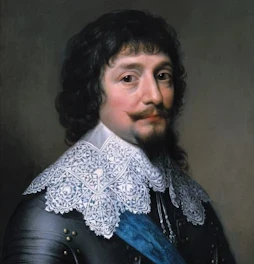
While I won’t go into full detail about the complexity of the war, this conflict originally started out as a civil war, with the deposition of catholic Emperor Ferdinand II von Habsburg from the throne of Bohemia and his consequent replacement by the protestant Frederick V of the Palatinate. While this revolt was suppressed in Bohemia itself, fighting expanded into territories of the Palatinate in 1620, dragging the Netherlands and Spain into the war due to its strategic importance. The ownership of territorial estates (Landstände) within the empire would also give Denmark and Sweden a motive to intervene in the years following. While an eventual Swedish defeat at Nördlingen in 1634 resulted into German anti-imperial forces sueing for peace, resulting into the Peace of Prague in 1635. The war would however enter a new phase as France declared war on Spain shortly before this peace and eventually invaded Spanish territories in Italy. France officially entered the war on March 20th 1636 with the signing of the Treaty of Wismar on the side of Sweden. The conflict finally ended with the Peace of Westphalia on October 24th 1648 after a failed attempt by Swedish forces to take Prague, though clashes briefly continued until November 1st.
Casualties
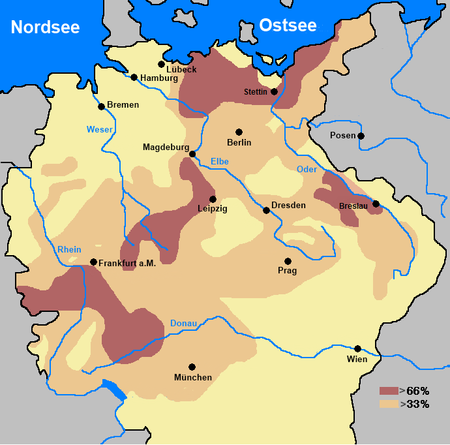
Modern estimates put the total casualties between 4,5 and 8 million. Most of these are civilians deaths that occurred after Swedish entry into the war in 1630, having major consequences for the demographics of the empire, especially in the area of Pomerania, Mecklenburg and Württemberg where the population is said to have fallen by over 50%. The depopulation is still felt in the German state of Mecklenburg-Vorpommern today, with large areas remaining very sparsely populated to this very day.
Among the most known events of the war is the Sack of Magdeburg between the 20th and 24th of May 1631 (also known as the Magdeburg Wedding), where Catholic forces ravaged and destroyed the city, resulting in the deaths of most of its 32,500 inhabitants. According to a census conducted the following year, the town was home to only 449 inhabitants. The resulting devastation eventually spawned the German term “Magdeburgisieren”, which is synonymous with total destruction. The city would not regain its pre-sacking population levels until the early 19th century.
Population Data
Below is a chart which shows the population development of some of the most devastated cities between 1500 and 1800 and two lists comparing the ten largest cities in territories of the Holy Roman Empire that are now located within Germany, Austria, Poland and Czechia in 1618 and 1648 respectively. This brings into perspective how truly devastating this war actually was for the region.
Sources:
"Urban population in Germany, 1500 - 1850" by Ulrich Pfister
"European urban population, 700 - 2000" by Dr. Etljo Buringh
1618
1648
1. Prague - 60.000
2. Regensburg - 60,000
3. Nuremberg - 50,000
4. Vienna - 50,000
5. Augsburg - 48,000
6. Cologne - 40,000
7. Hamburg - 38,000
8. Wrocław - 30,000
9. Lübeck - 25,000
10. Magdeburg - 25,000
1. Vienna - 75,000
2. Prague - 54,000
3. Hamburg - 43,000
4. Cologne - 40,000
5. Lübeck - 31,000
6. Regensburg - 25,000
7. Bremen - 24,000
8. Emden - 22,000
9. Wrocław - 22,000
10. Augsburg - 21,000
I can spend a whole day analysing the chart
I remember Quizmaster once posted a chart showing how, despite the war / insurgency, Iraq's population has been steadily growing for the past forty years. It's interesting to see how this wasn't always the case. I imagine modern ethical standards, better commanding, and more precise equipment have probably aided that.
And it's easy on the eyes too!