
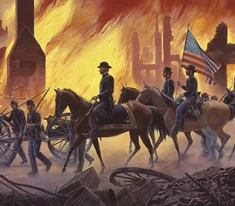
When Georgia Howled
Blog by
First published: Sunday August 17th, 2025
Report this blog
First published: Sunday August 17th, 2025
Report this blog
+10
Quick Links
This blog shall provide an brief overview of Sherman's March to the Sea, one of the transformative events of the American Civil War. This is largely adapted from an old version of the Wikipedia article on the song "Marching Through Georgia", which I wrote. However, I have trimmed and simplified some of the information and adopted a slightly more informal tone. Enjoy!
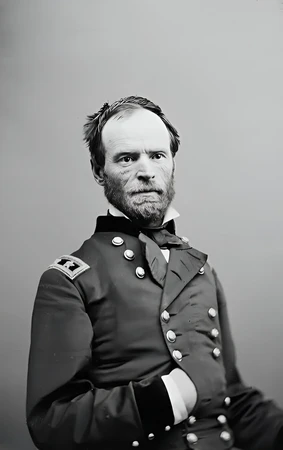
Maj. Gen. Willliam Tecumseh Sherman, depicted sometime between 1860 and 1870
Overview
I can make the march and make Georgia howl.
— Sherman to Grant on October 9, 1864, before the March to the Sea
Maj. Gen. William Tecumseh Sherman's March to the Sea was the most dramatic military campaign of the Civil War. Lasting from November 15 to December 21, 1864,[1] the 285-mile advance from Atlanta to Savannah, important cities in Georgia, split up the Confederacy and shattered Southern morale. A Union victory was on the cards. At the campaign's end, Gen. John W. Geary remarked: "This last campaign of Sherman has almost disemboweled the rebellion … The state of Georgia is about as badly destroyed as some of the tribes of the land of Canaan were by the Israelitish army, according to the Biblical record…. We are in sight of the 'promised land'… ."[2]
Planning
Prior to the march, Sherman had initiated a conquest of Atlanta. After three months of hostilities, the city fell to Union troops and, by September 2, it was completely evacuated and left in ruins. The Northern victory assured civilians, disillusioned by four years of a primarily bloody stalemate, that the war was soon to end. Their confidence was proven by president Abraham Lincoln's landslide reelection in 1864. In conjunction with Maj. Gen. Philip Sheridan's recent triumphs in the Shenandoah Valley, the South's military fortunes grinded to a near halt. After the fall of Atlanta, Confederate President Jefferson Davis admitted: "There are no vital points on which the continued existence of the Confederacy depends … ."[3]
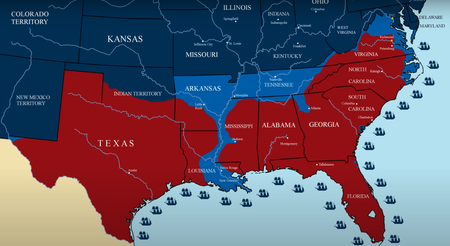
State of the Civil War just before the March to the Sea (credits to EmperorTigerstar)
Sherman felt confident enough to pursue another ambitious campaign in Georgia. He eyed the coastal city of Savannah which, if captured, would split the Confederacy in half. While marching to Savannah, his troops would seize every resource they could find and scourge every structure in their path. In late September, the plan was finalized but an obstacle sprung up; Gen. John Bell Hood and his Confederate militia had advanced to Tennessee in pursuit of Nashville. Hood hoped that this would provoke Sherman to redirect his army and abandon Georgia, but Sherman instead sent a small yet sufficient military force led by Gen. George H. Thomas.
With Georgia free from significant Confederate presence, Maj. Gen. Ulysses S. Grant finally gave his approval to Sherman's plan. The historian John Ford Rhodes commends Sherman for his perceived firmness and prowess: "No general, who lacked qualities of daring and resolution, would have persisted in his determination to advance through Georgia after Hood had crossed the Tennessee river, especially when Grant for a time doubted the wisdom of the movement."[4] After destroying all buildings and communication lines in Atlanta, the plan took action.
The March
On November 15, 62,000 Union troops left Atlanta and commenced the March to the Sea. They were split into two equally sized flanks, the right commanded by Maj. Gen. Oliver O. Howard and the left under Maj. Gen. Henry W. Slocum; 5,000 of the troops belonged to an attached cavalry division led by Brig. Gen. Judson Kilpatrick. Bearing only 20 days' worth of rations, the troops would have to scavenge the land for food and resources to sustain themselves. Sherman, who affirmed their entitlement to enemy territory, ordered them to "forage liberally on the country."[5] While some regulations were imposed, they were hardly observed.
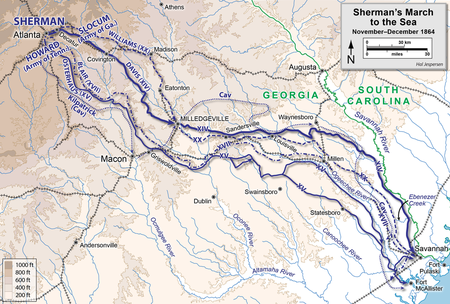
Map of the March to the Sea, lasting from November 15 to December 21, 1864
The South was caught off guard by the campaign and never managed to muster effective resistance. At any given point, Sherman's army only faced a maximum of 13,000 Confederate troops. Progress was smooth and nigh undisturbed. He recalls in his memoirs: "[Maj. Gen. Hardee, his main rival, had] not forced us to use anything but a skirmish-line, though at several points he had erected fortifications and tried to alarm us by bombastic threats."[6]
This success is partly owed to the army's deceitful movements; the two flanks intended to confuse the Confederates as to which city Sherman was destined to: Macon, Augusta, or Savannah. Howard's wing, joined by Kilpatrick's cavalry, seemed to head toward Macon while Slocum's appeared to rush to Augusta. In fact, the target was Milledgeville, Georgia's then-capital, which Slocum claimed on November 23. The first notable engagement occurred on November 22 at Griswoldville when Howard's wing came into contact with Maj. Gen. Joseph Wheeler's and Brig. Gen. Pleasant J. Philips's militia. The Confederate resistance quickly collapsed. Only minor skirmishes ensued, as Sherman covered 15 miles a day without having to engage in prolonged conflict.
On December 10, Sherman arrived at the outskirts of Savannah, ending the march and commencing the city's takeover. Before this could be done, he had to link up to the Union Navy to obtain supplies via the nearby Ogeechee River. Fort McAllister, blocking Union access to the river, was to be besieged. The second and final prominent action of the march, the Second Battle of Fort McAllister, took place on December 13; the fort was taken within 15 minutes. Unable to defend Savannah, Maj. Gen. William J. Hardee and his men withdrew to Charleston on December 20. The next day, Sherman's troops peacefully moved in, ending the March to the Sea. The path to the Carolinas was now open. Sherman waged an equally destructive and effective campaign on the two states the next year, culminating in the close of the western theater of the Civil War.
Throughout the march, troops left destruction in their tracks. Beyond plundering resources, the army was ordered to lay waste to public buildings and infrastructure. Sherman did lay out some rules, such as generally forbidding interference with private property, but could not enforce them. At one point, after hearing of the takeover of Howell Cobb's plantation, he wrote to the local militia: "spare nothing."[7] Sure enough, not much was spared. Railroads, warehouses, gin houses, mills and dwellings were first appropriated and then set ablaze. Nearly a fifth of Georgian cultivated land was scorched. An eyewitness comments: "One could track the line of Sherman’s march all through Georgia and South Carolina by the fires upon the horizon."[8]
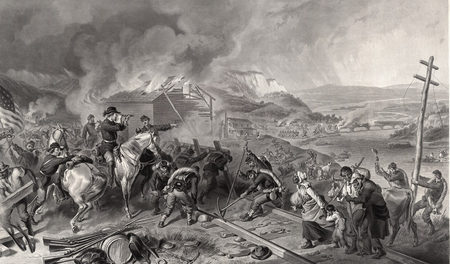
1868 engraving depicting the march's impact on Georgian civilians and territory by Alexander Hay Ritchie
Georgians grew increasingly anxious during the campaign as many would return to their residencies and farms to find all their property displaced, missing or destroyed. This fit Sherman's strategy as he attempted to persuade Southerners that the war was not worth supporting anymore. "They don't know what war means, but when the rich planters of the Oconee and Savannah see their fences and corn and hogs and sheep vanish before their eyes they will have something more than a mean opinion of the 'Yanks,'" he explained.[9] However, that is not to say that the havoc never reached excess. Unwarranted pillaging, burning, and stealing was bound to happen at the hands of frenzied troops.
Analysis
Eicher writes of the March to the Sea: "Sherman had accomplished an amazing task. He had defied military principles by operating deep within enemy territory and without lines of supply or communication. He had destroyed the South's potential and psychology to wage war."[10] A pioneering use of psychological warfare and total war, the destruction wrought by Sherman's troops terrorized the South. Civilians whose territory and resources was being ravaged before their eyes grew so appalled at the conflict that their will to fight on dissipated, as Sherman had intended. The march further crippled the Southern economy, incurring losses of approximately $100 million.[11] Maj. Gen. Robert E. Lee's army in Virginia also lost vital access to food, for the railway lines connecting the state to the Deep South had been burnt. This "[knocked] the Confederate war effort to pieces."[12]
The morality of Sherman's destructive strategy has been debated. Most utilitarians would argue that, since it expedited the end of the Civil War, still the deadlist war in American history, Sherman was right to use any means necessary to prevent more corpses from piling up. On the other hand, deontologists would assert that violence is inherently wrong and therefore never justifiable, including to stop violence. In this regard, the total war nature of the March to the Sea resembles that of the Hiroshima and Nagasaki bombings at the end of World War Two.
Impact on Slavery
The campaign contributed to the liberation of Southern slaves. By late 1864, the plantation system verged on total collapse, and the arrival of Union troops in Georgia inspirited slaves to flee the fields to freedom. Over 14,000 joined Sherman's troops with brisk enthusiasm as they passed near their native plantation. A minister reminisces the dawn of December 22, the day after the fall of Savannah; the city's African-American residents, who had long been praying for the Confederacy's downfall, broke out in religious praises and jubilation; they paralleled their triumph to the Israelites' liberation from Egypt in Exodus.[13]
While the slaves, now contrabands, assisted the Union troops, they were not welcomed with open arms. Sherman, in fact, discouraged them from attending the march due to shortage of food as well as racial prejudice. Once enlisted, contrabands were treated as second-class citizens and left famished and exhausted, to the point that administrative action was threatened against Sherman. Still, the march proved a momentous milestone of emancipation; the historian Edmund L. Drago writes: "These blacks considered themselves a chosen people whose day of deliverance was now at hand."[14]
"Marching Through Georgia"
Sherman's campaign was memorialized in the song "Marching Through Georgia", penned by Henry Clay Work in 1865. It is dedicated to Sherman. Since Work's piece exalted the march, referring to the 'liberated' Georgia as a "thoroughfare for freedom," the composition stoked controversy among Southerners, including at two Democratic National Conventions. The musicologist Sigmund Spaeth aptly said that it "rubbed Yankee salt into one of the sorest wounds of the Civil War."[15] "Marching Through Georgia" was very successful in the Civil War's dying days, but it also remain popular afterward, one of few songs with this distinction. After all, civilians had grown tired of war; "Tramp! Tramp! Tramp!", an anthem known to the entire Union, quickly left the spotlight after 1865, although it is somewhat well-known nowadays.
Interestingly, Sherman loathed "Marching Through Georgia" partially because it was ubiquitous in the North. When he reviewed the national encampment of the Grand Army of the Republic in 1890, the hundreds of bands present played the tune every time they passed him for an unbroken seven hours. Eyewitnesses claim that "his patience collapsed and he declared that he would never again attend another encampment until every band in the United States had signed an agreement not to play 'Marching Though Georgia' in his presence."[16] Sherman maintained his promise for all his life. Still, the song pursued him after his death, as it was played at his funeral.
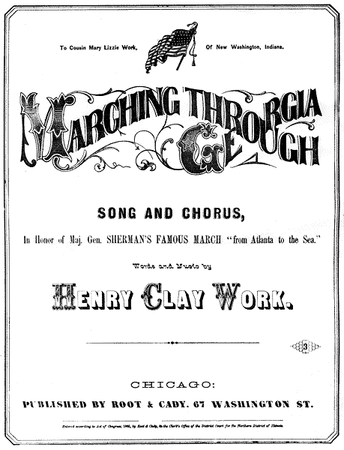
Original 1865 sheet music cover of "Marching Through Georgia" by S. Brainard Sons
Notes
[1] The campaign ended on December 21, but the march to Savannah itself concluded on December 10.
[2] Eicher, The Longest Night, 768–769
[3] Eicher, The Longest Night, 782
[4] Rhodes, "Sherman's March to the Sea", 466
[5] Eicher, The Longest Night, 763
[6] Sherman, Memoirs, 210
[7] Rhodes, "Sherman's March to the Sea", 472
[8] Sellers, "Economic Incidence of the Civil War", 180
[9] Hattaway, How the North Won, 641–642
[10] Eicher, The Longest Night, 768
[11] This roughly equates to $3.8 billion as of 2025.
[12] Hattaway, How the North Won, 655
[13] Simms, The First Colored Baptist Church, 136–138
[14] Drago, "How Sherman's March Affected the Slaves", 364
[15] Spaeth, History of Popular Music, 157
[16] Tribble, "Marching Through Georgia", 428
Bibliography
SOURCES
- Birdseye, George (1879). "America's Song Composers: IV. Henry Clay Work". Potter's American Monthly. 12 (88): 284–288 – via Internet Archive.
- Drago, Edmund L. (1973). "How Sherman's March Through Georgia Affected the Slaves". The Georgia Historical Quarterly. 57 (3): 361–375 – via JSTOR.
- Eicher, David J. (2001). The Longest Night: A Military History of the Civil War. New York City, New York: Simon & Schuster.
- Hattaway, Herman; Jones, Arthur (1991). How the North Won: A Military History of the Civil War (2 ed.). Chicago, Illinois: University of Illinois Press.
- Osborn, George C. (1950). "The Atlanta Campaign, 1864". The Georgia Historical Quarterly. 34 (4): 361–375 – via JSTOR.
- Rhodes, James Ford (1901). "Sherman's March to the Sea". The American Historical Review. 6 (3): 466–474 – via JSTOR.
- Sellers, James L. (1927). "The Economic Incidence of the Civil War in the South". The Mississippi Valley Historical Review. 14 (2): 179–191 – via JSTOR.
- Sherman, William T. (1875). Memoirs of General William T. Sherman. Vol. 2. New York City, New York: D. Appleton and Company.
- Silber, Irwin (1995). Songs of the Civil War. Mineola, New York: Dover Publications.
- Simms, James M. (1888). The First Colored Baptist Church in Northern America. Philadelpha, Pennsylvania: J. B. Lippincott Company.
- Spaeth, Sigmund (1948). ''A History of Popular Music in America''. New York: Random House.
- Tribble, Edwin (1967). "'Marching Through Georgia'". The Georgia Review. 21 (4): 423–429 – via JSTOR.
RELEVANT SELF-PUBLISHED BLOGS
- Brainstorm (March 26, 2024). "Should We Follow Social Customs?... according to Utilitarianism". Jetpunk.
_________________________________________________________________________________
Do you know Sherman’s christmas gift?