
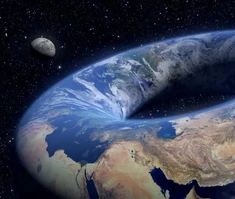
Could the Earth be Flat? A Topological Argument
First published: Saturday December 21st, 2024
Report this blog
If you're reading this, you're on JetPunk, meaning you've probably spent enough time online to have heard of "flat-Earthers". I haven't really met any hardcore flat-Earthers myself, but there are supposedly out there, denying the scientific community's claims that the Earth is (practically) spherical. In this blog, we will take a topological approach to the shape of the Earth, trying to give these flat-Earthers the benefit of the doubt as much as possible.
Topology
We'll be using largely topological arguments here, so let's begin by defining what topology is and identifying some key concepts used throughout. Topology can most easily be defined as the study of spaces. It is a branch of mathematics which seeks to understand a space (or more simply, a geometric object) by using a variety of tools. One important concept here is a homeomorphism. Two spaces are homeomorphic, if you can continuously deform one into the other. A simple example would be a circle and a square. If you have a cord that is in the shape of a circle, you can push out four corners to give it a square shape. However, you could not of course turn the circle into a sphere. They aren't even the same dimension!
Another relevant concept is a homotopy, which is a generalized version of a homeomorphism. Two spaces are homotopic if they can be continuously deformed, one into the other, where some properties of its size and shape need not be preserved. This is hard to see without getting into the formal mathematical definitions, so let's just look at an example of spaces that are homotopic, but not homeomorphic. Then we will move on.
A solid sphere is homotopic to a solid disk. Think of projecting all the upper hemisphere down, then projecting the lower hemisphere to the solid circle in the center of the sphere. However, these are not homeomorphic since the spaces cannot even be mapped bijectively onto each other.
Is the Earth a Manifold?
Here's another topological term: manifold. (For those mathematically inclined, we'll just simplify to a 2-manifold throughout since we're dealing with the surface of the Earth.) A manifold is a surface that is locally just like the Euclidean plane. That is, if you zoom way in on your space anywhere, it's just going to look like this:
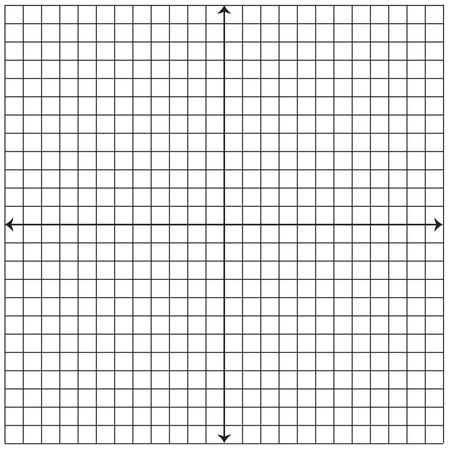
Of course you probably aren't going to have the grid lines, but hopefully you get the point.
So, is the Earth a manifold? Why of course! Heck, this is probably the human's most basic intuition is to say that the Earth is flat. No matter where you are on Earth*, it looks just like a simple flat surface. Now, I put the asterisk (*) because this is ignoring huge mountains or giant canyons. We really care about the surface of the Earth up to homeomorphism, or even just up to homotopy. This allows for us to just ignore these mountains and valleys as they can be adjusted via a homeomorphism.
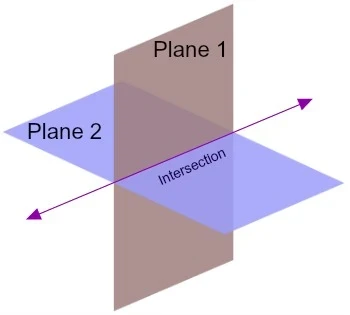
Maybe you're wondering what a space that is not a manifold would be. This would include surfaces such as a bounded circle. If you walk towards the bound at the edge, you can fall off. Another example is two intersected planes, because when you zoom into where they are intersected, you get a non-flat phenomena.
Note: We will ignore the further conspiracy that the Earth does not meet together at the South Pole, because this could mean that the surface of the Earth is not a manifold. We're just dealing with one conspiracy at a time here...
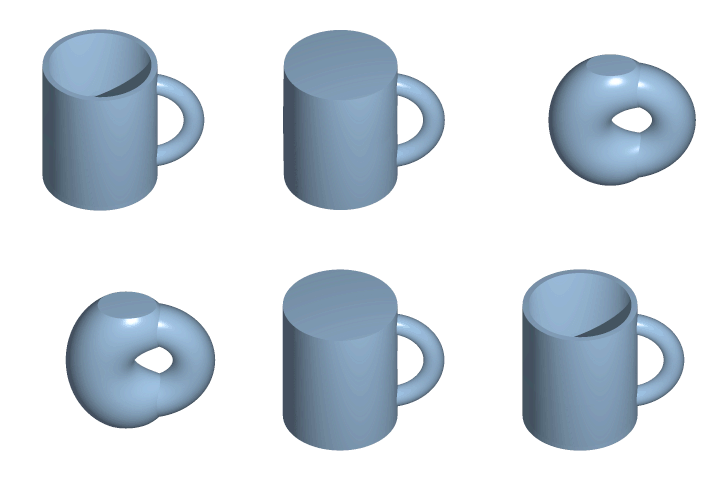
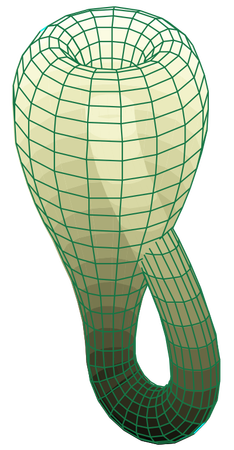
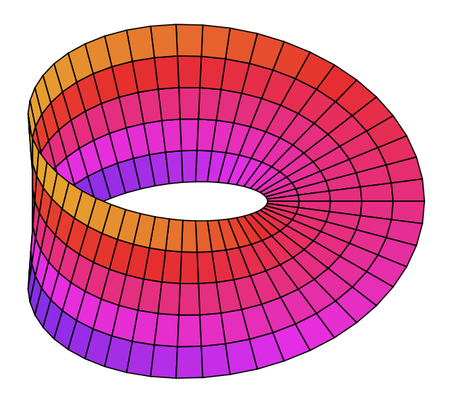
This means we have established that the Earth is a two dimensional manifold! So it's a sphere? We haven't quite gotten that far yet. But we can say that it must be: a flat (infinite) plane, a sphere, or a torus. We this also doesn't rule out weird shapes such as the Klein bottle. Since we've established there isn't some odd boundary (that you can fall off of), we luckily have eliminated some weird manifolds like the Mobius strip!
Orientability
The Earth is what we call orientable. This means that there's a consistent/well-defined orientation. For instance, up means up, down means down...or left means left and right means right. The Earth is orientable! North, south, east, and west are all well-defined. They aren't relative. Counter-examples are often a best way to understand a concept. So let's look at a non-orientable surface: the Klein bottle, pictured just above. Notice if you orient a direction (say clockwise), then once you've traveled far enough, the direct has now changed (to counter-clockwise). You can try the same with left vs. right on the Mobius strip. Thus, non-orientable spaces like the Klein bottle are no longer candidates!
Area
Let's knock out another manifold: the infinite plane. This of course cannot be, because the Earth has finite area. As a matter of fact, if you travel in a straight line on the Earth, you will eventually end up back where you started. So the Earth is finite in size. That was easy!
Sphere vs. Torus
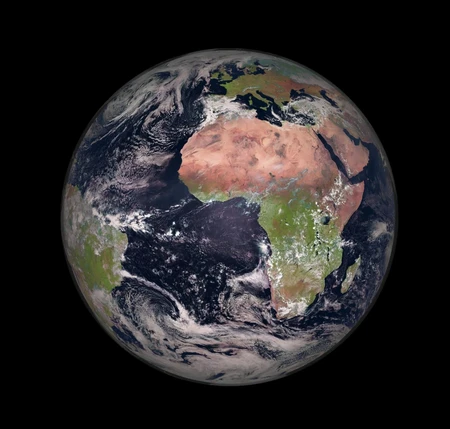
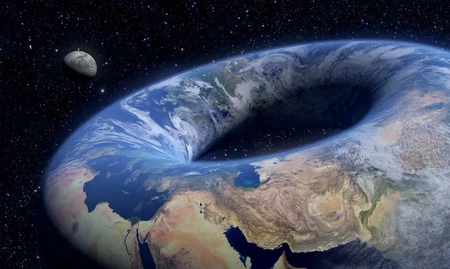
We've now looked at all the possible shapes that the Earth could be, up to homeomorphism, eliminating all options except the sphere and the torus. This is perhaps the best matchup since the surface of both spaces are
- Two-dimensional
- Manifolds
- Without a boundary
- Orientable
- With finite area
So let's break this down. If we had an infinite amount of time, and large enough rope to wrap around the Earth, we could use brut force to show that every loop you make around the Earth can be contracted (i.e., the Earth is simple connected). But since this argument can't be possibly shown, we must rely on other means. Perhaps there are theoretical proofs here that rely on physics by breaking down the theory of gravity or something, but as a mathematician, I want to keep things are pure as possible. So let's look at something that I personally don't find quite as convincing, but almost does the trick: the horizon.
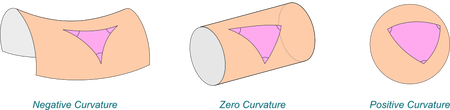
Look out over the horizon. It exists, right? As a matter of fact, it exists everywhere. The Earth must either positively curve or not curve at all. The problem with the torus is that while is has points of no curvature and positive curvature, there are also points of negative curvature. This would mean that there is no horizon. As a matter of fact, you should see incredibly far as the Earth curves upwards. And with a clear enough sky (and good enough telescope), you should be able to see other parts of the Earth from certain locations if you look upwards. And we know that this is not the case anywhere on Earth.
Thank you for sticking around this long for this blog! I tried to keep things as rigorous yet understandable as possible; I hope I was able to accomplish that. So, I'm sorry to the flat-Earthers...the Earth has just got to be a sphere!
Now we look into if the UNIVERSE is flat...that's a story for another day though :)
Very nice!
I realized after I finished that maybe titling the blog about "flatness" probably is a bit misleading since the blog focuses on establishing what topological space the surface of the Earth is rather than really talking about flatness.
showoff XD
Well I hope you enjoyed it!
long answer: nooooooooooooooooooooooooooo