
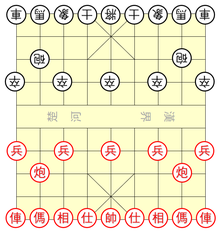
Introduction to Chinese Chess
First published: Sunday October 12th, 2025
Report this blog
My Chess Journey
I started playing Chinese chess since I was in primary school, around 7 or 8 years old or maybe even earlier. I did not know how to play chess (which is called "International chess" or "Western chess" in Chinese) until I reached secondary school.
Nowadays I mostly play chess online (i.e. chess.com). I am at intermediate level, and occasionally I can beat the advance level computer without hints or take-backs. On the other hand, I have not played Chinese chess for many years and cannot beat the computer even at the basic level now.
Anyway, I thought it would be interesting to write a blog comparing Chinese chess with International chess. In this blog, I assume you know the later well but not the former. If you already know Chinese chess well, you may want to skip this blog.
Chinese Chess vs International Chess
There are surprisingly many similarities between Chinese and International chess, including the goal of checkmating the king. This points to the likelihood that one must be derived from the other. While most Chinese people would deny that Chinese chess originated from aboard, the game as it is today was only first documented in the 12th century during the Southern Song dynasty. This compares to International chess which originated from India in the 6th century.
So let's compare the two games. First of all the board, Chinese chess pieces are put on the grid intersections rather than inside the square. Although the board looks similar in size, there are 90 spots in total compared to 64 in International chess. And same as International chess, there are 16 pieces on each side. It means there are more room to move and more possibilities for every move.
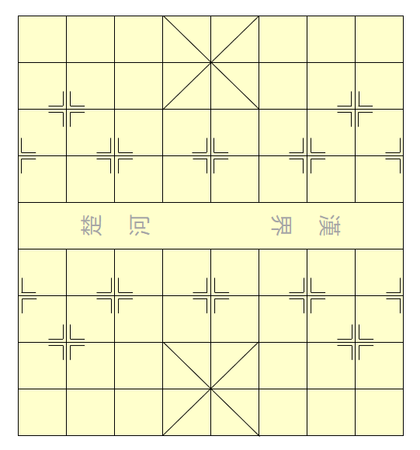
The first thing to notice is that there is a gap in the middle with four words written on it. It is called 楚河漢界 or Chu's River and Han's Boundary, in reference to the Chu-Han War in the 3rd century BC. Some pieces cannot cross the river, or others move differently once they cross it. I will get to that later.
Another thing to notice is the box in the middle bottom with the diagonal lines . This is called the palace. Some pieces can only move within it. Again more on that later.
Finally, there are some spots with markings on them. These are simply marking the starting positions of some pieces, other than that there are nothing special about these spots.

The two sides are in red and black (representing Han and Chu respectively), and the red side starts first (similar to white in International chess). Although the pieces are represented by different characters, they are the same on both sides, and here is the summary table with literal meanings and Mandarin/Cantonese pronunciations:
| Piece | Red | Black | Most similar to |
|---|---|---|---|
| General | 帥 / 帅 (marshal) shuài / seoi3 | 將 / 将 (general) jiàng / zoeng3 | King |
| Advisor | 仕 (mandarin) shì/ si6 | 士 (guard) shì / si6 | none |
| Elephant | 相 (minister) xiàng / soeng3 | 象 (elephant) xiàng / zoeng6 | Bishop |
| Horse | 傌 / 马 (horse) mǎ / maa5 | 馬 / 马 (horse) mǎ / maa5 | Knight |
| Chariot | 俥 / 车 (car) jū / geoi1 | 車 / 车 (car) jū / geoi1 | Rook |
| Cannon | 炮 (cannon) pào / paau3 | 砲 (catapult) pào / paau3 | none |
| Soldier | 兵 (soldier) bīng / bing1 | 卒 (private) zú / zeot1 | Pawn |

Now let's go through the rules on how the pieces move.
Chariot / Rook
This is essentially the same as in International chess. It can move along the horizontal (rank) or vertical (file) lines unrestricted. Because there is no queen (the Chinese can't fathom how women could fight in a battle let alone being the most powerful piece), the chariot is the most powerful piece in Chinese chess. The only difference is that there is no castling.
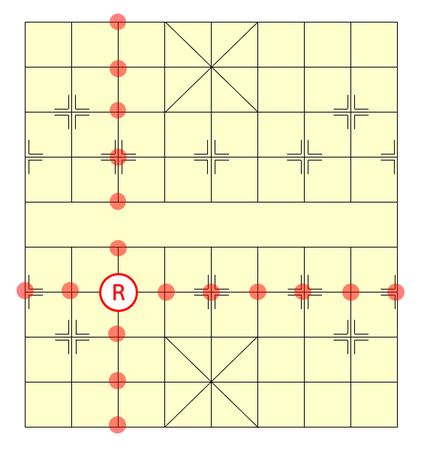
Horse / Knight
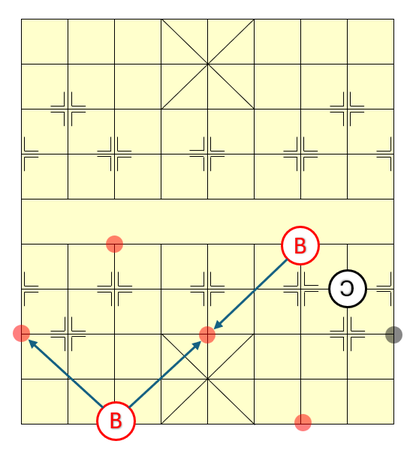
Again it moves similarly to the knight in International chess. It moves two steps forward and one step sideway, or in Chinese we say "horse moves in 日" (the character for sun). But unlike the knight, the horse can be stopped by having a piece in front of it (it is called "hobbling the horse's leg"). In the example below, the horse can move to the red spots but not the grey one because the pawn is in front of it (regardless of red or black piece).

Elephant / Bishop
The elephant in Chinese chess is much more restrictive than the bishop. Firstly it cannot cross the river. It can only move diagonally two squares at a time, or in Chinese it is called "elephant moves in 田" (the character for field). And similar to the horse, an elephant is blocked if there is a piece in the middle of the squares.
This means there are only seven possible spots where an elephant can move to.
Because there are odd number of files, there are no difference between the two elephants, unlike the black and white bishops. In fact, the two elephants can defend each other (similar to two connected knights). This makes the elephant essentially a defensive piece only in Chinese chess.
Advisor / Guard
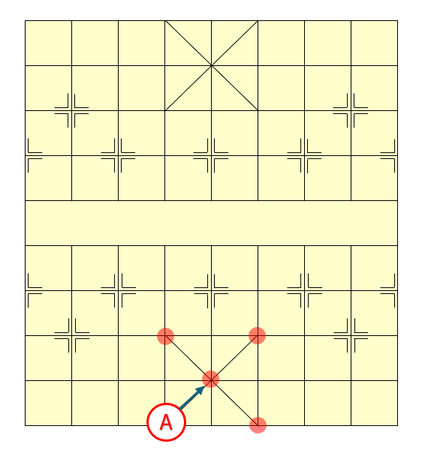
The advisor or guard is an even more restrictive piece than the elephant. It can only move diagonally one square at a time within the palace. That means there are only 5 possible spots for the advisors, making them the close bodyguards of the king.
Cannon
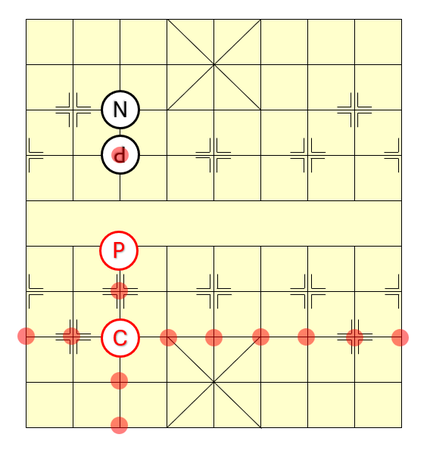
The cannon is perhaps the most unique and interesting piece in Chinese chess. Starting from the third rank, it can move freely like the rook. But to take an opponent's piece, it must jump over another piece called the "cannon platform", and it does not matter whether the platform is a red or black piece. As illustrated below, the cannon can either move freely in a straight line if it is not blocked, or it can take the opponent's pawn by jumping over the cannon platform (in this case its own pawn). It does not matter how far the platform or the opponent's pieces are, as long as there is a single platform piece in between (e.g. it cannot take the black knight below because there are two pieces between them). This makes the cannon the second most powerful piece after the chariot.
Soldier / Pawn
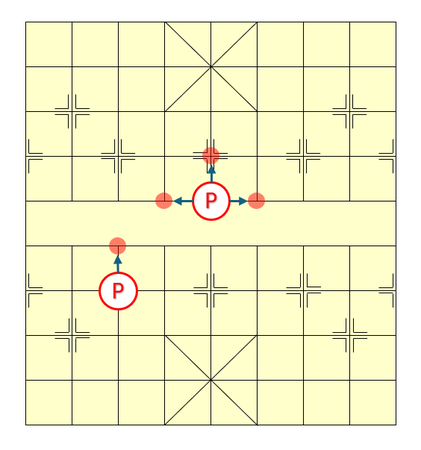
There are five pawns from each side starting on the fourth rank. Similar to International chess, a pawn cannot move backward, but this is where the similarity ends. In Chinese chess, the pawn can only move one step forward behind the river, or once it crosses the river, it can also move one step sideway. Unlike International chess, there is no two-step initial move, no en passant, no diagonal capture, and no promotion when it reaches the baseline (in such case the pawn is stuck on the last rank and can only move sideway).
General / King
Finally, the general can only move within the palace one step at a time and not diagonally. So it is much more restrictive than the king in International chess.
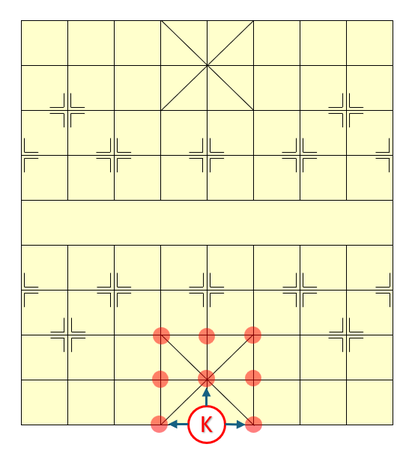
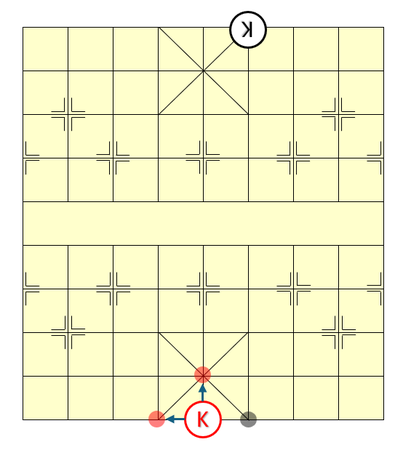
The only possible "attack" is via a special rule called the "flying general". It happens when the two kings face each other without any piece in between, and the king can fly over the board and kill the opponent's king which ends the game. In practice, it means that the king cannot move to a file if the opponent's king is already there and there is nothing in between them. For example, the red king cannot move to its right in the below diagram.
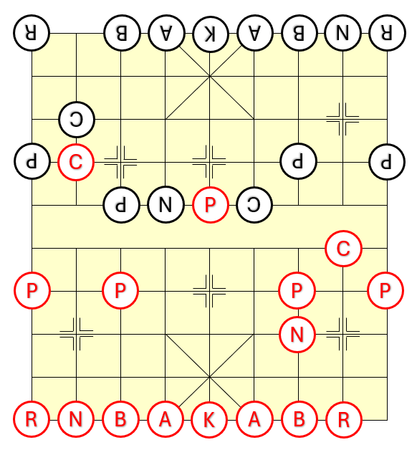
Or in the below example, the centre red pawn is pinned on the fifth file and cannot move sideway to capture the cannon or the knight.
Lastly, a major difference between Chinese and International chess is the rule on stalemate. In Chinese chess, you win the game if you can force a stalemate on your opponent. This really tricked me a lot when I switched from Chinese to International chess, when I thought I won the game but it ended in a draw which really surprised and deflated me.
Basic Tactics
The most basic and common opening is to move the cannon to attack the middle pawn, and the black defends it with the knight.
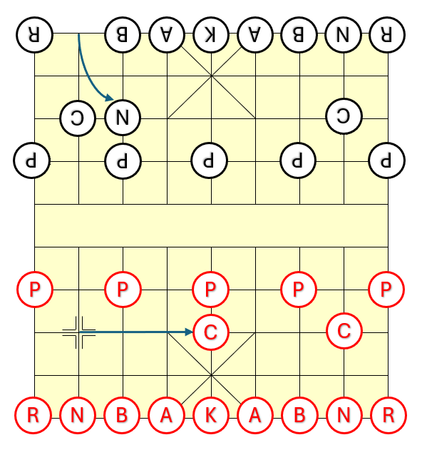
A rookie mistake is to move the middle pawn forward as a starting move, as this makes it indefensible.
Another starting variation is to move the cannon to the 5th or 7th rank. If the two cannons manage to stack together to check the king, it cannot be defended by blocking it with the bishop or advisor. And if the king cannot escape to another file, it is a quick checkmate.

Although the pawns are much less powerful than those in International chess, they can be useful towards the end game especially when few of them gang up together, such as in the example below.
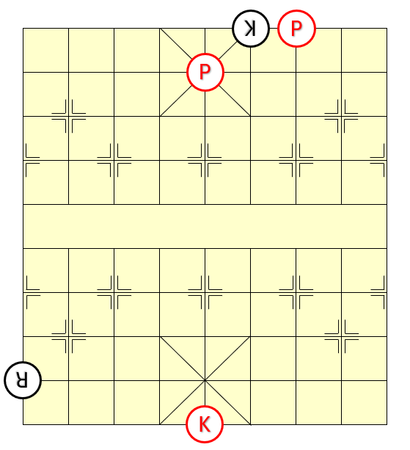
Otherwise, the common tactics such as pinning, forking or discovered attack are pretty much the same as in International chess.
This is the basic introduction to Chinese chess. If you find it interesting, there are many online resources to learn more and play the game. And to test if you have been paying attention, do try out my Chinese chess quiz.
I am baffled by the advisor, though. Seems like an awful useless piece.
Yeah the advisors are pretty useless, though it'll be very hard to checkmate your opponent when the advisors and elephants are all present.