
A Shortish History of Rome, Episode I
First published: Tuesday April 7th, 2026
Report this blog
Introduction
Salutations, fellow history fans! Eumenes here, back at it again, for the first time, with a history blog!
In this blog I will lay out a basic roadmap to a general understanding of the ancient history of Rome. Please note that I am not a historian, but just a simple man who enjoys learning about the past and sharing my knowledge with others. Also, keep in mind that much of Rome's early history as told by her inhabitants has been marred by myth over the millennia, and in keeping in the fun vibe of this blog I will not strain myself to distinguish proven events from mythical ones, at least until we arrive at the Republican era.
Trojan Beginnings
The story of Rome, as do all important things, begins with the legendary Trojan War.
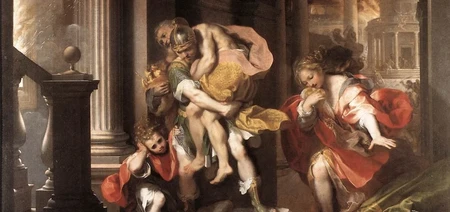
To keep it brief, this war, recorded in Homer's Iliad, was conducted between a confederation of Greek city states led by the Mycenean king Agamemnon and old king Priam's great city of Troy. Heroes on both sides fight desperately in what becomes an existential threat to Troy's survival. One of the heroes of Troy, following its destruction at the hands of the Greeks, survives to tell the tale. Aeneas, a warrior of the Trojan royalty, emerges from the rubble carrying his father, and goes on to lead a handful of survivors on an epic adventure around the Mediterranean, as chronicled by Virgil in the Aeneid. At the conclusion of his journey, Aeneas and his descendants settle down in modern day Italy, where they found the city of Alba Longa.
Roots of a Kingdom
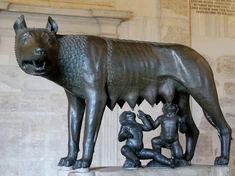
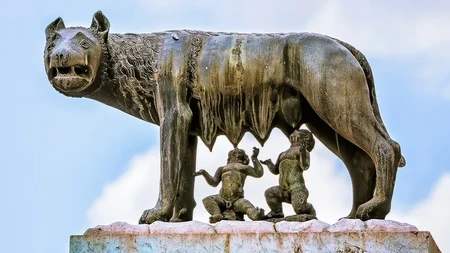
The mythical city of Alba Longa became a dominant presence in the Italian peninsula for hundreds of years after Aeneas's death, until king Numitor was usurped by his brother Amulius. To break Numitor's family line, Amulius made his daughter a Vestal Virgin. Well, as luck would have it, this daughter was "visited" by Mars, the god of war, and became pregnant. When she finally gave birth to twin boys, Amulius ordered them thrown into the river. The twins, named Romulus and Remus, survived this assassination attempt and were rescued and suckled by a she-wolf. After growing up to be remarkably strong and handsome young men, the brothers led a revolt against Amulus, killing him and placing their grandfather Numitor back on the throne. Having restored peace in the region, Romulus and Remus then set out to found a city of their own.
Unfortunately, Romulus and Remus ended up getting into a heated dispute that resulted in Remus's death and Romulus's accession. Looking around his new kingdom - Rome, he would creatively name it in 753 BC - Romulus realized that pretty much the entirety of his constituents were men, so he hatched a plan to liven up the ratio. The Romans then set out to the neighboring city of Sabina and stole as many women as they could carry. This led to a war between the two communities, which was actually settled by the kidnapped Sabine women, who had grown to love their new husbands and did not want them or their fathers/brothers to die. Finally, the two cities made peace, merged, and created a senate composed of half Sabine and half Roman nobles. It would be this senate that would ultimately kill Romulus after enduring years of wars caused by his insatiable appetite for glory. Thus does the story of the first king of Rome end.
Birth of a Republic
Having lived under a warlike ruler for so many years, the Romans decided to appoint someone that would focus on peace. The man they chose was Numa Pompilius, a religious and just man of Sabine descent who was loved by all. It was king Numa who revised the calendar to have twelve total months, inserting a month to celebrate the beginning of the year (January) and one to engage in purification rituals (February). Before this, the year started when it was warm enough to fight wars again (the month of Mars, March), but since this wasn't Numa's style, he figured it was time for a change. Somehow, though, he didn't see a reason to alter the names of the months, leaving us with some confusing ones, such as October, "the eighth month." Anyway, under the guidance of Numa, Rome thrived in an age defined by piety and justice, and when he died, the whole kingdom mourned.
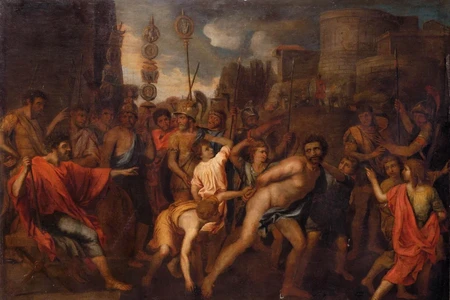
None of the five kings which followed could fill the shoes that Numa left empty; one by one they grew more selfish, greedy, and deprived until the seventh king of Rome, Tarquinius Superbus, was overthrown by fed-up nobles led by Lucius Brutus and Publicola in 509 BC. Following their successful revolt, the nobles vowed to never suffer the tyranny of monarchy again, and instead founded a new system of government led by two men - consuls, who would be elected each year - and supported by a council of senators. This administrative system, which they cleverly called a republic ("the public thing"), would be the status quo for nearly five centuries.
Wars, Wars, and More Wars
Rome would spend the better part of those five centuries engaged in constant conflict, either defending or expanding her territory against countless different foes.
The Latins
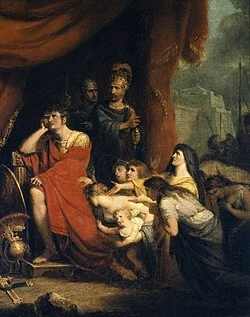
Immediately following the overthrow of Tarquinius Superbus, Rome began fighting Italian city-states in all directions. One of these wars was against the Volsci. This particular war is notable because of the Roman general Coriolanus, who fought fiercely against the Volsci and defeated them in battle before being exiled by the Romans. After being discarded by his compatriots, he defected to the Volsci and led them to many victories against his former allies. He then marched on a defenseless Rome, but before he laid siege to the city, his wife and mother came to his tent and begged him to reconsider. Moved by their pleas, he sabotaged the Volsci and prevented them from plundering his home. The Romans would go on to defeat and subjugate the Volsci along with all their Latin allies.
Brennus
Years after its conflict with the Latins, the Roman Republic faced its first war against the Gauls. Led by Brennus, the Gallic chieftain of the Senones, the Gauls rampaged the Italian countryside. By this point in their history, the Romans had developed an emergency plan to elect a single man to lead them in times of great need: the dictatorship. To fight Brennus, the Romans appointed Marcus Furius Camillus as their dictator. Camillus proved himself a very able leader, but after a disagreement with the senate, he was exiled. In Camillus's absence, Brennus thrived, he cut a bloody swathe through Roman territory until he arrived at the walls of the Eternal City. The Gauls then broke through those walls and a battle broke out in the streets, until only a small pocket of Roman resistance remained, encircled on the Capitoline hill. But, when all hope seemed lost, Camillus arrived. While Brennus laid siege to Rome, Camillus had been recruiting warriors from the surrounding villages, towns, and cities; and, in a valiant charge, his army broke the siege and pushed the Gauls out of Rome, liberating the city from Brennus's control.
Pyrrhus
A hundred years and several wars after the one with Brennus, the Romans were plunged into the Pyrrhic War. Pyrrhus, the king of Epirus (modern-day Albania), entered the fray against the Romans to assist his allies in southern Italy and Sicily prevent Roman expansion into their territories. Unfortunately for Pyrrhus though, he learned his enemy's greatest strength the hard way: manpower. While the forces of Epirus were able to thwart Rome in the field on several occasions, the cost of winning outweighed the benefits, since the it was much easier for the Romans to raise new armies of fresh troops than it was for the Epirotes. For example, after winning a battle, Pyrrhus was quoted, "One more victory like this, and we are lost!" showing how hopeless he realized his cause had become. By 275 BC, he was forced to withdraw to Epirus, giving up his fight against Rome.
Following their seemingly endless stream of good fortune in war, Roman territory and prestige had reached all-time highs. They had finally proven themselves as the apex predators of the Mediterranean, but they still had one worthy adversary that threatened to end their hot streak.
War Again, But Bigger
Near the tail-end of the Pyrrhic War, another powerful empire was dragged into the fold to defend its territory in Syracuse: Carthage. The Carthaginians were neck and neck with the Romans in the race for Mediterranean supremacy for years. A Phoenician (Punic) people descended from modern-day Lebanon, Carthage had burst onto the scene as a primarily maritime people along the coast of Northern Africa with their strong navy and marine trade network. Interestingly enough, their legendary beginnings are tied with Rome's, as Aeneas's journey to Italy was interrupted by a sojourn in a nascent Carthage, where their founder, Queen Dido, had fallen in love with him. The couple ultimately didn't work out, or else this conflict may never have arisen, but because Aeneas chose his settlement so nearby, a fight for Sicily seemed to be inevitable. And so it was, as disagreements over disputed territory on the island sparked the First Punic War in 264 BC.
The First Punic War
Led by their brilliant general Hamilcar Barca, the Carthaginians fought fiercely to protect their lands from Roman conquest. The war was mainly a naval one, and in the end, Rome's fortune proved better than Carthage's. As part of the treaty that ended the conflict, Carthage was forced to cede all of Sicily, Corsica, and Sardinia to the Romans. Hamilcar never forgot this humiliation, and he raised his sons with one goal in mind: revenge against Rome. While his sons were still quite young, Hamilcar took them along with him on his campaign into the Iberian peninsula. Following years of conquest in modern-day Spain, Hamilcar was killed in battle, leaving his oldest son (who had by now spent most of his life living in army camps among soldiers) as the frontrunner for control of the Punic armies. That young man was Hannibal Barca.
The Second Punic War
It didn't take long for Hannibal to follow in his father's footsteps. After pushing further and further into Hispania, he was eventually confronted by Roman envoys who demanded he withdraw from his new territory, as he was encroaching on their land. Knowing he had done nothing wrong, he gave the envoys a piece of his mind and dismissed them from his camp. When the Roman diplomats went straight to Carthage and demanded that Hannibal be punished for his transgressions against them, the Carthaginian senate refused. Thus began the Second Punic War.
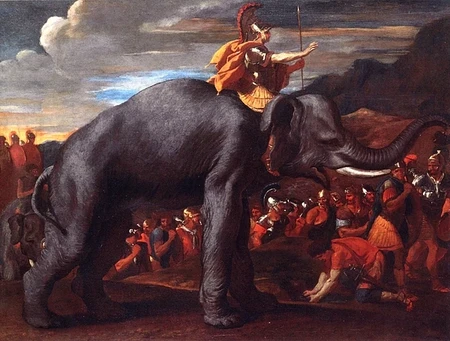
Deciding against waiting for the Romans to attack him, Hannibal led his army on elephant-back out of Hispania, through Gaul, over the Alps, and into Italy. It was a maneuver the Romans hadn't expected, and Hannibal immediately began ravaging the countryside. While his brothers Hasdrubal and Mago fought to defend Spain, Hannibal continued to win numerous battles against the Romans by recruiting troops from rival Italian cities. The greatest battle Hannibal won (and the worst defeat Rome ever lost) was at Cannae in 216 BC, where his army of roughly 50,000 men decisively destroyed an army of approximately 90,000 Romans. A survivor of this battle, Scipio Africanus (he wouldn't earn the name "Africanus" until later), shot up the ranks of the Roman senate and military, and eventually landed troops in Hispania, where he would go on to crush the forces of Hasdrubal Barca, killing him, and reclaim the region for Rome. Meanwhile, with dwindling manpower reserves and limited supplies being sent from Carthage, Hannibal's momentum was being ground to a halt by the "Sword and Shield of Rome" Claudius Marcellus and Fabius Maximus. Each man had held several consulships in the recent years of turmoil but had very different demeanors on the battlefield. Marcellus was known for his aggressive approach, having been one of only three Romans in history to achieve spolia opima, killing an enemy army's commander in single combat; whereas Fabius was at first despised and then admired for his slow and cautious strategy of avoiding open battle against Hannibal's elite army, while preventing enemy reinforcements and resources from reaching and strengthening them. At the same time Hannibal was losing his grip on the Italian peninsula, Scipio invaded Africa. Hannibal, after fifteen years at war with Rome and nearly four decades away from his home, was recalled to Carthage for a final desperate defense against Scipio.
Before facing off on the battlefield, Hannibal and Scipio met to discuss alternatives to a battle. After confessing their respect for each other, the two parted knowing there was no choice but to fight. In 202 BC, the Battle of Zama commenced. Hannibal, though supported by a fresh set of war elephants, was leading an army that was fighting together for the first time, had no chemistry, and spoke several different languages; whilst Scipio's forces operated as a well-oiled machine, having won several recent battles across Northern Africa. Thus, Scipio's forces crushed Hannibal's, but Hannibal escaped with his life and fled to Asia, where he would serve other enemies of Rome as an advisor or general for the remainder of his life. Legend has it that Scipio and Hannibal met again years later in Ephesus as friends, regaling each other with stories from when they were sworn enemies.
The Third Punic War
After Zama, the terms of Carthage's unconditional surrender were meant to cripple them forever. They were forced to give up all overseas territory, their entire navy, and all their war elephants; while also being prohibited from declaring war on anyone without Rome's permission, and owing Rome the equivalent of half a billion dollars of today's money. Regardless of these limitations, Carthage managed to rebuild their prosperity rather quickly, even paying their debt long before their 50-year deadline had passed. However, despite Carthage's complete compliance to Rome's harsh rules, they aroused the suspicion of the senate.
Following a diplomatic visit to Carthage, Cato the Elder returned to the senate house and swore that their old enemies would soon rise again to threaten Rome's very existence and that they must be destroyed, "Carthago delenda est." Succumbing to Cato's repeated pleas, the Romans sent a large army to Carthage. The consuls in charge of this army demanded that the Carthaginians give up all their swords, armor, city defenses, and ships in return for their lives. The Carthaginians, desperate to save their city, agreed to the terms. After Carthage was fully defenseless, the consuls then ordered all citizens to abandon the city - which would now be razed to the ground - and build a new one miles from the coast where they wouldn't be able to thrive as a marine power. The Carthaginians refused this final order and prepared to fight for their lives. Thus, in 149 BC, the Third Punic War began.
The resulting conflict was brutal. The men, women, and children of Carthage fought and died along the streets they grew up in, while the new general of the Roman army, Scipio Aemilianus (descendent by adoption of Africanus) lamented their unavoidable fate. When the city was finally taken, it was demolished, and the undisputed Roman hegemony in the Mediterranean was officially undeniable.
Thank you for reading my blog! Feel free to comment to let me know if you liked it, if you absolutely hated it, if you just want to say "Hi," or something in between. Next time, we'll pick up where we left off and cover some of the most exciting personalities of Rome's history, such as Marius, Sulla, Pompey, and - the big one himself - Gaius Julius Caesar. Also, if you like history, maybe check out my quizzes; you might find some fun ones! Vale!