
History in a Nutshell #1: Germany
Last updated: Thursday February 6th, 2025
Report this blog
- The Holy Roman Empire (962 - 1806)
- German Confederation (1815 - 1866)
- German Empire (1871 - 1918)
- Weimar Republic (1918 - 1933)
- Nazi Germany (1933 - 1945)
- German Division (1945 - 1990)
- Federal Republic of Germany (1949 - 1990)
- German Democratic Republic (1949 - 1990)
- Reunification - Germany (1990 - today)
- Read also
- Sources
- Expected blogs
Every country has its own history. This series offers a brief insight into the development of each nation and shows how it became what it is today.
The Holy Roman Empire (962 - 1806)
We begin with the first confederation of states in german history, the Holy Roman Empire (HRE). It wasn´t a united state - there were more than 300 different principalities, kingdoms, bishoprics and free imperial cities. But all belonged to a king or an emperor - even if his power was more symbolic. He had to respect the power of regional princes.
In the middle ages, the empire grew - but the power struggles between king church led to crises.
Then, from 1618-1648, the Thirty Years‘ War took place. Beginning with a conflict between the Catholic and Protestant churches, the conflict escalated into a territorial war when foreign powers got involved. The war destabilized the empire and in year 1806, the empire collapsed.
German Confederation (1815 - 1866)
Another confederation of states was the German Confederation. The state failed because of different ideas how the state and society could look like, but also because of the war between Prussia and Austria.
An important event was the failed revolution in 1848/49. There was the idea of a united, sovereign german state. But the revolution was stopped, among other things, by Prussia and Austria.
German Empire (1871 - 1918)
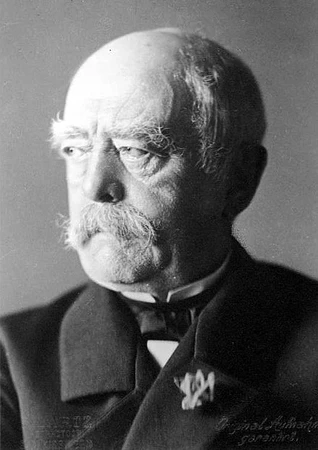
Under Otto von Bismarck, the dream of a United German state became reality. Under the rule of the emperor, Wilhelm I., Otto von Bismarck (the chancellor) aimed for a neutral foreign policy and mediated between the imperial powers.
This changed under Wilhelm II. He colonized some parts of Oceania and Africa.
In 1914, the World War started. Because of an assassination of Serbia to Austria-Hungary, a series of alliances began. Germany fought together with Austria-Hungary, and Germany invaded the neutral Belgium (to attack France). The protective power, UK, helped Belgium and so on... There were many conflicts that led to a World War.
The Treaty of Versailles ended the war officially.
Weimar Republic (1918 - 1933)
Due to the high reparation demands of the Treaty of Versailles, the new republic began with the “Years of Crisis” (1919-1923). This period was marked by hyperinflation, poverty, and violent attacks from both right- and left-wing parties. The republic stood on the brink of collapse.
However, a turning point emerged: Inflation was finally halted by a currency reform at the end of 1923. The Rentenmark (later the Reichsmark) was introduced in Germany, and the economy slowly recovered. The ‘golden’ twenties began, characterized by economic growth and a flourishing of culture and the arts.
This phase came to an abrupt end with the Great Depression of 1929. A stock market crash in the USA led to the withdrawal of US loans from Germany. This had severe consequences, as the German economy had been supported since 1924 through the Dawes Plan. Mass unemployment and poverty fueled the political radicalization of the population. A series of government crises further weakened the republic, driving more votes to the National Socialists.
Nazi Germany (1933 - 1945)
Hitler became Chancellor in 1933. The Nazis quickly consolidated power, establishing a regime based on extreme nationalism, anti-Semitism, and Aryan racial superiority.
Their aggressive expansion led to World War II, starting with the invasion of Poland in 1939. During the war, the Nazis occupied much of Europe and committed numerous atrocities, including the Holocaust, where six million Jews and millions of others were systematically murdered.
The regime ended with Germany’s defeat in 1945, and the Nuremberg Trials held Nazi leaders accountable for their crimes.
German Division (1945 - 1990)
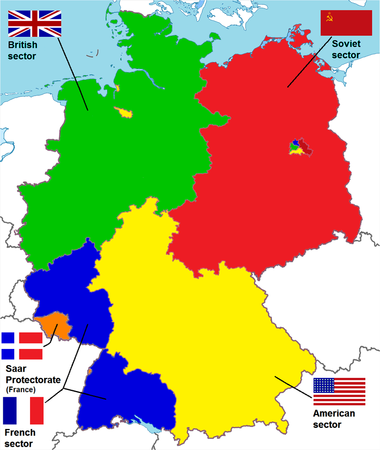
After the war, Germany was divided into four occupation zones.
Federal Republic of Germany (1949 - 1990)
The three western zones—French, British, and American—merged to form one country in 1949: the Federal Republic of Germany. The Basic Law, its constitution, was created to prevent a repetition of Nazi times. With Bonn as the capital city, a democratic state was established.
German Democratic Republic (1949 - 1990)
The GDR emerged in contrast to this. Following the Stalinist model, a state was created that suppressed freedom of expression and used the STASI to spy on its own citizens.
As a result, many citizens emigrated. Increasing numbers of people fled to the West. To stop this, the East German government built barriers along the inner-German border between East and West Germany.
However, one zone remained open: Berlin. Never before had a metropolis, a large city with millions of inhabitants, been divided like this. That changed when the GDR built a wall to prevent its citizens from escaping through Berlin. This wall was continuously reinforced and soon became the most heavily guarded border in the world.
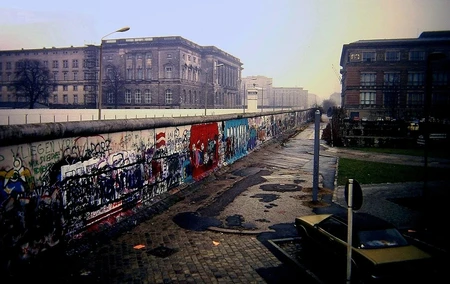
The Berlin Wall was also a symbol for the Cold War between the East and West powers. A war without weapons, but with constant fear of a war.
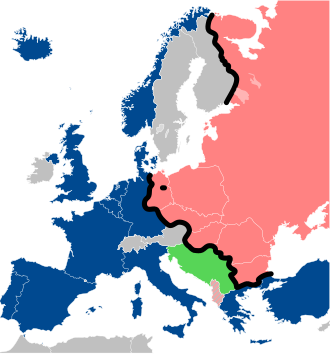
Reunification - Germany (1990 - today)
After reunification in 1990, Germany faced economic challenges, especially in the former East German states, with slow growth and high unemployment.
Chancellor Gerhard Schröder's red-green coalition made important changes to improve the country, addressing job market issues and promoting environmental policies, like the decision to stop using nuclear energy.
Angela Merkel became Chancellor in 2005, bringing a time of economic stability. However, this stability faced challenges from the global financial crisis and the Eurozone crisis. From 2015 onward, the refugee crisis caused political tensions and led to the rise of right-wing populist groups. Merkel’s last term also dealt with the COVID-19 pandemic, which Germany managed through national vaccination programs.
In 2021, Olaf Scholz took over as Chancellor, leading a coalition that focused on digitalization and climate action. The Russian invasion of Ukraine in 2022 led Germany to impose strong sanctions and increase military support for Ukraine.
Today, the biggest topic in Germany are migration and the rise of the radical party, AfD.
In reflecting on Germany's history and present, it's essential to remember the dark times of the Nazi era. However, this history also shows us the incredible power of change when people are willing to embrace it—something we can see in the transformations after World War II and the reunification of East and West Germany.
Thank you for reading! Please comment, give it a like and subscribe, if you enjoyed.
Read also


Sources
Information:
- (Background knowledge)
- (german) Erster Weltkrieg I Die Schuldfrage I musstewissen Geschichte (youtube.com)
- https://www.britannica.com/place/Germany/The-revolutions-of-1848-49
Pictures:
1. Bundesarchiv Bild 146-2005-0057, Otto von Bismarck (cropped) - Otto von Bismarck – Wikipedia
.jpg)
2. File:Allied occupation in Germany (1945-1949).png - Wikimedia Commons
.png)
3. Why Was There a Berlin Wall in the First Place? - JSTOR Daily
4. upload.wikimedia.org/wikipedia/commons/2/2a/Iron_Curtain_map.svg

The thumbnail was created with canva.
Expected blogs

How to Use AI correctly in Blogs
In the past, there were some bloggers who used AI to create full blogs. But there is also a helpful side of AI. In this blog, you’ll find out when the using of AI is okay and when not.

Reunification of Germany - a finished history?
Germany is reunited. But there are still differences between East and West today. How well did the integration of East Germany go? Where are there still problems today?

?
Write your wish into the comments!
2025/02/06: Content errors fixed
You can give me also ideas for new blogs, I am open! You can choose the topic!