
Should the UN be given more power?
First published: Wednesday November 12th, 2025
Report this blog
- Why was the UN created?
- How well can it achieve its goals?
- Does the UNO need more power?
- Statements from the JetPunk Discussion Group
- More Power for the UN: Pro Arguments
- More Power for the UN: Contra Arguments
- What conditions would be necessary for the UN to actually gain more power?
- Reform of the security council
- Changing the UN charter
- Financial stability
- Political agreement
- Current limits vs. future visions
- Conclusion - Should the UN be given more power?
- Sources
- See also
The United Nations is one of the most important international organisations in the world. Almost every country is a member and the UN regularly appears in the news - from peacekeeping missions to climate conferences. But one question remains controversial: Does the UN actually have enough power to fulfill its goals - or should it be strengthened?
In the JetPunk Discussion Group, we took a closer look at this topic.
Why was the UN created?
In 1945, the most devastating conflict in human history - the Second World War - came to an end. World leaders agreed that a global organization was needed to prevent another catastrophe and to ensure that future generations would never experience such destruction again.
The idea of such an organization was not entirely new. After the First World War, the League of Nations had been created with a similar goal, but it failed to stop the rise of aggression in the 1930s. The United Nations was designed to learn from these mistakes and to be stronger and more effective.
On June 26, 1945, representatives of 50 countries signed the Charter of the United Nations in San Francisco, officially founding the organization. Its main goals were to maintain international peace and security, to promote cooperation among nations in solving economic, social, and humanitarian problems, and to protect the human rights of all people.
How well can it achieve its goals?
The UN can record success in terms of peacekeeping missions. Examples are Cambodia, El Salvador, Guatemala, Mozambique, Namibia and Tajikistan, where conflicts ended and reconciliation began.
UN interventions often help to end conflicts and begin a new chapter of a country - the reconstruction of its institutions. Fragile institutions can be strengthened and political transitions supported. Moreover, the population could have been protected and human rights have been enforced or have been made stronger.
On the other hand, there are conflict regions were UN troops didn’t succeed, e.g. in Somalia, Rwanda or former Yugoslavia in the 1990s. UN troops faced challenges such as poor coordination and limited resources. In some cases, escalation could not be prevented because the root causes of the conflicts were not properly addressed. Some actions damaged the reputations, e.g. reports of sexual exploitation and abuse by the UN troops.
Overall, UN peacekeeping has contributed to stability in many regions, but its success often depends on political will, funding, and clear mandates.
One of the areas where the United Nations has made remarkable progress is human rights.
Since the creation of the High Commissioner for Human Rights in 1993, the UN has gained an independent and global voice to advocate for the dignity and freedom of all people.
New legal standards have been established to protect women, children, people with disabilities, and other vulnerable groups.
The establishment of the Human Rights Council and its Universal Periodic Review has made human rights a matter of global accountability rather than national secrecy.
Moreover, the International Criminal Court now ensures that war crimes and crimes against humanity cannot go unpunished.
However, despite these achievements, human rights violations are still widespread, and the UN often lacks the power to enforce its own resolutions. Many governments ignore recommendations or block investigations, showing that progress remains uneven.
So there are a few challenges the UN needs to face. The organisation heavily depends on the contributions of its member states. When major donors like the US reduce their payments, many programs face budget shortages. Under President Trump, the United States - traditionally the UN’s largest financial contributor - has drastically reduced its funding. Through USAID, many humanitarian and development programs have been cut or suspended, leaving critical UN operations under financial pressure. At the same time, there are many crisis regions around the world that urgently need assistance.
Does the UNO need more power?
A poll on the Official JetPunk Discord Server shows the following result:
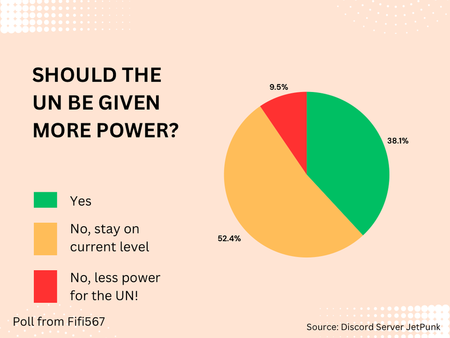
The half of the voters have the opinion that the current level of power of the UN is okay. But there is also more than one third arguing that they prefer more power for the UN.
So can more power help the UN to achieve their goals?
Statements from the JetPunk Discussion Group
Let‘s hear what the contributors of the JetPunk Discussion Group say to the question: „Should the UNO be given more power?“
More Power for the UN: Pro Arguments
On the one hand, more power for the UN could help improve the world more effectively.
Firstly, human rights could be enforced more strongly. The UN could better ensure compliance with international law, impose sanctions faster, and demand justice for violations.
Secondly, fighting global crises could become more effective. Global challenges such as pandemics or climate change require unified action. A stronger UN could make regulations binding and help prevent crises from spreading.
Thirdly, peacekeeping missions could be more effective. If the UN were less dependent on the support of the member states, it would avoid political delays and conflicting national interests that often weaken its interventions.
Lastly, a stronger UN could reduce the tendency of powerful nations to act alone in military or political crises.
More Power for the UN: Contra Arguments
On the other hand, more power could also mean more risk.
Firstly, more authority without stronger checks could allow authoritarian states or political blocs to influence decisions disproportionately - some critics warn of a “League of Dictators” scenario.
Additionally, there is a lack of democracy. Without reform, major authoritarian powers like Russia could worsen the problem of legitimacy. Especially the veto system and the underrepresentation of certain regions are weaknesses of the current structure and would worsen if the UN gained more power without reform.
Lastly, the UN remains dependent on the support of the member states. Even with more power, this dependency would continue in most cases - whether for providing troops, enforcing sanctions, or funding operations.
What conditions would be necessary for the UN to actually gain more power?
Many points are being discussed to reform the UN. Some of these reforms are looking for a stronger UN as well. We‘ll take a look now to these ideas.
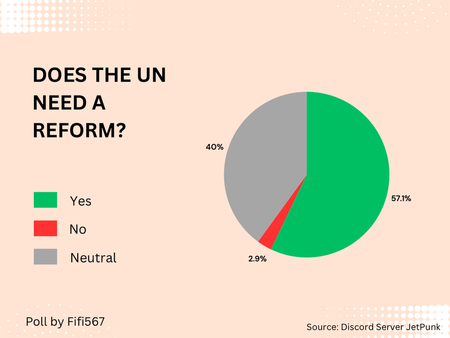
Reform of the security council
Many Member States and officials argue that the United Nations Security Council (UNSC) no longer reflects modern global realities. For example, the UN Secretary‑General has backed calls to “make the Council represent the world of 2025, not 1945.” Among the proposed changes are restricting or abolishing the veto power of the five permanent members (P5) in cases of mass atrocities or when they act as parties to a conflict, as well as adding more permanent seats to better balance power and ensure that authority is not concentrated in the hands of the current five states - a reform also supported by Germany.
Changing the UN charter
Giving the UN more binding power, for instance allowing the General Assembly to make enforceable decisions, would require changes to the UN Charter. This is a complicated process that needs agreement from most member states, including all five permanent members of the Security Council. Experts say such reforms are politically difficult, but they could be necessary if the UN is to gain more influence
Financial stability
The UN relies heavily on contributions from its member states with a few countries providing most of the funding. Analysts warn that without predictable and reliable financing, giving the UN more power would not achieve much in practice.
Political agreement
Finally, countries would need to agree to give up some of their sovereignty in certain areas - for example, global health, climate change, or preventing mass atrocities. Experts note that this is most realistic if the UN’s power increase is focused on specific sectors, rather than trying to give the UN unlimited authority across the board.
Current limits vs. future visions
Let‘s conclude where the UN struggles today:
• Frequent veto use blocks collective action, e.g. in Ukraine or Gaza.
• The UN has funding problems. Without steady financing, it cannot act effectively.
• The UN still relies entirely on voluntary troop contributions from member states. There is no standing army.
For the future, several visions are discussed.
Focusing on specific areas:
One realistic idea is to give the UN more power in certain important areas, instead of everywhere at once. For example, it could have stronger authority to enforce climate agreements, handle global pandemics, or prevent mass atrocities. This approach is seen as practical because it targets issues that really need international cooperation.Big changes to the UN Charter:
Some experts imagine more far-reaching reforms, like creating a UN parliament with real decision-making power. This would give the UN much more authority, but it would be very hard to make happen politically. It would require agreement from almost every country, especially the five permanent members of the Security Council.Step-by-step changes:
A middle way is to make gradual improvements. For example, the veto power could be limited in certain situations, like urgent humanitarian crises. This would let the UN act faster and more effectively without completely changing the system.
In short:
The UN faces real limits today. Most experts agree that the most realistic way to give it more power is either focusing on specific areas or making gradual changes, like regulating the veto. Both approaches would help the UN act more effectively while staying politically possible.
Conclusion - Should the UN be given more power?
The United Nations has achieved a lot since 1945 - from peacekeeping and humanitarian aid to the protection of human rights. But at the same time, it is often limited by political interests, lack of funding, and slow decision-making.
Giving the UN more power could help solve global problems faster and more effectively. Yet this would only work if reforms make the organization more democratic and financially stable at the same time. Power alone is not enough - what really matters is how it is used.
A stronger UN could be a real force for peace and justice in the 21st century. But to get there, countries must be ready to share responsibility and trust in common rules, not just national interests. In the end, the UN can only be as strong as its members want it to be.
Sources
See also


Nice blog! Really sheds light on the topic.
hopefully my children are the same