
The History of the Nuclear Bomb
Last updated: Friday November 29th, 2024
Report this blog
The nuclear bomb is a permanent instrument of politics to issue pressure and threats. Countries like the USA, China and Russia are spending sums in the billions every year. But how did such a huge bomb come about and how did it affect the world?
In order to build the atomic bomb, the foundations had to be created. The beginnings go back to shortly before the Second World War.
Discovery of Nuclear Fission
In year 1938, the two German scientists Otto Hahn and Fritz Straßmann discovered nuclear fission by irradiating a uranium core with neutrons. This resulted in the formation of barium isotopes, which do not occur in nature. Chain reactions are created in which enormous amounts of energy are released.
This discovery offered new possibilities - both in civilian use for the generation of energy in nuclear power plants or in medicine - but also for a weapon that can destroy everything in its perimeter.
Concern about Nazi Germany
Fore the latter, there were great fears in the USA and elsewhere that Germany, which was in the hands of the Nazi regime under Adolf Hitler, was trying to build such a bomb. In the end, it was Leó Szilárd who convinced Albert Einstein to send a letter to the then US President George Roosevelt. Among other things, it said:
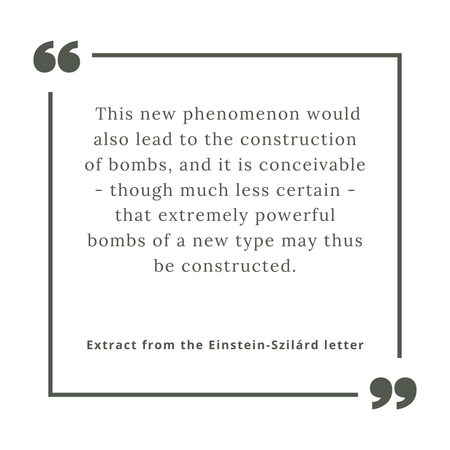
The warning that Germany might work on an atomic bomb was formulated in this way:
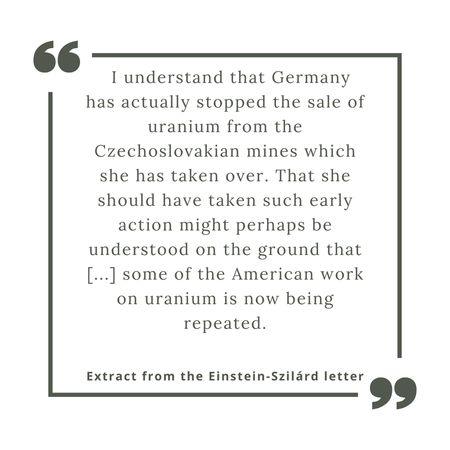
In simple terms, Germany has stopped exporting uranium to use it for their own purposes. These warnings and reports from intelligence services led President Roosevelt to the decision to start an own atomic project.
The Manhattan Project
The biggest and most expensive project in human history was started in 1942. The USA invested enormous sums in an amount of almost 1.9 billion U.S. dollars into the project, involving 150,000 employees under the direction of Robert Oppenheimer. To 1945, in highest secrecy, two nuclear bombs were built: Little Boy (made of Uranium) and Fat Man (made of Plutonium). At that time, war in Europe already was over. the victorious powers won over Germany and his allies. But one country in Asia refused to give up: The Japanese Empire.
The First and Last Dropping of Two Atomic Bombs
USA chose two goals to force Japan to surrender: On the one hand, Hiroshima, which had been spared until then but was an important military base. On the other hand, Koruka was targeted, which was important for the defence industry. Due to bad visibility, the latter destination was changed to Nagasaki.
On 6th August 1945, after Japan refused an ultimatum and a warning from the USA, the first atomic bomb ‘Little Boy’ was dropped on Hiroshima. When Japan still refused to surrender, the second was dropped.
The consequences were devastating. Around 160,000 people died in the Hiroshima bombing alone. You can find a discussion about whether the bombing was justified here. The moral question of this still occupies humanity today. Nagasaki claimed around 70,000 lives.
Armament in the Cold War
After the Second World War, relations between the two superpowers, the USA and the Soviet Union, worsened. Mistrust grew and after the Soviet Union successfully realised its own nuclear project, the two powers fought a duel. Nuclear bombs as a deterrent - the more, the better. In year 1986, in total both had approx. 64,000 nuclear bombs.
This period was characterised by uncertainty, tension and mistrust. Until the end of the Cold War in 1990, the two powers did not fight each other directly - but if they had, the world would probably no longer exist, or at least not as we know it. The two powers did, however, fight each other in a number of proxy wars, for example in Korea (1950-1953), Vietnam (1955-1975) and Afghanistan (1979-1989).
During the Cold War, four new nuclear powers were added: the United Kingdom (1952), France (1960), China (1964) and India (1974).
Efforts to Disarm
During and after the Cold War, there were international efforts to lead the states to (nuclear) disarmarment. One of the most important contracts here is the Nuclear Non-Proliferation Treaty that were established in 1968. Non-nuclear weapon states undertake not to acquire nuclear weapons. In contrast, the five nuclear powers are committed to reducing their nuclear weapons and completely disarming in the long term. 191 countries are part of that contract - 93 of them ratified it. North Korea left the contract in January 2003, four states (India, Israel, Pakistan und South Sudan) never were part.
This led to international disarmament.
Current Situation
India and Pakistan are at dispute over the demarcation of borders in the Kashmir region. Both states have therefore armed themselves with nuclear weapons as a deterrent.
As already mentioned, North Korea withdrew from the Nuclear Non-Proliferation Treaty and has also equipped itself with nuclear weapons. Some tests are intended to demonstrate their strength and are also part of the propaganda against the USA.
Iran also has a nuclear programme. US Secretary of State Anthony Blinken announced in July 2024 that the country was on the verge of producing nuclear weapons.
There are currently around 12,121 nuclear weapons worldwide. They are spread across nine countries.
In comparison to the times of Cold War, where over 70.000 nuclear weapons existed, the situation improved. But people still feel afraid of a atomic war. That is also not unjustified - according to a study, 100 nuclear bombs would be enough to destroy the earth sustainably. Even if they were only used to bomb one country, there would be global consequences. A nuclear autumn would cause a cloud of smoke to enter the atmosphere and block out the sunlight. Temperatures would fall and rainfall would become less frequent. This would lead to food shortages and famine.
In the ongoing war in the Ukraine, a potential use of nuclear bombs play a crucial part in the question if the NATO should interverne in the Ukraine. So far, it has remained limited to material aid - the fear that Putin would use his nuclear weapons is too great.
Conclusion
The discovery of nuclear fission in 1938 marked a turning point in the history of mankind. The resulting atomic bomb was used in the Second World War and claimed hundreds of thousands of lives in Hiroshima and Nagasaki. The Cold War further fuelled the development of nuclear weapons as the USA and the Soviet Union fought for global power. To this day, several countries possess nuclear weapons, posing a constant threat to world peace.
The long-term effects of the atomic bomb are devastating. In addition to the immediate loss of life, the use of nuclear weapons leads to serious damage to health and long-term environmental pollution. The fear of nuclear war still characterises international politics today.
Although there have been efforts to disarm in recent decades, there are still thousands of nuclear weapons around the world. The ethical question of the use of such weapons of mass destruction remains unresolved. Humanity faces the challenge of minimising the dangers of nuclear weapons and shaping a future without nuclear weapons.
Sources
Discovery of the nuclear fission: The Discovery of Nuclear Fission
Einstein-Szilárd letter: Albert Einstein's letters to President Franklin Delano Roosevelt – E-World (hypertextbook.com)
Death numbers of Hiroshima and Nagasaki: WWII: Hiroshima and Nagasaki casualties 1945 | Statista
Proxy war: Proxy war – Wikipedia
How Many Nukes Would It Take To Totally Screw Humanity? | IFLScience
Treaty on the Non-Proliferation of Nuclear Weapons – Wikipedia
Blinken says Iran’s nuclear weapon breakout time is probably down to 1-2 weeks | CNN Politics
Related to the Topic


See also


