
Was the Treaty of Versailles fair?
Last updated: Monday September 30th, 2024
Report this blog
The Treaty of Versailles officially ended the First World War. But it also created new problems - for the new republic, the Weimar Republic. The treaty was one (of many) reasons why the first democracy of Germany found their end. I think you can say quite neutrally that the contract was a failure. In this blog, I´ll explain why - also with opinions from the JetPunk Discussion Group.
What was Treaty of Versailles?
The conditions for ending the First World War were written in the Treaty of Versailles. This included the following points:
- Sole blame for the war
Germany and their allies are the only countries to blame for the war.
- Cessions of territory
Germany had to give up their colonial territories in Africa and Oceania and they ceded territories to France and Poland.
- Demilitarism
The treaty required the delivery of all heavy war material like warships, airplanes, and tanks. Additionally, the size of the Reichswehr was reduced to a maximum of 100,000 soldiers. Furthermore, the territories ceded to France and Poland were demilitarized, meaning that no soldiers were allowed to be stationed in these areas.
- Reperations
Germany had to pay billions of marks in loans.
There were lots of more, but these are the most important ones. But were these conditions fair?
Were the conditions fair?
At first, a poll from users of JetPunk:
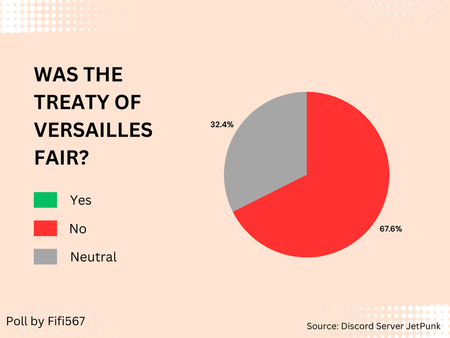
No one voted that the contract was fair. A 2/3rd majority said that the treaty wasn´t fair. But why?
Reparations
Firstly, we take a look on the reparations. It is disputed among historians whether Germany was even able to pay the reparations imposed on it. The Australian historian Bruce Kent believes that Germany's reparation obligations were too high to pay from the very beginning. None of the different payment plans were based on a realistic assessment of how much the German Reich could actually afford. Instead, domestic political interests or, in relation to the inter-allied war debts, the foreign policy interests of the recipient countries were always the priority.
Other historians are of the opinion that the reparations weren´t a barrier in the "reconstruction" of Germany.
Others, however, stress the political rather than the economic toll. They say the treaty was used by extremist parties to create voices against the republic. And:
Cessions of territory
Now, we have a look on the territorial cessions. There were some votes in regions if they should belong to Germany or their neighbours. This was the case in Schleswig, Upper Silesia, and East Prussia. In other regions like West Prussia or Alsace-Lorraine (the latter belonged to France until 1871) weren´t held votes.
There were some economical effects because of the migrations of some important industrial areas and important workers. But all in all, you can say the votes in some regions were fair (if not, tell me in the comments!).
The question of who is to blame
The question of who is blamed for the war is a very difficult one between historians. The blame of Germany was the main justification for the winning powers to demand the reparation payments.
At first, you should know that in the time before WW1, the countries upgraded their armies continuously and formed alliances. It was a tense situation with the feeling of an upcoming war.
I now present you different theories:
1. Pre-emptive war theory
Germany knew that the Entente (alliance between Russia, France and the United Kingdom) armed their armies - and the longer Germany waits, the stronger the Entente would be. So they started the war - because they thought that they would have better chances now than later. Germany is to blame.
2. Imperial politics
Germany wants to avoid that France never becomes a world power again. They want to push Russia back and make a new central Europe. Different territories should be conquered, Belgium should be completely dependent from Germany. In total, they aimed to have the political and economical control over Europe. Germany planned the war for a long time and is to blame.
3. Sleepwalker theory
Because of the partial mobilisation, Russia forced the other countries to buildup their arms. France had Russia’s back, as they sought revenge with Germany. Austro-Hungary would have escalated the situation with Serbia to make war unavoidable. Great Britain didn´t do enough to keep on the peace because of inner political reasons. Serbia had gone too far (especially with the assassination). Germany would have condoned war.
So all powers are to blame for the war, because all made decisions that led to the war.
That Germany has at least a partial fault, is almost clear. But it isn´t clear who is also to blame - if all powers are to blame.
The consequences of the treaty
The treaty was followed by several problems for the Weimar Republic - with a hard start and an early failure of the state - also because of the high reparation demands. And as a follow of the problems in the republic, the radical right parties became stronger and led Germany into the Second World War.
Conclusion
In conclusion, the Treaty of Versailles created as many problems as it aimed to solve. By imposing harsh reparations, territorial losses, and military restrictions on Germany, it fueled resentment and instability in the Weimar Republic. Many argue the treaty was too harsh, crippling Germany’s economy and giving extremist groups a reason to rise.
As for who was to blame for the war, it wasn’t as simple as pointing fingers at Germany alone. All the major powers played a part in the build-up to World War I. In the end, the treaty’s failure to bring lasting peace helped set the stage for World War II.
Thank you for reading! Leave a comment and, if you enjoyed the blog, give it a like.
Main sources & next blogs
- Arguments For and Against the Fairness of the Versailles Settlement (gcsehistory.com)
- Treaty of Versailles – Wikipedia
- Question of who is to blame (German): Erster Weltkrieg I Die Schuldfrage I musstewissen Geschichte (youtube.com)
Note: The quotations have been corrected for spelling. They may contain content/historical errors and do not represent the opinion of Fifi567.
----------------
The next blogs:
- History in a Nutshell #1: Germany
... Stay tuned and subscribe for notifications for the next blogs!


It suffered many defaults : important German minorities remained outside of Germany, the Dantzig corridor and blaming Germany for the war.
I do not think the reparations were unfair. Belgian and French occupied regions were completely destroyed, not only because of war : during their retreat, German troops intentionaly destroyed everything they could destroy (coal mine, trees...). Thus, reparations were vital for France and Belgium. On top of that, war never happened on German territory, and their productions were less impacted by war: it would have been easier for Germany to regain a strong economy than for their neighborhood (who were highly indebted). Note that Lloyd George was responsible for the significant increase in repairs.
Finally, demilitarism was also vital for Germany's neighborhood security: they do not have an ocean or the sea to protect themselves!
Sorry for multiple posts, it was hard to sum up what I think and know due to character limitation.
And yes, a yes opinion would have been good to describe the other point of view.