
Why Do People Become Criminals?
First published: Saturday January 17th, 2026
Report this blog
Shoplifting, burglary, corruption, cybercrime, tax fraud, espionage, blackmail, murder - there is a large variety of criminal actions. And the reasons why people do these offense are diverse as well.
Is criminal behavior in the genes? Or is it poverty, social inequality or personal decisions? Or is it a mix of all? Criminology is a very complex topic - in this blog, we try to answer the questions.
Biological Theories
Regarding biological factors, genetics in particular play a role. Some genes are said to be more decisive for the development of criminal behaviour than others, according to a study by the journal American Sociological Review. However, this does not guarantee a criminal life: even this can already be weakened, for example by a strong family bond. Spending moments together is important, e.g. a daily meal with the family.
Genetic predispositions include impulsivity, control over it, and the ability to make decisions. Differences in brain structure or in dopamine/serotonin levels could be a reason too. In combination with other factors, biological factors could increase the tendency towards crime.
Psychological Theories
Psychological reasons include little self-control and difficulties in impulse control. Traumatic experiences, neglect or violent experiences, for example in the family environment, can increase the risk of becoming criminal later.
Studies show that people who experience violence in their childhood are more likely to use aggressive or norm-violating behaviour. However, this does not mean that victims become violent themselves, but that such experiences influence emotional development, the handling of conflicts and the perception of boundaries.
Social Theories
In criminology, social factors are analysed most frequently.
People need prospects. If they don’t have them, it leads to despair, then to hopelessness, and finally to crime. This is the case, for example, if education is lacking or people do not receive job offers. For people with low levels of education or early school leaving, there are often lower career prospects. The lack of prospects thus increases the probability that people commit crimes, to ensure their survival but also because they are frustrated by inequalities. For example, a data set across 16 countries shows that inequality is a significant predictor of higher crime rates and has a stronger impact than poverty alone.
Families are important for prevention as well. If children do not learn the norms of society, but experience violence or abuse, it is more probable that they adopt this behaviour. Equally important are social contacts like friends. If they are missing, for example, people do not learn to care for others.
It is nearly impossible to identify a single factor as a reason of crime. Rather the interaction between these three categories, with a lot of sub-factors, is decisive for wether someone is a criminal or not.
Is Criminality Innate?
If we speak about crime, sooner or later it is asked whether people with a migration background commit crimes more frequently. However, to answer this question, a view of the background is not sufficient. Much more decisive are the living conditions under which people live.
Many refugees bring stressful experiences with them. War, persecution, violence or extreme poverty shape their past. These experiences leave traces – psychological and emotional. They can decrease trust in other people, and handling stress or conflicts becomes more difficult. In some cases, the threshold to commit crimes can decrease, or rules become less important.
In addition, arrival in a new country is often not easy. Those who do not know if they can stay, who do not get a work permit or who have to wait years for decisions, live in permanent insecurity. Building up a future then seems useless. Without prospects, despair grows – and some people look for ways to manage life.
All this does not mean that migration or origin causes crime. What matters is how refugees are taken in. If they have access to education, work and social contacts, they find support, orientation and opportunities. Successful integration clearly decreases the risk of crime.
Therefore, crime is not a question of nationality. It arises from stressful experiences and a lack of opportunities and can be avoided if society offers prospects.
📊 Facts: Education and Crime (US, UK & International)
- In the US, completing high school significantly reduces the probability of incarceration: graduation decreases the likelihood of imprisonment by about 0.76 percentage points (White) and 3.4 percentage points (Black). (NBER)
- Increasing high school graduation rates by 1 % in the US could prevent nearly 100,000 crimes per year, with social savings of over $2 billion annually. (CEPR)
- Approximately 58 % of formerly incarcerated Americans have no traditional high school diploma (without GED). (Prison Policy Initiative)
- In England and Wales, students permanently excluded from school are more than twice as likely to commit serious violent offences compared with peers who remain in school. (The Guardian)
- In England and Wales, incarceration rates are higher among students from lower-rated schools: 1.4 % vs 0.9 % in high-rated schools. (UK Office for National Statistics)
- Prison education programmes can reduce recidivism by up to 43 %. Inmates with post-secondary education are about 29 % less likely to re-offend. (ScienceDirect)
- A Swedish long-term study found that each additional year of schooling reduces the likelihood of conviction by around 6.7 %. (Economic Journal / ScienceDirect)
Crime Prevention
You cannot simply lock away or deport crime. Those who only fight the symptoms do not change anything about what pushes people into the corner where they become criminal.
Far more important is to change the conditions under which people live. Education plays a key role. People who have the opportunity to go to school, to learn something and to get a job later have more prospects and fewer reasons to break rules. Friendships, supportive teachers and adults who listen, help and act as role models are important as well. They show that there are other ways to solve problems.
Especially teenagers need stable relationships. Family, friends and school are crucial – if something becomes unstable in one of these areas, this can quickly lead to problems. Those who receive support early experience stability, orientation and trust and have the chance to move confidently within society.
Leisure activities, sports clubs or youth projects can also help. They offer a space to receive recognition, develop skills and experience success without committing crimes. Crime rarely develops without reason. It grows where people have no opportunities, no prospects and no one who shows them that there is another way. This is exactly where prevention can start: by opening paths instead of blocking them.
Conclusion
Crime should not be understood as a moral judgement of people. In most cases, it is the result of circumstances, experiences and a lack of opportunities. Deportation or punishment is often discussed without dealing with the real causes.
It becomes clear time and again that crime is not a question of nationality or origin. It arises where education is lacking, social problems remain unresolved and people see no prospects. Those who want to reduce crime in the long term do not need to exclude people, but to create conditions that enable participation, orientation and opportunities.
Sources
Here are the most important sources (English (EN) and German (DE))
https://www.die-debatte.org/kriminalitaet-ursachen/ (DE)
https://www.crimpsy.com/causes-of-criminal-behavior-in-criminology/ (EN)
https://www.laacib.org/understanding-why-people-commit-crimes/ (EN)
https://www.britannica.com/science/criminology/Sociological-theories (EN)
https://nij.ojp.gov/topics/articles/pathways-between-child-maltreatment-and-adult-criminal-involvement (EN)
https://www.diw.de/de/diw_01.c.937170.de/publikationen/diw_aktuell/2025_0108/mehr_sicherheit_durch_praevention__wie_bildung__arbeit_und_soziale_stabilitaet_kriminalitaet_verringern.html (DE)
https://academic.oup.com/ej/article/125/587/1290/5077850 (EN)
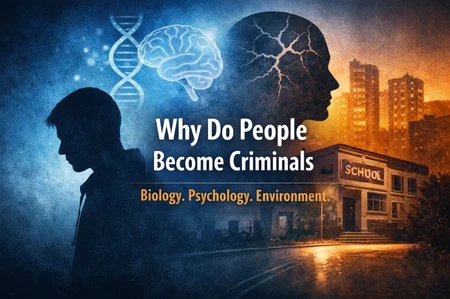
The thumbnail has been created with AI.
Read also


Good blog, otherwise! Very informative and interesting, and especially well researched!
Everyone has a conscience. The basic sense of right and wrong with things like killing or stealing.. is universal.
Your beliefs and values determine your actions.