
World Peace - An Unattainable Goal?
Last updated: Thursday November 28th, 2024
Report this blog
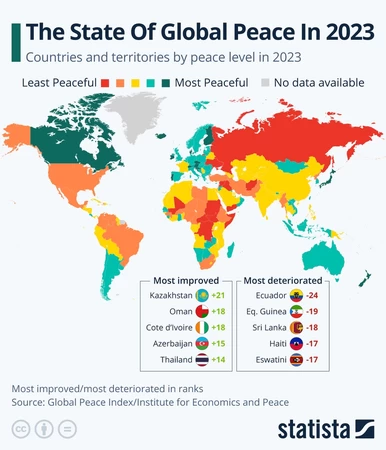
Many people are suffered from wars - in the Ukraine, Palestine oder in Yemen, or a lot of other places. Many countries are feeling the effects firsthand: More people are immigrating, prices are increasing because of interrupted trade chains, and probably the fear of a 3rd World War is rising. Because of that, peace seems to be an unattainable goal. However, in total this century is more peaceful than others, according to the Global Peace Index. So, could humanity ever achieve world peace? If so, how? This is what we will explore in this blog.
What are the current conflicts in the world?
According to the Armed Conflict Survey, 33 conflicts took place in year 2022.
The civil war in Ethiopia and the Russian-Ukrainian war claimed particularly high numbers of victims. Many deaths are also to be expected in the Israel/Palestine conflict.
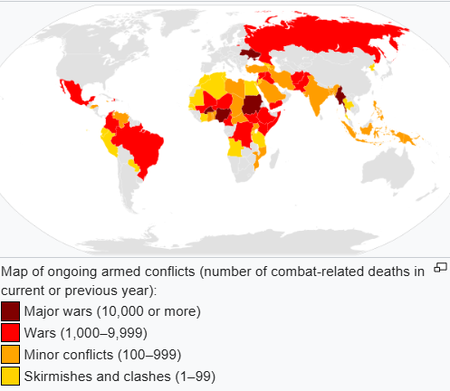
The map clearly shows that there are many problems in Africa. But there is also unrest in many parts of Asia.
One look at the map is enough to give you a shocked feeling. Yet world peace seems like a distant utopia.
The wars have also an impact to neighbouring countries and the whole world. A great example shows the Ukraine-War: The Ukraine is the fifth biggest wheat exporter of the world. With the invading of Russia, the exports are becoming more difficult - Millions of people in Africa are threatened by famine.
According to the latest Global Trends Report from the UNHCR, 108.4 million people worldwide were displaced at the end of 2022. That is more than ever before, and the curve is constantly rising. And the high number of refugees is also making itself felt in wealth countries: More money has to be spent on integration, capacities are being exhausted, etc.
What stands in the way of world peace?
There are five basic causes of war. These usually lead to war.
- Politics
• Leaders try to achieve their wishes and goals by using violence.
• Violent confrontations could be triggered by political instability.
- Economy and Demography
• Rare ressources are leading to distribution struggles.
• A too high increase of the population could be a cause of distribution struggles.
• Inequality among the people can convey an unfair feeling.
- Culture
• Fights between religions are almost unavoidable. The first rule in many religions: "You shall have no other gods before me."
• Minorities are often oppressed.
- Military/Security
• Disagreements over territorial claims, such as those between India and Pakistan near the Himalayas, can lead to tensions.
• Military build-ups could be perceived as a threat by other countries. What follows is a race for the best military.
- Environment
• Environmental problems like the climate change, water shortages and und environmental pollution can lead to fights for ressources.
In general, the word “greed for power” also summarizes many causes of war.
These problems are the main contributors to wars (there are many others). There is often a connection between several problems, which triggers the conflict. One of the main problems is that one person has too much power and uses it to destroy other peoples or expand their own interests. This leads to a lust for power. How can the problems be solved?
Is a single world state the solution?
Even in the past, many dictators and rulers dreamed of a world state - whether Galius Julius Caesar in ancient Rome, Kaiser Wilhelm II in the German Empire, Adolf Hitler in the Third Reich or the imperialist powers - they all wanted to have power over the entire world. But all of them failed, all of them lusted for power and all of them fell.
My assessment:
There has never been a world state and probably never will be. Because so many different religions, opinions and traditions cannot simply be brought under one roof. The “arbitrary” demarcation of borders during the colonization of Africa shows this clearly; even today, unrest still occurs between peoples who are rivals but have to live on the same territory. If all the different peoples were to be united into one state, this could easily lead to unrest and even civil wars.
The UN as peacekeeper?
The UN was founded on October 28, 1945 with the mission of ensuring global peace and security after the Second World War. Since then, it has helped to prevent conflicts, help parties in conflict to make peace, secure peace and create conditions in which peace can prevail.
The organisation now includes 193 countries - almost all of the world´s countries. Only the Republic of China and Vatican City are not part of the organisation, but they have the observer state.
Can the UN actively prevent countries from waging war?
Not really, because the UN hasn´t enough power. It can pass resolutions, but it cannot pass laws. After all, it is not a world government. It can try to find a diplomatic solution for both parties to the conflict, but it cannot prevent the attacking party from attacking anyway. A good example of this is the war in Ukraine. The UN tried to negotiate as best it could, but Putin was not deterred from his plan. After the attack, the UN is virtually powerless apart from a few sanctions.
An interesting body that does not belong directly to the UN, but works together with it, is the International Criminal Court (ICC). It deals with crimes under international criminal law and can issue arrest warrants. States parties are 123 countries, 60% of the world's states. Here, the ICC can arrest people or enforce court rulings. However, the ICC is powerless in states that have not signed the treaty. In order for this body to be used effectively worldwide, all countries must become part of this organization.
The UN is a good start on the road to global peace - and with more power and some reforms, the organization can make an important contribution to world peace.
How can world peace become realistic?
What is need to become world peace?
Since around 30% of all conflicts are internal, states must ensure justice for the people. Because without justice, there is no peace. Minorities must be recognized, prosperity must be made possible for all and everyone must have access to basic services such as education and healthcare systems. Corruption must be combated and people must not only think of their own interests. Violations of human rights must also be prevented at all costs.
Another point of justice is to avoid the Inequality of natural ressources. Every poor country must be supported by rich countries, every starving country by countries that have an abundance of food.
Apart from justice, another important issue is the threat of weapons. It is important to conclude global disarmament agreements to reduce threats from military equipment.
Diplomacy is also a crucial point. States should agree to prevent compromises and balance interests.
Humanity has shown time and again what it is capable of when it is determined to get something done. But before world peace can be achieved, the world must be turned upside down. The strongest international cooperation is needed to achieve this goal. Hatred of other religions or peoples must be eliminated. Whether all this will happen is questionable.
Conclusion
In order to establish world peace, a number of problems need to be eliminated. Cultural issues such as different religions and the greed for power of some politicians are just two of many points.
A single world state is not a solution. History shows that this has never been possible and even today humanity is far too diverse.
The UN can contribute a lot to peace, but it would be even better if it had more influence/power to persuade states to find peaceful solutions. An independent international court would also be very helpful here.
Nevertheless, the most important thing is to rely on diplomacy rather than taking up arms. Governments should see finding peaceful solutions as their top priority.
No one can answer whether there will ever be world peace. But Europe has shown what is possible in peace when there is prosperity and cooperation.
This was my assessment to the opportunity of world peace (translated from german). But how do JetPunk users see it? We asked them - in the JetPunk Discussion Group.
Statements from JetPunkers - JetPunk Discussion Group

Can humanity ever achieve world peace?
Read also


Sources
Thank you for reading!
I think I'm going to join that group
And welcome in the group :)
Agree most with DawnX's statement, money given as aid is often mishandled by the government.
I think the most important question about World peace is: "What is World Peace?" Just No wars or conflicts? I think no, in my opinion World peace is also about having enough Food, Water and a house and all that important things because if people dont have everything they need, theyll do everything to get it and that can be a war/revolution but they could also do crimes and many big things. So the first step should be about getting enough water and Ford for everyone, but i think thats impossible. For me World peace is just a dream, but we should do everything to get peace in Our own countries and if everyone would do that, we have nearly World peace. (Sry for my Bad english, i hope you could understand my text)
And yes, I think the question "How world peace could look like" is also an interesting question for another blog. Thanks (and nice English)!