
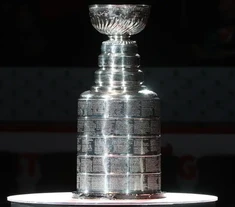
The History of the Stanley Cup
Last updated: Saturday March 1st, 2025
Report this blog
Where it all began...
In 1888, Sir Frederick Arthur Stanley was appointed by Queen Victoria to be the Governor General of Canada. When he arrived in Canada, he watched his first hockey game, and it was between the Montreal Victorias and Montreal AAA (Amateur Athletic Association). Lord Stanley was hooked! He became Canada's highest ranking hockey fan, and he got his whole family involved too, his sons and daughters even took up the game of hockey themselves.
In 1892, Lord Stanley decided to donate a trophy that would be awarded to the best hockey team in Canada each year. The trophy was made in the shape of a bowl with engraving around its base and eventually on the bowl itself.
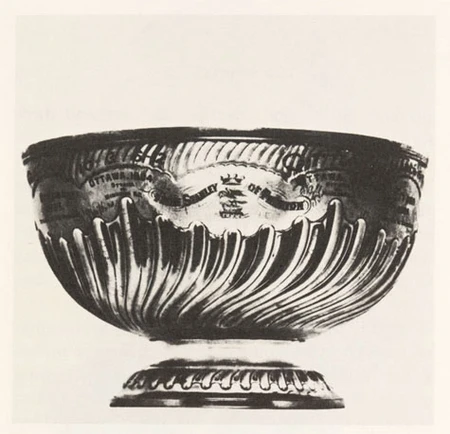
Back then, Canada's official name was, the Dominion of Canada, and the trophy was called the Dominion Hockey Challenge Cup. Soon though, it become more widely known for its donor, and was referred to as the Stanley Cup. Lord Stanley never saw a Stanley Cup championship game, and never got to present the cup in person. He returned to England in July of 1893, after his elder brother died to succeed him as the 16th Earl of Darby. Lord Stanley himself died in 1908.
The first recipient of the Stanley Cup was the Montreal Amateur Athletic Association in 1893. Team names were engraved on the base ring until it became full in 1903. From then until 1907, the winning teams names were inscribed on the bowl itself. In 1907, the Montreal Wanderers became the first to engrave the names of individual team members on the Cup.
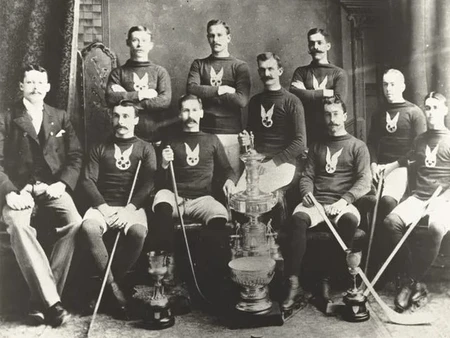
Since 1924, it has been a tradition to engrave the names of players and other important team officials on the Stanley Cup. The addition of these names took up lots of space and the Cup had to grow taller to make everything fit. A new base ring was attached in 1909 by the Ottawa Senators, and many rings were added in subsequent years as the Cup kept growing.
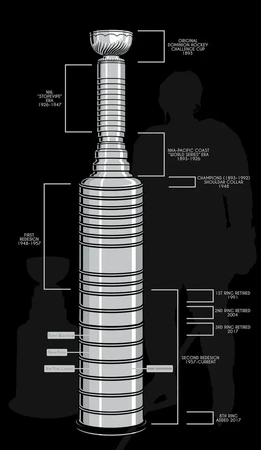
If the bands weren't removed and replaced, the Cup would look like something this nowadays. By the 1940s, with all of the base rings making it taller and taller, the Stanley Cup looked like a stovepipe, it was cumbersome and well... ugly.
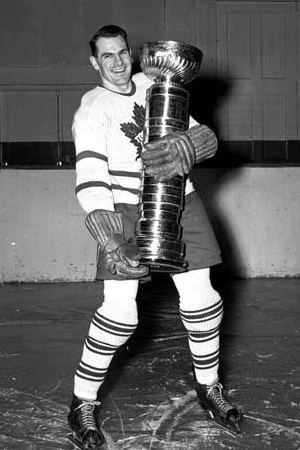
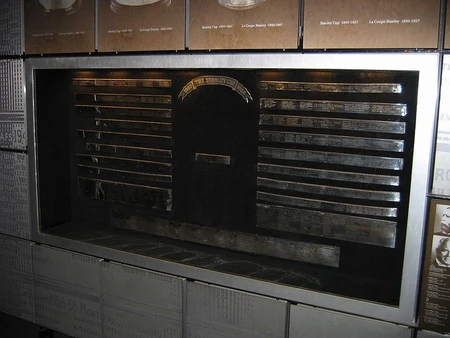
The Stanley Cup as we know it today debuted in 1948 and was redesigned 10 years later. It's easily the most gorgeous trophy in all of sports, but why has it not grown in size in almost 80 years? Well, the five main bands on the 1958 Cup are movable and can be re-positioned once they get full all the way around. The bottom main band of the Cup is the newest and when it gets full, the top band is retired and placed in the Hockey Hall of Fame in Toronto, and a new blank band is added at the bottom, all the other bands slide up a notch, each band can hold 13 years of Stanley Cup champions. The Hockey Hall of Fame has a display of all the retired bands and other parts of former Stanley Cup trophies.
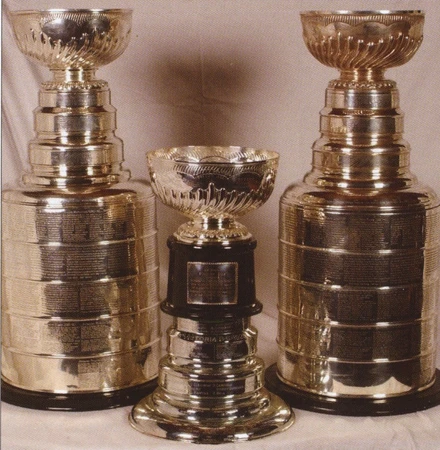
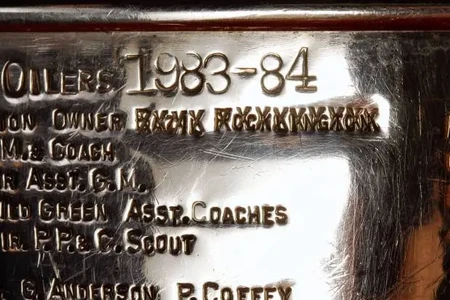
There are actually two copies of the Stanley Cup, the presentation cup is the one that is handed to the championship team each year and carried around the ice. That Cup is the "real deal." And is often taken on the road for promotions and displays, and it is also loaned to each championship player for one day in the summer, so they can celebrate with the Cup have a home town parade or whatever they wish, more about that later. The other version of the Stanley Cup remains on permanent display in the Hockey Hall of Fame in Toronto. And of course, there is a third Stanley Cup, which is the original bowl donated by Lord Stanley all those years ago. It remains in the Hockey Hall of Fame also. Although the two Cups are identical in almost every respect, the presentation cup can be distinguished from the replica cup in one key way. When the 1983-84 Edmonton Oilers names were being engraved on the Cup, team owner, Peter Pocklington insisted that an extra name be added, that of his father, Basil. Well, Basil Pocklington has nothing at all to do with the Oilers, so when the NHL saw that the Cup had his name on it, the league ordered that it be X out. The presentation cup has the Basil Pocklington X out name on it while the replica cup is blank in that same location, because the extra name was never put on in the first place, so look for the 1983-84 Oilers about halfway up the Cup, if you ever get close to it. If you see the X out name, you're looking at the real presentation cup.
The Cup certainly has a colorful history, it's been lost, stolen and simply left behind on several occasions. According to the Hockey Hall of Fame, the Ottawa Silver Seven team members drop-kicked the Cup into the Rideau Canal in 1905, it was found in the canal the following day. In 1907, the Montreal Wanderers left the Cup with a photographer who was living with his mother, she decided to plant flowers in it and actually kept it for a few months until the team got it back. In 1924, Montreal Canadiens were on their way to a party and had the Cup with them when they got a flat tire, they stopped to change the tire and when they left the scene, they accidentally left the Cup behind in a snow bank. They realized later that night that they had left the Cup abandoned and went back to look for it and there it was.
Even though the Stanley Cup has been synomymized with the annual NHL championship, the league does not actually own the trophy. The Cup is awarded each year under an agreement with the Stanley Cup trustees, which honors the original deal set by Lord Stanley. There are always two living trustees, who serve until they pass away, when one dies, a replacement trustee is appointed to share the legal governance over the Cup. At the time of blog was written, the two trustees are Lanny McDonald and Gary Meagher.

The current Stanley Cup topped with a copy of the original bowl is made of a silver and nickel alloy, it's just under 3 ft tall or less than 1 meter, it weighs 35 lb or 15 kg.
The Cup has been won over 100 times by 22 active NHL teams, 5 defunct teams and in its earliest days 9 different teams when it was the Challenge Cup. The Montreal Canadiens have won the Cup a record 24 times and are the most recent Canadian-base team to win the Cup in 1993. The Detroit Red Wings have won the Cup 11 times, the most of any American-based NHL team most recently in 2008. The smallest municipality to produce a Stanley Cup champion team is Kenora, Ontario, the town had a population of about 4,000 when the Kenora Thistles captured the Cup in January 1907. The Art Ross Trophy, given to the player with the most points in a regular season in modern times is named for a member of that Kenora team, who went on to a great career in hockey with the Montreal Wanderers and the old Ottawa Senators.
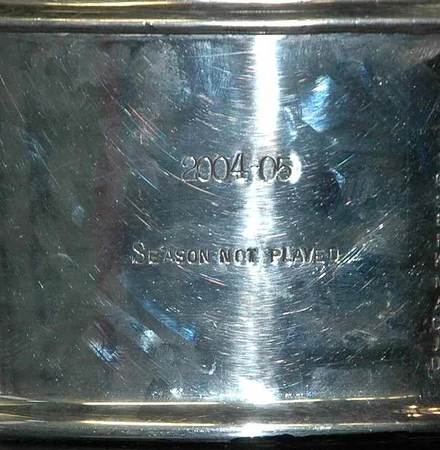
In 2005, during an NHL lockout, a movement was award to the Stanley Cup anyway maybe to the top amateur hockey team, as well was originally intended by Lord Stanley. A website (freestanley.com) was set up to build interest in the idea. The movement actually made some headway, an agreement was signed that would allow the Cup to be awarded outside the league for any season, in which the NHL did not operate. By the time the agreement was finalized, the league was back in operation, so the 2005 year says, "Season Not Played"
The current rules on who gets to be engraved on the Cup are as follows:
- A player must have played at least half of the regular season games (which is 41)
- Provided the player remains with the team when they win the Cup.
- Played in at least one game of the Stanley Cup Final
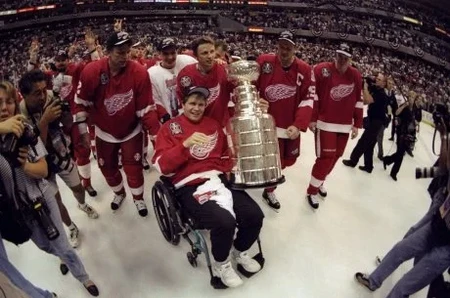
Since 1994, teams have been permitted to make a plea to the NHL commissioner to engrave a player's name on the Cup, if the player was unavailable to play due to extenuating circumstances. This happened in 1998, when the Detroit Red Wings received special permission from the league to inscribe the name of Vladimir Konstantinov, whose career ended after a car accident the previous year just after they won the Cup. Through the 1997-98 season, the Detroit Red Wings considered Konstantinov a full member of their team, even though he was never able to play hockey again.
With the Montreal Canadiens having by far the most Cup championships of any team, the list of players who have been engraved on the Cup is dominated by Montreal. Henri Richard has had his name engraved 11 times having played on more Stanley Cup championships than any other player. He is followed by Jean Béliveau and Yvan Cournoyer of the Canadiens with 10 championships. Claude Provost of the Canadiens has 9. 4 players are tied with 8: Red Kelly, who won 4 with the Maple Leafs and 4 with the Red Wings, the most for any player who was not a member of the Canadiens and Habs (nickname for the Montreal Canadiens) players: Jacques Lemaire, Maurice Richard and Serge Savard. Jean Béliveau's name appears on the Cup more than any other individual: 10 times as a player and 7 times as management for a total of 17 times.
Usually when the Cup is awarded after the final game, it is handed to the team captain for the first skate around the ice. This has not always been in the case though. In 1993, when the Canadiens won their 24th Stanley Cup, team captain, Guy Carbonneau immediately handed the Cup to Denis Savard, who was injured and unable to play in the team's final game. And in the 1998 Detroit win, captain Steve Yzerman gave the Cup to Vladimir Konstantinov, who was in a wheelchair. In 2001, another special moment happened with the Cup, Ray Bourque, one of the league's elite players had been with the Boston Bruins for a long time, but the team never won a Stanley Cup while he was with them. Near the end of his career, he was traded to the Colorado Avalanche, who had a good chance of winning another Cup that year, sure enough the Avalanche won and Bourque would finally get a chance to raise the Stanley Cup, captain Joe Sakic gave Bourque the honors.

The Stanley Cup championship team is alotted the summer to pass around the Cup. Their time with the trophy includes a team parade time with sponsors, a day with each player and member of the team staff.
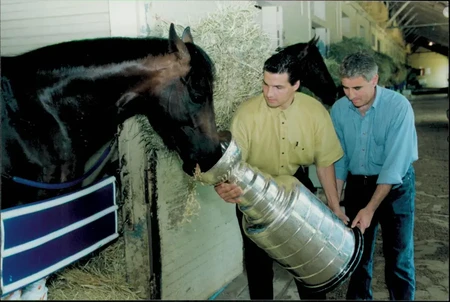
The Cup is always transported by a representative from the Hockey Hall of Fame. Before being so closely guarded, some funny incidents have happened with the Cup. During the 1940-41 season, the mortgage on Madison Square Garden was paid the management publicly celebrated by burning the mortgage in the bowl of Cup. Some fans claimed this act desecrated the Cup. Leading to the curse of 1940, which allegedly caused the New York Rangers to wait 54 years for their next Cup win. In 1962, the Toronto Maple Leafs won the Stanley Cup, during a party after the win, the trophy was dropped in a bonfire and badly damaged, it was repaired at the expense of the team. In 1964, Red Kelly of the Toronto Maple Leafs posed a photo of his infant son sitting in the Cup, only to find that the child peed in it. A week after the Detroit Red Wings won the Cup in 2008, Chris Draper's newborn daughter pooped in it as she sat in the bowl. In 2022, when the Colorado Avalanche won the Stanley Cup, when the team decided to take a team photo with the Stanley Cup, Nicholas Aube-Kubel was holding the Cup and fell and accidentally dent the Cup. The New York Islanders, Brian Trache admitted to sleeping with the Cup as have apperently dozens of other players. After a parade in their honor, in 1994, several New York Rangers took the Cup to Belmont Park, filled it with Oats and let Kentucky Derby winner, Go for Gin eat out of the Stanley Cup. In 2003, Martin Brodeur ate popcorn out of the Cup. In 2011, Brad Marchand ate cereal out of the Cup. In 2018, Alexander Ovechkin ate caviar out of the Cup. In 2022, Colorado Avalanche defenseman, Cale Makar drank slurpee out of the Stanley Cup. Three players: Clark Gilles of the New York Islanders, Shawn O'Donnell of the Anaheim Ducks, and Nick Bonino of the Pittsburgh Penguins have allowed their dogs to eat out of the Cup.





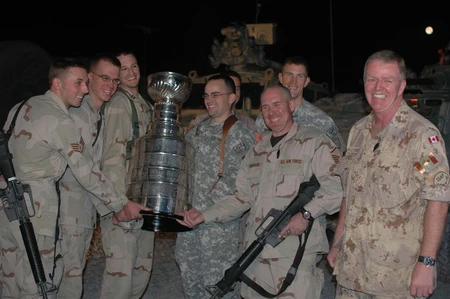
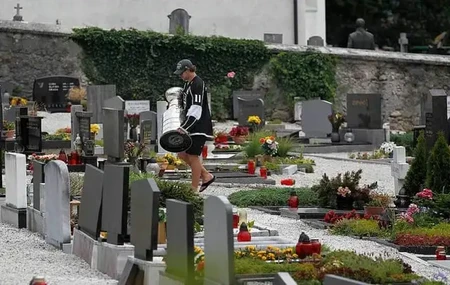
The Stanley Cup has been visited in 25 countries (Afghanistan, Austria, Bahamas, Belarus, Belgium, Canada, China, Czech Republic, Finland, France, Germany, Italy, Japan, Liechtenstein, Mexico, Russia,Slovakia, Slovenia, Sweden, Switzerland, Turkey, Ukraine, United Arab Emirates, United Kingdom and the United States of America). When players win the Stanley Cup, they bring the Cup to their hometown. During the trip to Kandahar, Afghanistan from May 2 to 6, organized by the NHL, the Hockey Hall of Fame, the NHL Alumni and the Canadian Department of National Defense, the Cup was put on display for Canadian and other NATO troops. The Cup was not damaged when its host base sustained a rocket attack on May 3. If an American or Canadian team wins the Stanley Cup, the leader of the country meets the team and the Cup as well!



The Stanley Cup is like no other trophy in sports, it has been dreamed of by little kids for generations, and sometimes those little kids grow up to become NHL hockey players. Some play professional hockey for 20 years and never win the Cup, while others play only a few games right out of the minor leagues and win the Cup before they really have their first rookie season. It's part of the magic of the NHL.
Being from the UK, I know about hockey, or as we call it Ice Hockey to differentiate from Field hockey that I used to play in school many many years ago.
Well done!