
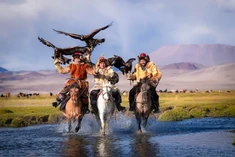
The Hidden Country - Mongolia
First published: Monday June 23rd, 2025
Report this blog
The country of Mongolia doesn't get too much popularity compared to its larger neighbors of Russia and China. Mongolia is often shadowed, and people don't really get to see what it is really like. So in this blog, I would like to show you... The Hidden Country of Mongolia.
Introduction to Mongolia
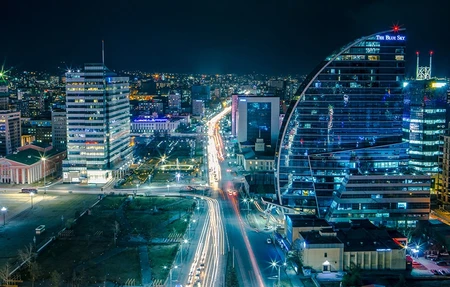
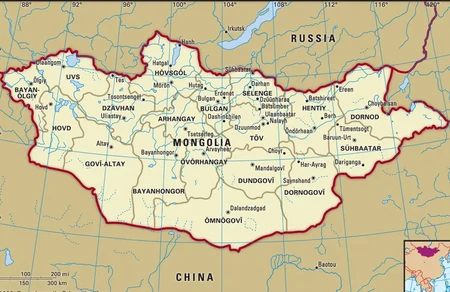
Mongolia is a vast rural country between Russia and China. Mongolia is the 18th largest country and covers an area of 1,564,116 square kilometers (603,909 square miles). On the other hand, Mongolia has the 132nd highest population, of 3.5 million, making it the world's least densely populated country. Mongolia's capital, Ulaanbaatar accounts for around half of the country's population at 1.7 million and is a growing cosmopolitan city in the center of the country. Most of Mongolia is covered in a cold, grassy steppe where nomads commonly live. Mongolia is a Buddhist country where Buddhism was spread from Tibet and more notably, the Qing Dynasty in the 17th century. The official language is Mongolian, a language that is unique to the nation.
Geography and Climate
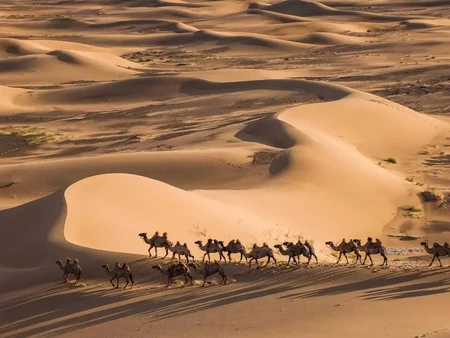
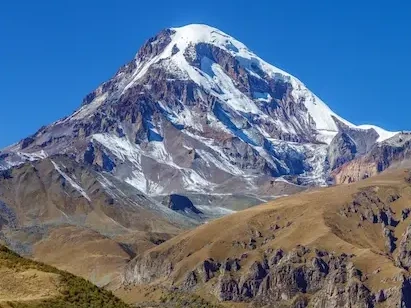
With Siberia in Russia to the north and Inner Mongolia in China to the south, Mongolia is home to a wide range of geography. Mongolia is a huge country in East Asia mostly covered in grasslands in what is called the Mongolian Steppe — a flat region with high elevation. To the north and west towards Russia, there is a cold mountainous region made up of the Altai and Kentii mountain ranges. To the south towards China, there is the vast Gobi Desert, the coldest non-polar desert in the world. This results in a lot of geographical isolation. The highest point in Mongolia is Khüiten Peak in the far west at 14,350 feet or 4,373 meters high. Most of the country is hot in the summer and extremely cold in the winter due to wind blowing from Siberia. There are also many rivers and lakes in Mongolia. The Selenge-Moron river system is the major river system, flowing into Lake Baikal in Russia. There are also numerous lakes including Lake Hovsgul and Uvs Lake.
History of Mongolia (Told Somewhat Briefly)
Most of us know or think we know the basics of Mongolian history. You know, the "fact" that the Mongols were savages who led to the end of numerous empires and were constantly attacking others. But, lets put our biases aside and learn about the real history of Mongolia that now many people know about. It all starts in the 12th century obviously not, but who cares about the stone age when a chief known as Temüjin united the Mongol tribes to form the Mongol Empire which was soon to be the largest continuous land empire in world history. In 1206, he took the name many know him by... Genghis Khan, and waged a series of wars across Asia known for their brutality. Under Genghis Khan and later his successors, his empire stretched from modern day Poland and Ukraine in the west, to Korea in the east, covering around 33,000,000 square kilometers or 13,000,000 square miles.
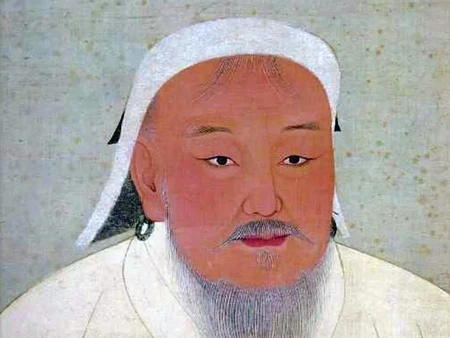
After his death, his empire was split into four sections or "Khanates". One Khanate, known as the "Great Khanate" was in modern day Mongolia and China and later became the Yuan Dynasty under Ghenghis Khan's grandson, Kublai Khan. After the collapse of the Yuan Dynasty by the Ming Dynasty, the Yuan's government fled north to Mongolia, causing a series a chaos lasting centuries. In the early 16th century, Dayan Khan reunited the Mongol groups under the Genghisids. His grandson, Abtai Khan met with the Dalai Lama, and quickly spread Tibetan Buddhism across Mongolia after converting himself. In the early 17th century the Manchus started conflicts with the Mongols, later resulting in many of the Mongol tribes submitting to the Manchus in 1691, who later formed the Qing Dynasty. Under the Manchu rule, the Mongolian culture was preserved due to the strict forbiddance of mass Chinese immigration to the region.
After the fall of the Qing Dynasty in 1911, Mongolia under Bogd Khaan declared its independence. However, China didn't accept this and considered Mongolia to be part of its territory. Finally, after a series of battles with China, and the help of the Bolsheviks in Russia, Mongolia (known as the People's Republic of Mongolia) became fully independent on July 11, 1921, as a communist nation closely allied with the Soviet Union.
The Soviet Union was tough on its "protection of Mongolia's communism", killing any leader fighting against communism and up to 17,000 Buddhist monks during the Stalinist purges of Mongolia in the 1930's. The Soviet Union however did protect Mongolia from Japanese Imperialism through a series of battles after Japan occupied Manchuria in northern China.
The collapse of the Soviet Union in 1991, influenced the people of Mongolia to fight for the end of communism. The peaceful revolution brought an end to communism in Mongolia in January 1990 and a multi-party system and a market economy were introduced. (Sorry, that wasn't very brief).
Cities and Provinces
Mongolia is divided into 21 provinces or "Aimags" and the capital city Ulaanbaatar governed as a provincial municipality. The largest of the provinces is Ömnögovi in the south and the most populous is Ulaanbaatar. Ulaanbaatar is also the largest city by far with over 1.7 million people. Here is a list of the 10 largest cities in Mongolia:
1. Ulaanbaatar
2. Erdenet
3. Darkhan
4. Choibalsan
5. Mörön
6. Nalaikh
7. Bayankhongor
8. Ölgii
9. Khovd
10. Arvaikheer
Best Places to Visit
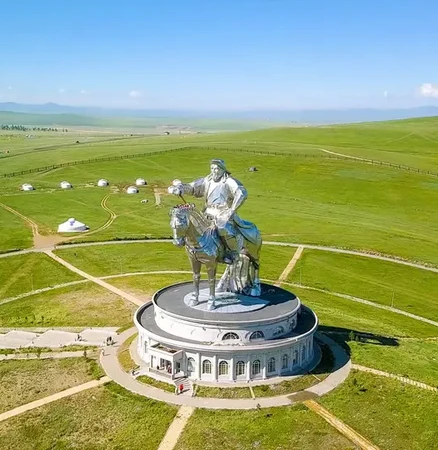
1. Chinggis Khan Statue Complex - a 33-foot tall majestic steel statue of Genghis Khan in the middle of the Mongolian grassland
2. Gorkhi-Terelj National Park - beautiful mountains and stunning landscapes just outside Ulaanbaatar
3. Gobi Desert - pristine sand dunes, ancient monasteries, and dramatic canyons
4. Hovsgul Lake - gorgeous freshwater lake in northern Mongolia
5. Ulaanbaatar - bustling capital city with many historic sites and so much culture
Culture
Mongolia has a very rich and unique culture that has been shaped by its nomadic heritage and its position as the crossroads of numerous empires. Mongolian culture is influenced by the cultures of Mongolic, Central Asian, and East Asian people.
The nomadic lifestyle of a quarter of Mongolians is one of the most unique aspects of Mongolian culture. The nomadic lifestyle involves the herding of many animals including cows, sheep, camels, etc. The nomads commonly live in yurts known as "Gers" which are a main feature of the nomads. Music, dance, and storytelling are also important aspects of nomadic life.
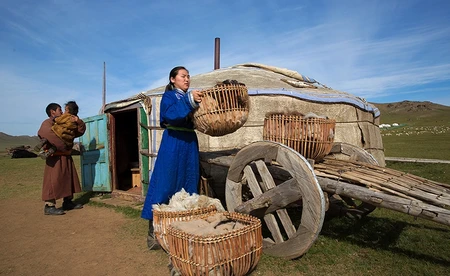
The deel or kaftan is the traditional Mongolian garment, which hasn't changed much for centuries. It is a long, loose gown cut in one piece with the sleeves; it has a high collar and widely overlaps at the front. Traditional Mongolian cuisine consists mostly of meat and dairy with beef, goat, and sometimes camel meat being the most popular. Dairies made from cow's milk or goat's milk consist of cheese, curds, and creams. However, modern Mongolian cuisine has evolved to include more similarities to Chinese and Russian cuisine after much influence over the years. Traditionally most fine arts in Mongolia were based on religion, or Buddhism. These included mostly bronze sculptures of deities. Nowadays however, paintings are more common. A large part of Mongolian culture is the belief of superstition and the belief in good and evil omens. Many believe talking about negative things can bring a bad omen and do many superstitions to prevent it such as rubbing charcoal on a child's forehead. The most important public festivals are the Naadam meaning game. It is like the Olympics of Mongolia and is held in Ulaanbaatar each year in June. These games involve horse racing, wrestling, and archery competitions. Mongolia has very old music traditions including throat singing, the Morin Khuur (fiddle), and other string instruments. A popular dance is the "Mongolian waltz" where a man and woman, both mounted on a horse, circle each other to a traditional song, which speeds up as it progresses.
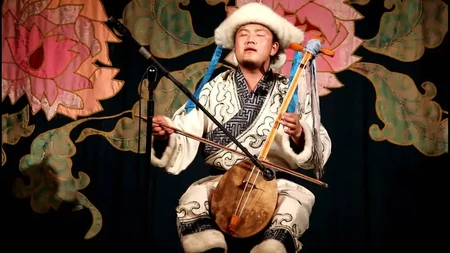
Fun Facts About Mongolia
1. Mongolia is the largest landlocked country bordering no internal sea
2. Its capital Ulaanbaatar is the world's coldest capital city at an average temperature of -3 degrees Celsius or 29.7 degrees Fahrenheit.
3. The northernmost part of Mongolia is at the same latitude as Berlin, despite having extremely different climates, the southernmost part is adjacent to Rome or New York City.
4. At its maximum size, the Mongol Empire took up approximately 22% of the world's entire landmass and with a population of 100 million people, had 25% of the world's population at the time.
5. Mongolia is home to the northernmost population of camel, the two-humped Bactrian camel.
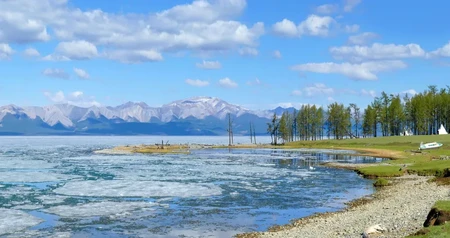
So this wraps up the beautifully hidden gem of Mongolia! I hope you enjoyed reading my blog! Also, make sure to vote in the comments for which nation you would like me to do next.
The options are:
Armenia
Uruguay
Slovenia
Happy blogging!
Slovenia: 10 votes|1st Place
Armenia: 2 votes|2nd Place
Uruguay: 0 votes|3rd Place
The next hidden countries blog, on Slovenia, will likely come out next Monday.
Great blog btw!
(Mongolia not Slovenia)
My next vote is Slovenia :D
also slovenia
I vote Slovenia too btw, I love that country, so beautiful.
Armenia and Slovenia please!
Btw, according to a Slovenian I met, Slovenia is the only country with ‘love’ in it. :/