
A Memoir of a Vancouver Roadtrip #2
First published: Saturday May 16th, 2026
Report this blog
By Day #3, me and my cousin had completed three days of travelling and exploring, and had reached our other cousin's place in Abbotsford BC. Day #3 was relatively relaxed and uneventful, and more of a chance to catch up with our cousin on his day off from work. It also gave us a chance to prepare for bigger adventures in the next few days...
Day #4
I woke up once again on the floor, except, confusingly at these hours, my sleeping mat was on the floor of my Abbotsford cousin's room and not the floor of a minivan. Me and my cousin woke up slowly, appreciating the fact that we were in a warm house, that warm showers awaited us and that we wouldn't have to step out into the cold mountain air to brush our teeth.
Not that the outside air was cold anymore either. We had left the harshness of the mountains behind, and now we were in the temperate Fraser Valley, with its humid air, rainforests and abundant greenery.
After breakfast, we clamoured into the van to complete the final leg of the journey into Vancouver.
Vancouver
The highway from Abbotsford to Vancouver kept growing and growing, lanes adding on to lanes. I could see my cousin get tenser at the wheel, as he had grown up on a farm, and so he was now entering into the polar opposite of his element. A carpool lane opened up to the left, and we debated for a while whether or not we were elligible to take it, or if the carpool stickers we saw on certain other vehicles was a requirement.
Fines were pricey and listed everywhere around Vancouver. We did not want a Vancouver fine.
As traffic began to crawl, we finally turned off of the highway and headed into Surrey, a Vancouver suburb. Our plan was simple - park in Surrey, where parking is cheaper and more abundant, take the Skytrain into Downtown Vancouver, longboard the length of the Vancouver Seawall and Stanley Park, before ending the day at English Bay.
Poetic, really...
----
...but nearly doomed to a bad start!
We parked the van and hopped on our boards, which basically glided over the smooth Surrey pavement. Turning a corner, it was all downhill towards Surrey Central Station. Feeling my board rapidly pick up speed, I lowered my foot to slow down, as my thoughts flashed back to Cranbrook.
My cousin slowly disappeared over the crest of the hill.
When I came over the crest, I saw him across a boulevard down below, waiting in a crowd of people. I was confused for a moment, "why did he cross without me?" I rejoined him.
That's when my cousin revealed that in fact, it was an involuntary crossing, spurred on my too much speed, and that in the process, he had run a red light. I was glad for two things, that he had escaped unharmed, and that I hadn't seen any of that.
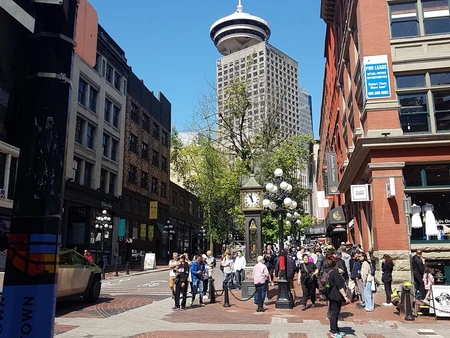
Taking the Skytrain into Downtown Vancouver really solidified what a big city we were now in. As the train hurtled out of Surrey, we suddenly found ourselves far above the Fraser River, elements of the city framing the riverbanks below, all underneath the majestic mountains rising up from the North Shore. We held on to the handlebars with one hand, our longboards with the other, as we moved from door to door so that other passengers could enter from the platforms. I noticed a man on an electric bicycle on the train, a food delivery package strapped on to the back of the bike as he kept an eye on his deliveries via his mobile phone.
----
As the train descended under the city, images of my time in Egypt flickered through my mind, and taking the Cairo Metro. It was a moment of nostalgia.
----
We got off the train at the last stop. Stepping out of the gradiose station onto the city streets, something caught my eye immediately - the ocean! Down below us lay the port of Vancouver, and our first glimpse of the sea. We hopped back on our boards and immediately made our way down the Seawall, right where it met Canada Place. From here, we began following it up and towards Stanley Park.

Growing up in Alberta, a landlocked province, with three mountain ranges and 12 hours between me and the ocean, I find the ocean to be a very special place. Standing in the tidal zone, the waves lapping up against your feet, you really get the feeling that you are interacting with a massive body, a giant beyond comprehension, whose slightest groans and turns create pulverising storms and waves. A giant body mysterious and unknown to humanity, yet one that human civilisations have sailed upon, fed off of and used for thousands of years.
Smelling the salty mist, hearing the rhythmic patterns of the waves, watching the seagulls circling massive ships setting sail for China and Japan, I wished I could have spent more time by the sea.
----
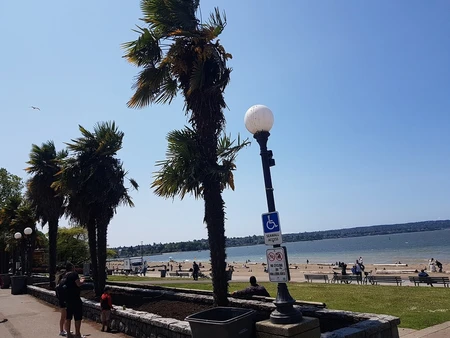
We longboarded the 15 kilometre stretch around the Vancouver Seawall, with ancient rainforest on one side and the sea on the other, stopping only to snack on a pack of Taki chips and check out the totem poles in Stanley Park. Finally, our long ride was finished off hanging out amongst the windmill palms on English Bay beach, and weaving up and down busy Vancouver streets back to the train station to wrap up the day.
Day #5
To give my cousin a break from the overstimulating Trans-Canada highway, we instead opted to take Highway 7, crossing the Fraser River early into Mission, and following the windy road down the Fraser through small towns and, eventually suburbs. Finally, we turned off into the satellite city of Port Coquitlam and I finally realised my dark tourism destination.

Riverview Insane Asylum
Potentially Canada's most infamous insane asylum, Riverview Hospital was active from 1913 to 2012. During the mid-20th century, it operated as an insane asylum, and like other, similar mental health institutions of its era, it was a place of abuse and maltreatment. If you search online, you can find many horror stories about this place, some true, some legends. Stories about the terrors inflicted by staff towards the inmates, and stories about inmates attacking each other or visitors to the site. With more modern understandings of mental illness and mental health in general, the site became more and more modernised too, before its closure in 2012.
Since then, Riverview's decaying, abandoned buildings have been used by various film crews over the years, particularly the picturesque "Lawn Buildings". Meanwhile, some other buildings on the site have since been demolished, while others have been refurbished and used for new mental health facilities. It is a big site.
Films/shows filmed here include Deadpool 2, the X-Files and Elf (yes, the Will Ferrel version). Apparently they filmed the department store scenes here, the office scenes, the orphanage and the singing scene in Central Park here. A very fitting filming location indeed.
I arrived with my cousin in the morning, the sounds of the city and the nearby highway drowned out by the many trees in the compound. Immediately, we had the feeling that we had entered a place where we were not meant to be.
We were not alone. Arriving at the West Lawn Building (perhaps the most dilapidated one), it had be redressed by a film crew who had rebranded it as "Crescent Veil Academy". They were filming the pilot for a TV series when we had pulled in! Meanwhile, a truck pulled around the corner - a security vehicle on patrol - making me feel a bit uneasy.
----
I should clarify that we never planned to enter the facility, but rather snoop around the outside, seeing whatever was visible from the exterior. Trying to enter a guarded facility, in plain daylight, active security sensors and in one of the busiest urban centres in the country was just a tad bit too stupid... even with the tone of our road trip! But even still, I fully expected that we could be thrown out of the grounds at any moment, either by a suspicious security force, or by a busy camera crew.
But, luckily for us, neither side seemed to pay us much attention at all.
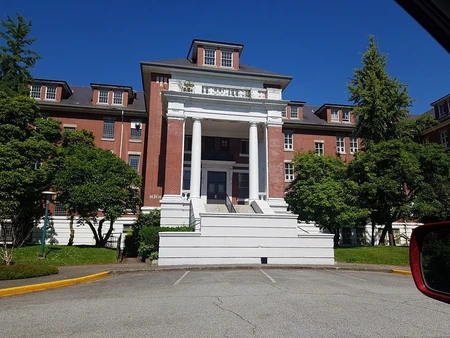
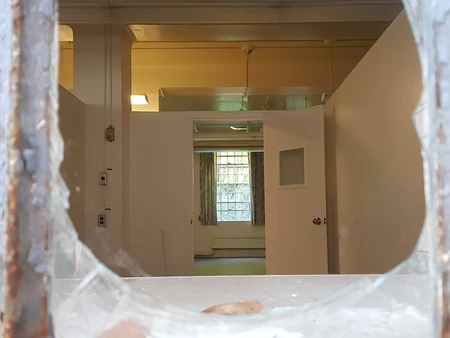
We made quiet regardless, careful not to draw in too much heat. Walking around the back of the buildings, I noticed something: at least half of the ground floor windows were smashed in, giving us the ability to peer inside the building and at least get some feeling of exploring the facilities ourselves! It was erie seeing a healthcare facility like this in a state of abandonment. While the interiors were still in relatively good shape, seeing such a large and sophisticated place such as this completely empty, bar for a couple piles of cloth and curtains, certainly gave us a mysterious and uneasy feeling.
By far the creepiest feelings came from the East Lawn Building. Of the three Lawn Buildings, it was in by far the best shape, and appeared as if it had been used until recently. Walking into a semi-courtyard, surrounded by the building's towering walls, I felt a deeply sinister feeling. Perhaps it was the first time when I felt the truth really sink in, that we were in a deeply evil place, where terrible things happened - not just a rotting relic of the past or a movie set.
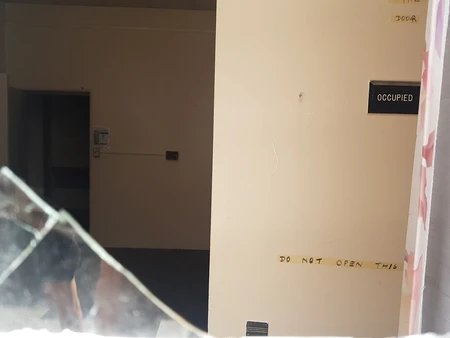
On our way back, we saw a lonely camera crew assistant guarding the entrance to the Centre Lawn Building. Suddenly, a flash of hope sparked in both our heads, spontaneously: could he possibly let us slip in? Or at least show us around.
We approached him, my cousin asking,
"Is there any way we could see the inside?"
"Absolutely not" he replied, without hesitation.
Dreams dashed, we stopped to talk to the assistant, and he told us more about what it was like to work inside the buildings with the camera crew. He said the scariest was going into the facility alone, at night (this seems like the setup to a B-list horror flick). We were instantly a little envious of his job! He also gave us some insight into the TV series that was being filmed there... or at least the pilot. He told us that (whomever was producing the series) would film a pilot episode, something about a girl attending a gothic-style school if I remember correctly, and if it performed well with test audiences, then and only then would they come back and film more episodes.
It has been almost a year and I still can't find any information on what they were filming, it remains an enigma. Perhaps it was cancelled before it could make it on air.
----
Our last full day in the area, we did some longboarding in Port Coquitlam, before heading back to our cousin's place in Abbotsford, where we met another one of our cousin's who had come in to visit, as well as my cousin's fiancee. We amused all of them with some of our crazy stories from the trip thus far.
Day #6

Our journey on the return trip
With questions of uncertainty flooding our minds once more, about what the day would look like, where we would sleep, we packed our belongings back into my cousin's red minivan and prepared to leave.
However, leaving proved to be tougher than expected. Stopping in the service station to top the tank up on gas, the van decided to choose this very particular moment to not start up again.
----
My cousin had warned me about this before, how - rarely - the ingition would fail to start. Here, it decided to present itself to us early in the day before we expected to drive for a few hundred kilometres. Damn it.
But my cousin had one trick to coax the van into giving us what we needed. He put his hand on the shifter and began to wiggle it around, as if it were a Magic-8 ball. In true Magic-8 ball fashion, it gave us the reading "outlook, not so good". My cousin called his father for suggestions, who advised us to put the van in neutral and give it a push, Karate Kid-style. A suggestion that inspired some level of confidence in me, somewhere. I suddenly became aware that we were stuck in the middle of a busy service station, potentially blocking other vehicles.
Then, just as I began to jest that this was by far not the worst place to have to stay and live in, the van took pity on our plight and jumped back to life. We had been sitting there for close to 25 minutes.
Blue Hawk Mine
The journey to the Okanagan, by British Columbia standards, was not a particularly scenic one. After parting ways with the Coquihalla Highway (the fastest way out of the Lower Mainland), we cruised for a couple hours through dry, Okanagan forests, heavily logged for timber, on roads that sometimes continued for kilometres in completely straight lines. It was like Prairie driving, but with more hills.
But eventually, we descended into the Okanagan Valley for the second time.
When researching for the trip, I had read about an abandoned mine near Kelowna, called Blue Hawk Mine. While typically, I am worried about the idea of entering any abandoned mine due to hearing any assortment of horror stories about the various things that can kill you, this is a mine that is well travelled by curious locals, and one that is relatively shallow.
My curiosity had been piqued. The only problem is that it was way out of the way!

Staying on the west side of the Okanagan Lake (and without yet entering Kelowna proper), we carried on a twisting, hilly road along the lakeside shore, passing through small settlements with suspiciously oceanic-sounding names, like Traders Cove. My longing for the sea was ignited once again, the feeling of leaving it behind and heading towards dry, landlocked highlands a pill that was tough to swallow.
However, the more we continued onwards into remote logging country, the more Blue Hawk Mine continued to evade us.
Ominous signs began to appear, some warning us about permits we needed to have to use certain areas of the mountain we were on (and thousand-dollar fees if we were found without), with other signs warning us about washouts from the large amounts of snowmelt and rain (mentioned in part one of the blog). Finally, it became clear that the remainder of the logging road was 4X4 only. Remembering the suffering we had inflicted on the poor, protesting van back in Bountiful earlier that week, we came to our good senses and turned back to Kelowna.
Kelowna
The vanity city of the British Columbian summer, we arrived in Kelowna at around mid-day, with our longboards in hand. Making like Albertan senior citizens or cashed up 20-somethings we did the one thing that made sense - make for the lakefront.
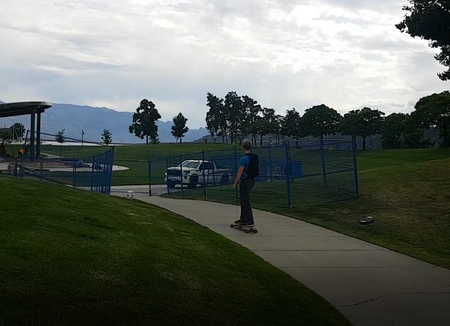
Although overcast, the lakefront was very impressionable, albeit superficial. Expensive boats filled dockyards, overlooked by fancy resorts and a bright green statue of the Ogopogo (think the Okanagan cousin of the Loch Ness Monster). We weren't here for any of this, however, and we took great pleasure in cruising down the lakefront paths, in between shiny new Kelownan skyscrapers and the Okanagan. For a bit of mischief, we even longboarded right through a couple different resorts, seeing as they opened directly onto the lakefront paths.
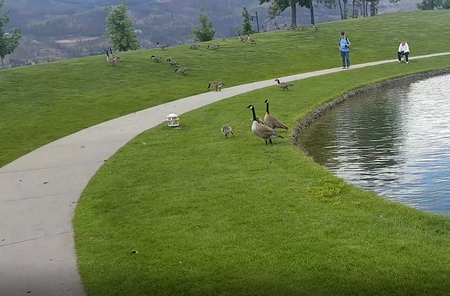
Although I have taken a few shots at Kelowna by now, we honestly enjoyed our time there. In fact, we stayed longer than expected on our longboards, the day slipping away from us. Since the Okanagan is an expensive, popular and populated place, free-camping in this region was not preferable, and so we had quite a bit of ground to make in front of us before we retreated back into the safety of the forest.
----
Leaving the Okanagan behind was a strangely mystifying experience. As we followed the highway out of Kelowna, a brief hill gave me a gimpse through the hills and far into the distance, where I saw the glistening white peaks of the Monashee Mountains, located in the Kootenay Region. It felt like a level in a video game, where you reach the end of the level and you can see the theme of the next level appear in the background.
This moment gave me a new feeling of freedom, a feeling of not just the removal of certainty, but that of progression, of steadily crossing a massive province. Of waking up near the sea, travelling through mountain ranges and arid valleys all in one day.
If this was a good feeling, it was to be complemented by the beauty and tranquility of BC Highway 6 through the next mountain range.

The road was dead quiet, snaking its way up and down hills, the mountain air cool and humid in the evening glow. Spirits were very high on this stretch of the road, as we rolled down the windows and cruised at a leisurely 70-80 kilometres per hour. The road seemed neverending, and yet we never wanted it to end. We had nowhere else to be, nor did we wish to be anywhere else in that moment.
Finally, we reached a cable ferry, one of two free ferries we planned to take during our trip, between Needles and Fauquier. We had decided on our scenic cruise, that we would arrive at the ferry, and, depending on how easy it was to get across, camp on either one of the landing terminals. As we caught the second last ferry trip of the day, that left us to make camp on the Fauquier side after marvelling at the spectacular evening views of the lake.

Camp #3
We arrived on the other side of the lake, where we drove up onto a rest stop just 100 metres from the ferry itself. Camp was a simple parking pad, with full facilities. Comfortable, but a little more exposed than our previous stops, eliminating a sense of security. With the last ferry pulling in to the dock, however, the environment became remote and quiet once again.
Further down the parking pad, a man was pulling a tent out of the back of his motorcycle storage compartment. We approached him and he introduced himself as Martin, a retired police officer who was heading in the opposite direction as us in order to watch his son graduate from the police academy. He was a kind, quiet and thoughtful neighbour happy to engage us in discussion while we unpacked our stove and our dinner for the night.
----
We soon discovered that three nights of (relative) luxury had softened our outdoor cooking skills, and me and my cousin soon realised that the portable cookstove we had borrowed from our grandfather was no longer pressurised, something you had to manually do before use. Fortunately, we had a back-up stove, borrowed from my mother. Martin, noticing our struggle, and possessing the same kind of stove himself, came over and taught us how to use it.
Unfortunately, what we did not know at the time, was that the stove used rocket fuel, which burns very hot!
My canned pea soup quickly burned under the intense heat, and gained a sharp bitter taste as a result. I didn't realise the culprit quite yet, and figured that Habitant soups had really gone downhill. We cooked up some hot chocolate after dinner, using milk which also became horribly burned, before taking it to the lakeside and forcibly chocking it down. Despite how bad the hot chocolate tasted, the atmosphere more than made up for the misadventure, and we spent about half an hour sitting by the lake and watching the ferry terminal lights as they flickered on the lake shore.
----
As this was out most "developed" camping spot yet, there were plenty of opportunities for noise and lights to distrupt our sleep that night. In particular, a bright, flashing light was positioned directly at the back window of the van, each flash illuminating the entire vehicle as we tried to sleep. We solved this by pilling up several bags and boxes against the back window. This was a solution which worked fine, until, when I was about to drift off to sleep, I felt a sudden jolt of vertigo and kicked the pile down. Despite this, I was tired enough not to care about the blinking light anymore, and so I went back to sleep right away.
Day #7
The last full day of a trip always has a certain feeling attached to it. Like the conclusion of a great film or a novel, by now you know the plot, you've seen the best scenes and you know that this small, temporary refuge from the ordinary and the mundane will soon cease. On the other hand, you have wonderful memories and stories fresh in your mind, ready to share with friends and family. And once you get back home, your life has been changed. You continue with schedules and work, in all their flamboyant dullness, but you approach it from a new light, a new angle. If you're anything like me, you start planning the next adventure.
That's not to say that this adventure was anywhere near finished just yet, but, as I munched on my cereal and milk in the brisk morning air, watching the ferry resume its morning routine, I subconsciously came to terms with the fact that home was on the hilly horizon.
----
We packed up and immediately ventured into the mouth of the paranormal.
Sandon Ghost Town
I figured that after trampling century-old graves and sticking my camera into the windows of an abandoned insane asylum, that the ghosts would be on to us by this point. So, me and my cousin made the rational decision to make peace with them. Spend some time amongst them, perhaps.
But first, we stopped in the slightly-less-abandoned town of Nakusp for a hot cup of Joe's.
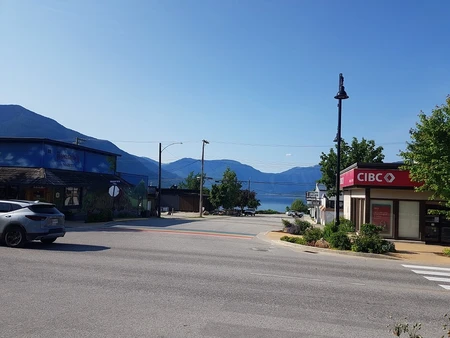
Nakusp was a pleasant, yet slightly isolated experience - as it is both far from cities while also not being on any of the major routes that traverse southern B.C. On top of this, we had arrived early in the tourist season. We certainly sensed that the few people we saw out and about were locals and not visitors, much unlike many of the other towns we visited in the Kootenay region that trip.
The one place that was packed, however, was the local cafe. It was here I noticed that the one person we interacted with in this town, the waitress, had a very distinct accent. It was certainly a Canadian accent, but sounded quite unique, especially in the way she pronounced specific words (like "onion"). She likely could have come from another region (Saskatchewan? Northern Ontario?) but this one minor detail cemented the idea in my mind, that we had come to a very isolated place.
----
But the isolation was to continue, as me and my cousin followed the road through New Denver, snaking our way up a mountain valley and into the ghost town of Sandon, BC.

The end of this dirt and gravel road raised more questions than it answered, and we passed construction vehicles and restored wood buildings, before ending up parking by a group of old Vancouver busses. What was going on in this ghost town? Was anyone here?
Not terribly pressed by time, we began to explore, climbing into the 1960s bus left open for the public to enter. We also circled around to the front of some of the wood buildings, which included a museum (which seemed closed) and a placard dedicated to Japanese-Canadians who had lived through Japanese internment during WWII (many were sent to Sandon and nearby New Denver).
Another person appeared. At first, they seemed to pay us no notice, but, after a few minutes, they called out to us. Something about seeing "the power generator".
"Alright" we thought aloud in hesitation, not knowing what was in store.
We climbed further up the path towards a building, simply marked: SANDON GENERATING STATION. Peeking inside, a woody, slightly musty scent greeted us, along with a loud whirring machine.

An older gentleman with a grey handlebar moustache and sunglasses suddenly appeared behind us. "You'd like a tour of the old generating station then?" We took up his offer, and entered into a world of environmentalism, anarchism, potential militism, history and technology which could only exist in the same mountain valleys that house Bountiful, or the hippie city of Nelson (a place we didn't visit on this trip).
The generator was a design conceived by Nikola Tesla himself, created specially to collect power from a stream as it cascaded down neighbouring Sandon Peak. When Sandon was thriving as a steel mining town, the generator had thrived, alongside a handful of other, similar designs in other regions. However, eventually the steel mines shut down, and everyone left in the mid-20th Century, leaving the town in the possession of the moustached-man's family. They preserved the generator and kept it running, however, running into conflict with the B.C. government along the way, and today the generator was the last of its kind - a historic relic kept alive via donations from visitors.
This is the abridged version, anyway.
We had a long chat with the gentleman, before leaving this strange and fascinating place behind. On the way down to the highway, I was left thinking about this generator. How a small number of passionate people had kept a strange and unique piece of history alive - hopeful that it could be used to inspire new solutions to green energy.
While the ghosts of the residents lingered over the faded town, these individuals had prevented the generator, and other physical remains of the townsite, from becoming ghosts in their own right.
Kootenay Lake
Ever since the idea of this road trip was conceived, my cousin had but one goal in mind - go fishing and catch fish for dinner.
So when I told him about a specific, rocky beach on Kootenay Lake, where I had camped with a group of fish six years prior, and where an eccentric kayaker had given us two rainbow trout he had freshly caught, my cousin was very excited to test his luck in the same area.
In fact, before we had left, he had even bought a seasoning mix of seafood rub to top off a fish dinner.
----
I was less enthusiastic about fishing myself, as someone who has till date never had any success with catching fish. However, I was happy to see my cousin have such a great opportunity to get a catch. And so, upon reaching the small town of Kaslo, on the northern reaches of the beautiful Kootenay Lake, we stopped to get my cousin a one-day B.C. fishing licence.
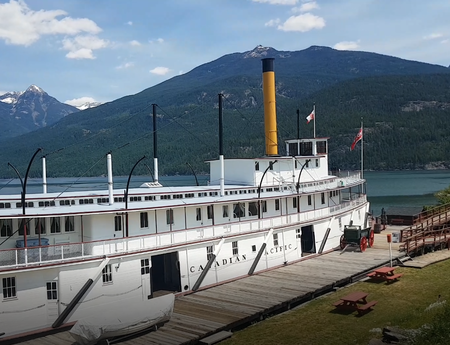
Using the power of the 1 bar of mobile signal, my cousin successfully registered his licence on the B.C. government webpage. Meanwhile, parked outside a church near the town centre, we heard honking. "What could possibly be going on?" we thought.
Looking behind us, a convoy of decorated vehicles emerged behind us, with students poking through car sunroofs and in the beds of trucks. They were the Kaslo graduating class of 2025! For a strange, brief moment, we cheered on the convoy, momentarily becoming part of the town's social fabric, before slipping off to the rocky beach to test out luck with fish dinner.

The beach was located next to a majestic waterfall, its true height obscured by cliff walls and forest, while its base was constantly shrouded in a cloud of mist and vapour. On the beach, someone had aranged a bench out of stones. We added a couple extra for armrests and a stool to put our pop bottles. The heat of the day was on us now, as my cousin entered the water and cast his rod.
And we waited...and waited...
I didn't sit for long, instead opting to wander around the area, taking in memories from my previous camp on this very beach. Boredom inspired me to toss a branch above the waterfall, and watch it get closer and closer to the edge, before the falls violently sucked the branch in. I tried following the branch, carefully walking down the steep path (which followed the edge of the cliff overlooking the waterfall), but the branch was gone.
Back on the beach, my cousin was having no luck. He tried casting in several locations along the beach, partially guided from my memory from where the kayaker caught his fish those short years ago, but it was all to no avail. Fish dinner began to slip, further and further into the realms of unlikelihood.
We tried to compensate with a trip to the fish and chips restaurant just across the highway, but they weren't open either :(
Coffee Creek Mine
Before catching our second, and last, ferry of the trip across Kootenay Lake, I had another unfinished memory to put to rest.
On the road along Kootenay Lake, there is a section where the highway suddenly dips into a narrow, mysterious valley carved by the raging Coffee Creek. When I was young, I came here with my family, where we stopped for a rest on the way to nearby hotsprings. It was here that we spotted a strange hole in the wall of the valley, opposite to the rest area and across the torrent of water. Me, my father and my younger brother crossed the bridge to the other side to investigate, where my father guided us along the wall of the ravine, until we dropped down right in front of the mouth of this hole. A mine.
This memory of gazing into the darkness of this hole was a very impressionable experience on my childhood, leaving me an enigma many years later. I wanted to get close to the mine again, and replicate the feeling of staring into its haunting void.
----
The pulloff to the rest area was much steeper than I remembered, and was awkward to navigate in the van. But, after leaving the vehicle and clamouring over a few boulders of the shore of Coffee Creek, we quickly spotted the hole.

After around 17 years, my memory had deceived me. The mineshaft was much lower than I had remembered, much closer to the raging creek. And with one glance at the ravine wall, I seriously began to wonder if I had hallucinated the whole episode - the walls of the bank were steep.
For the first time on the entire trip, we grabbed our canister of bear spray. I had a bad feeling about this place, and I thought that perhaps I was worried about cornering a bear if one lived in the mineshaft (although we never intended to actually enter it).
Waiting for a break in cars, we bolted across the highway bridge. On the other side, the banks appeared familiar to me, although once again more hostile than in my memories. We waded through tall grass before navigating down to a fork - either we could get close to the water and creep between bushes and the roar of the creek, or try to climb up around trees on the steep embankment.
----
I tried the lower option first, but, placing just one foot on the rocks next to the water's edge, I made a terrifying realisation of the words of our researcher friend, all the way from our first evening of the trip.
This season had exceptional runoff, and all the creeks were far more swollen than normal.
While Coffee Creek on a good day may have been a raging torrent - and most definitely not somewhere you would want to fall in - the height of the water today made it downright lethal. If either one of us fell in the water, the fast-flowing stream could have easily swept us away and drowned us!
Upon this realisation, I immediately stepped back from the damp shoreline rocks and into the banks of safety.
Giving my goal of reaching the mine's entrance one more attempt, I looked into the possibility of climbing up the bank, as I believe we successfully did all those years back. However, with my hands holding on to tree roots, I was still looking down at the powerful creek's flow down below, and I decided that slipping here was only marginally less bad than slipping directly off the shoreline itself.
The mystery of the mine lives on in my memories.
Camp #4
After our pleasant stay at the ferry landing zone the previous night, we decided to make life a little easier on ourselves and spend our last camp of the trip on the second and final ferry landing, on Kootenay Lake.
----Arriving in the tiny town of Balfour, me and my cousin had to pick up a consolidary dinner - something to make up for our lack of luck on the fishing that day. We stopped at the local general store and browsed the frozen foods section, wanting to make dinner a little easier this time. A frozen box of pulled pork caught our attention, something which you were meant to reheat by cooking the contents in a plastic pouch, in boiling water. This would prove to be a much better use of the rocket stove than our attempt with the singed soup the previous day. We also picked up some freshly baked buns to enjoy with the pulled pork.
The queue for the ferry was a long one, the loading zone looking more like a Walmart parking lot than anywhere on such a beautiful lakefront had any right to be. While waiting for the ferry to make the 20-30 minutes run across the lake. I heard voices from the camper van next to us, in a familiar accent - Aussies!
We quickly became acquainted with Mia, an Australian visiting on a Working Holiday Visa, and her mother, who was in Canada on a brief visit. We passed the waiting time for the ferry, trading stories about our journeys through the province, talking about Australia (a place I have yet to go) and about Mia's mother's dream of seeing bears and moose in BC. I wished her luck with realising this dream, hoping that she would get a better impression of the BC wilderness than just the mosquitos (mozzies) which had swarmed each of our campsites thus far.
The Aussies were called up to the ferry first, and me and my cousin cooked some noodle soup for a late lunch before finally catching the penultimate ferry for the day, sailing into the cool, dark evening mist of Kootenay Lake.

The Kootenay Lake ferry was significantly larger than the previous we had taken, with a large deck for vehicles, and indoor and outdoor seating areas. It was the world's longest free ferry ride (until a longer service in Nova Scotia eliminated fees), and therefore I thank all the taxpayers of BC for funding our voyage.
However, due to the larger, more formal nature of the ferry journey, and our placement on the very front of the deck, we had a moment of worry as the shores of Crawford Bay drew ever nearer. "What if the van stalled on us again?" "What if we had a repeat of the infamous incident at the Abbotsford service station?"
If there was any place for the van to fail us, this would be the absolute worst place possible. Nightmarish images began to flow through our heads. Twisting the keys frantically. The marshallers signaling to us to get a move on. Impatient drivers behind us honking at us to go ahead. It was a very tense moment!
We decided to start the ignition early, the tension too high to deal with any longer. Mercifully, the van started, and the nightmares quickly faded once more as we waited to disembark.
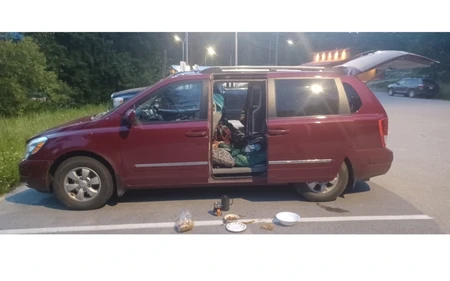
The final camp was in a much more populated area than anywhere else we had (stealth)camped thus far. Despite this, we had now entered into a different groove. Cooking dinner in the parking lot no longer felt strange or mischievous, it had become part of the routine. We had learnt to embrace the lifestyle, the lack of any privacy or personal space, the mess...
which is why, when I found out that the water jug had leaked all over my sleeping bag, I didn't worry too much. I simply pulled the sleeping bag over me, without entering it, embracing a slightly damp last night's sleep before having a warm bed the following night.
Day #8
Waking up on the shores of Kootenay Lake was a beautiful, yet bittersweet moment. The calmness of the area was serene, coloured by immense greenery and humid morning air. I remember leaving the van and staring at a road that winded along the lake and into the mountains, and - just for a moment - I could have sworn we were in the beautiful landscapes of Vancouver Island. It was bittersweet, since it was the last place to have this feeling, before heading back to familiar, dry and flat Alberta.
For the first time, I could forego the morning tea ritual. We were parked within 100 metres of a cafe. Me and my cousin had been eyeing it the night before, as we watched the owner closing up shop for the night, and now it was time for our weary eyes to check it out. Entering the cafe, we were hit with a small town whiplash. Half the people inside were greeting us, and someone even recommended us the best breakfast items. It was an exceptionally friendly place, and somewhere that stood out to me amidst all our journey.
----
From here, the route back was very simple. We were to quickly reach Creston, retracing our footsteps along the same Highway 3 which we took on the way out, all the way back to Lethbridge. We stopped just once, in Cranbrook, to stretch our legs and reminisce over the Hill of Death which had nearly killed us just a week prior. A moment which had quickly become but a memory. By early afternoon, we rolled back into Lethbridge, and thus our roadtrip had finally ended. The final page had been written.
----
Minivans are the perfect vehicle, small enough to get to places a car would, but big enough to sleep in.
Looking forward to your report of the trip east.
I'm glad you enjoyed the blog! I am certainly expecting to write another based on the upcoming trip :)