Blog about Vietnam
First published: Monday October 28th, 2024
Report this blog
Vietnam
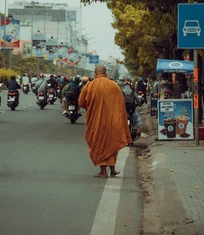
Vietnam is a country with a population of over 100 million, which was surpassed in this year. Vietnam lays in South-east asia. Vietnam is known for its spacious grasslands, beautiful natures, big cities and small streets. Vietnam is a well-known country n the world, it has shown itself in wars, in history and espacially in the trading market in the world. Lots of products are made or packed in by Vietnam fabrics
Nature
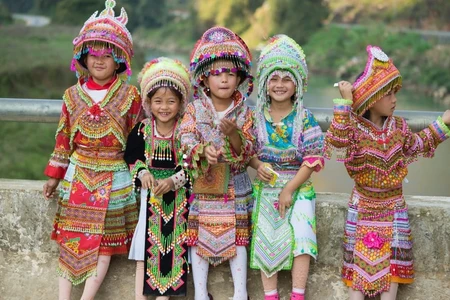
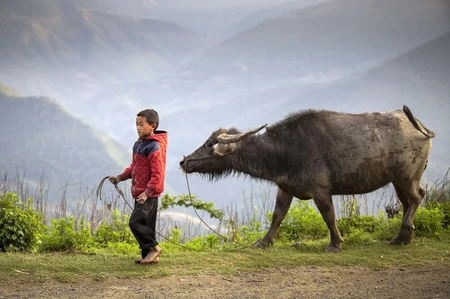
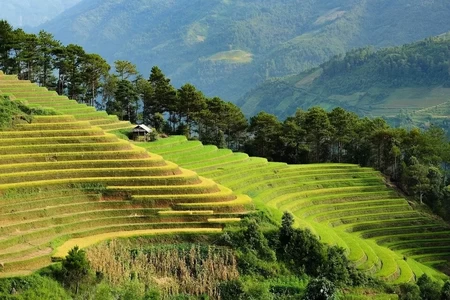
Vietnam is home to one of the most beautiful natures in the world, although in my opinion surely. Vietnam is a sort of country which lookes like Thailand a lot. Mountains by the sea that you can sail between, many high mountains, verby beautiful and clear rivers, waterfalls. You have almost all types of nature in Vietnam. The animals that live in Vietnam are mainly jungle animals such as monkeys, elephants, tigers and lizards. But there are also plenty of bears, deer and many cows. In short, Vietnam is a beautiful country if you like nature.

History
The Kingdom of Champa
In the 2nd century ad, the Kingdom of Champa establishes itself in the area of present day Danang. It is founded by the Cham people, who are not ethnically related to the Vietnamese and probably emigrated from Indonesia. The Kingdom of Champa sits in the middle of two stronger neighbours: Vietnam to the North and the Khmer Kingdom (Cambodians) to the South.
In 1471 the armies of the Vietnamese Ly Dynasty conquer the Kingdom of Champa and reduce it to a small area around present day Nha Trang.
When in 1720 a new attack by Vietnamese armies threatens the Kingdom of Champa, the entire Cham nation emigrates to the southwest, into an area north of Lake Tonle Sap in present-day Cambodia.
In 1471 the Vietnamese conquer the Kingdom of Champa.
In the 18th century the Vietnamese expand further to the South into the Mekong Delta, an area that until then had been settled by the Khmers (Cambodians). The Khmers are pushed west into present-day Cambodia.
Colonial Times
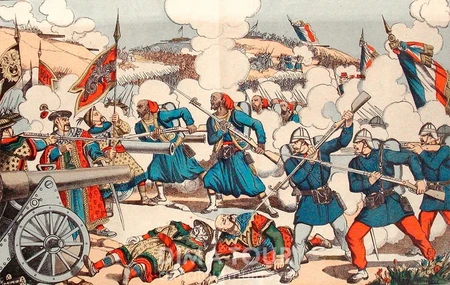
In 1859 French troops conquer Saigon. The French invasion was triggered by the persecution of Christians in the Vietnamese empire, which started in the 1830s.
In 1862 the Vietnamese emperor Tu Duc surrenders South Vietnam to the French, who set up their colony of Cochin China.
In 1883 France forces the rest of Vietnam to accept the status of a French protectorate. Administratively the French divide the country into the colony of Cochin China (in the South) and the protectorates Annam (central Vietnam) and Tonkin (North Vietnam).
In September 1940 Japanese troops occupy Cochin China without meeting any resistance. The French colonial power leaves all military installations for the Japanese to use and in return the French colonial administration remains in office. As a result there is less destruction in Vietnam, during World War II, than in fiercely contended Asian states like Burma and the Philippines.
With the Japanese capitulation on 14 August 1945, World War II ends in Southeast Asia and France attempts to re-establish herself as the colonial power in Vietnam.
War Against France
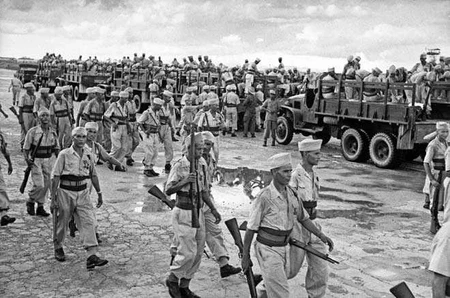
On 2 September 1945, Ho Chi Minh publicly declares Vietnam independent. While in South Vietnam the communist Viet Minh start a guerrilla war against the French colonial administration. Soon after his declaration of independence, Ho Chi Minh, decides to negotiate with France as he is having to contend with Chinese aggression.
In 1946 the Chinese agree to withdraw from Vietnam and shortly afterwards the Viet Minh resume their attacks against French colonial forces in both North and South Vietnam. While the French succeed in keeping the cities under their control, the countryside is increasingly ruled by the Viet Minh.
On 20 November 1953, the French colonial forces install a garrison of troops in Dien Bien Phu, intending to control the border region between Laos and Vietnam and so stop the shipment of arms to the communist movement in Laos.
In March 1954 the Viet Minh attack the French garrison at Dien Bien Phu and on 7 May 1954, they conquer the French command centre.
On 20 July 1954 in Geneva, negotiators from the Viet Minh and France agree on the division of Vietnam into two states: a communist North Vietnam and a capitalist South Vietnam.
War Against America
Between 1959-1963 the communist government of North Vietnam escalates military confrontation against the South Vietnam government. More than 40,000 North Vietnamese guerrillas infiltrate the South and provide the South Vietnamese communists with arms and ammunition using the Ho Chi Minh Trail, which passes through Laotian and Cambodian territory.
In 1961, newly elected US president Kennedy, worried about the spread of communism, sends the first 100 military advisors and a special unit of 400 soldiers to Vietnam. In the following year the US increase the presence of their troops in Vietnam to 11,000 soldiers.
On 2 August 1964, two American cruisers are fired at by North Vietnamese patrol boats in the Bay of Tonkin. The US insist that the cruisers had been in international waters and use the incident as an excuse to bomb targets in North Vietnam for the first time.
In March 1965 the US Air force starts Operation Rolling Thunder, the wide-scale bombardment of North Vietnam. During the following three-and-a-half years more than twice as many bombs are dropped over North Vietnam as were dropped during the entire World War II. At the peak of the Vietnam War, in 1968, the US has about half a million soldiers in Vietnam. Australia, New Zealand, South Korea, the Philippines and Thailand together sent another 90,000 troops. The South Vietnamese army at that time counts about 1.5 million men. The National Liberation Front under communist leadership, named Vietcong by the US, opposes this contingent with 400,000 troops.
On 1 February 1968, the forces of the National Liberation Army begin their large-scale Tet Offensive against targets in 105 South Vietnamese cities. Even though the Vietcong are repulsed successfully everywhere except in Hué, and even though the Vietcong suffer tremendous losses, the Tet offensive is considered the turning point of the Vietnam War. For the US, the Tet Offensive causes a change of attitude towards the war: the US government is no longer primarily interested in winning the war but rather looking for a way out.
Operation Rolling Thunder ends in October 1968 and the US begin to withdraw troops from Vietnam.
In 1969 in Paris, the US, South Vietnam, North Vietnam and the Vietcong start negotiating a full withdrawal of US troops from Vietnam. In 1972, before the Paris negotiations are put into effect, the US reduces its troops in Vietnam to less than 100,000.
30 March 1972 sees a communist spring offensive by conventional North Vietnamese troops crossing the demarcation line (the 17th degree of northern latitude) to invade South Vietnam. Intensive bombardments by American fighter planes force the North Vietnamese troops to retreat.
On 27 January 1973, a cease-fire agreement is signed in Paris and becomes effective that day.
In March 1973 the last American troops leave Vietnam.
About two years later, North Vietnamese and Southern communist forces begin a large-scale offensive with the declared aim of a total victory over the South Vietnamese state.
Only a few weeks later, on 30 April 1975, North Vietnamese troops occupy Saigon and thus bring three decades of war to an end.
A United Vietnam
After unification, initially for fear of political persecution and later because of the difficult economic situation in Vietnam, large numbers of so-called boat people flee the country. In 1979 alone, more than 270,000 boat people flee from Vietnam.
On 25 December 1978, after a series of transgressions at the Cambodian-Vietnamese border, Vietnamese armies invade Cambodia.
On 7 January 1979, Vietnamese troops occupy Phnom Penh and overthrow Pol Pot. A Vietnam-friendly government is installed, Heng Samrin, a Khmer Rouge guerrilla who before had fled to Vietnam, is declared president.
In 1989 Hanoi recalls the Vietnamese troops from Cambodia.
At its 6th party congress in 1986, and after a decade-long economic crisis, the Communist Party of Vietnam decides on a far-reaching program of economic reforms aiming to introduce a liberal economy. Since then the economic structure of Vietnam has become increasingly capitalist although the Communist Party remains the sole political power of the country.
Wealth
Geograpy of Vietnam
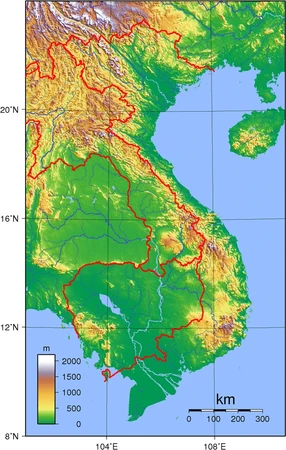
Vietnam is a country as i said in Southeast Asia, the two biggest cities lay far from each other, the biggest city Ho Chi Minh City lays in the southern part of Vietnam while Hanoi, the second biggest city, lays in the northern part of Vietnam. Vietnam has a lot of mountains, has beautiful beaches because the whole east part of Vietnam borders to sea and its also home to a lot of lakes and clean rivers. Vietnam borders China to the north, Cambodia and Laos to the east. Vietnam is an average country if you talk about how big it is.
Sports
Now in the modern days, soccer has captured the hearts of the Vietnamese people, and even the kids play informal games on the streets and in parks.
Vietnam also hold a four-year multi-sport event involving participants throughout the country. It is called the “Vietnam National Games” where goals are; one, to examine the training cycle of the athletes, secondly, to encourage each city in training new athletes and lastly, to exercise the national sporting athletes for international competitions
One of the most successful athletes from Vietnam is Lee Nguyen. He is regarded to be the most popular mid-fielder in Vietnam and is playing for the New England Revolution in Major League Soccer.
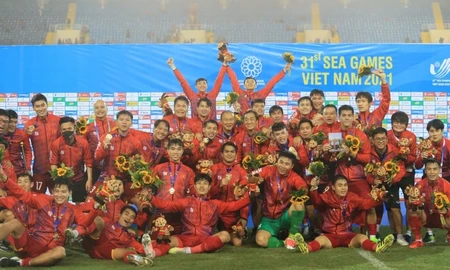
Vietnam has been a participant to the Olympic Games since 1952 with exception to 1976 Montreal Olympic Games, 1984 Los Angeles Olympic Games and the Winter Olympics. However, they only have received two medals (both silver) from Trần Hiếu Ngân (2000 Sydney, TaeKwonDo) and Hoàng Anh Tuấn (2008 Beijing, Weightlifting).
Below are details of sports, sporting events and sports people related to Vietnam.
Popular sports of VietnamFootball, Badminton, Tennis, Volleyball, Table Tennis, ChessLocal or Traditional Sports of VietnamVovinam — a Vietnamese martial art.Vocotruyen - Vietnam Traditional Martial ArtsDau Vat — vietnamese wrestlingVietnamese Sporting SuccessThe national football team won the ASEAN Football Championship twice in 2008 and 2018Great athletes from VietnamLee Nguyen (soccer)Bui Thi Nhung (track and field)Vu Thi Huong (track and field)