
How Formula One Works
Last updated: Friday May 1st, 2026
Report this blog
How Formula One Works
Well, I’d hoped to have this released in time for the start of the F1 season, the Australian Grand Prix. That was on March 8th, and you can see I didn’t quite make that deadline, but there’s still 19 races left this season. Welcome to How Formula One Works!
Whether you're a fan of the sport who wants a refresh during before the new
season, or if you've never really paid much attention to F1 and you're
curious about it, take a read through and I'll (hopefully) make it easy
to understand!
The Championships
F1 drivers and teams compete in two championships each season: the Driver's Championship and the Constructor's Championship.
The Driver's Championship is awarded to, of course, the single driver who scores the most points across the season. The Constructor's Championship, meanwhile, is contested between the race teams, being won by whichever team has the highest amount of points by the end of the season.
However, the championships aren't always awarded at the final race of the season. Rather, they are awarded whenever it becomes mathematically impossible for another driver or team to score higher than the competition leader. During the 2025 season, the McLaren team won this with six races left before the finale, since their points tally was too high for any other team to pass them in the remainder of the season, while the Driver's championship was contested right up to the final race of the season.
This leads me right on into my next talking point..
The Points
Points are awarded to drivers at each Grand Prix. A Grand Prix is the name for an F1 race, but more on that later. Under the current system, the top ten drivers receive points while the lower ten get none. This does mean that finishing eleventh out of twenty-two, one place outside the points, is equal to finishing dead last. That being said, the system now is definitely an improvement on other systems that have been used in the past.
Back to the points. The driver who places first gets 25 points, second place gets 18, third 15, and so on down to tenth, with the amount of points lessening with each place down a driver finished. Check out the table on the right for the full list.
| Place | Points |
|---|---|
| 1st Place | 25 Points |
| 2nd Place | 18 Points |
| 3rd Place | 15 Points |
| 4th Place | 12 Points |
| 5th Place | 10 Points |
| 6th Place | 8 Points |
| 7th Place | 6 Points |
| 8th Place | 4 Points |
| 9th Place | 2 Points |
| 10th Place | 1 Point |
| 11th-22nd Places | no points |
You can see easily from this chart that finishing well and getting points is very important to a team's performance over the season. In 2025, McLaren finished 1st and 2nd in almost every race and scooped a huge chunk of the points, while the other teams were left fighting for lower places.
The Races
- The Grand Prix
There are 24 Grand Prix races in each Formula One season. The standard schedule is as follows:
- Friday: First Practice session, Second Practice session
- Saturday: Third Practice session, Race Qualifying
- Sunday: Race
On six race weekends throughout the year, there is an added Sprint Race (more on that later). During a Sprint weekend, the second and third practice sessions are replaced by Sprint Qualifying and the Sprint Race. Now, here’s how each session works.
First, Second, and Third Practices: These are just as the name suggests: practice sessions for the drivers to familiarize themselves with the track and the car, and also to test any new equipment configurations the car may be running that weekend. Each practice session lasts sixty minutes, and the drivers can stay out as long or as little as they and their team want.
Race Qualifying: This is to determine the order that the cars will start in the actual race. Starting in the 2026 season, all 22 drivers will have eighteen minutes to set a lap time around the track. This part of qualifying is known as Q1. The sixteen fastest drivers get to advance to Q2, while the slowest six are assigned their respective places at the back of the grid. The drivers who made it through to Q2 then get fifteen minutes to set their fastest lap, with only ten getting to advance to Q3. At the end of the three sessions, all the cars will have their starting places on the grid.
Getting good lap times in Quali is very important for a driver’s race day performance, as a faster lap means they get to start farther ahead.
Grand Prix: This is the actual race race that everyone came to see. Points will be awarded to the top ten drivers according to their finishing positions, and the top three get to stand on the podium and spray champagne on one another. You’re probably familiar with this scene if you are even slightly interested in racing.
The number of laps the drivers are expected to drive each race differs depending on the course, but it’s usually somewhere around 52-58. The exact number of laps is calculated for each track, so that the total distance raced always equals 305 kilometres.
- The Sprint
.Sprint races are a new format to Formula One, first
introduced in 2021. Essentially, each Sprint is like a mini Grand Prix,
usually about a third of the length of a standard race, with points only being
awarded to the top eight finishers.
Now, however, the Sprint has developed into an event in its own right, separate to both Qualifying and the Grand Prix. This is much better, as in the old format a driver could score points but not have a podium moment to celebrate- exactly what happened to Max Verstappen when he won the 2023 World Championship off a sprint race in Qatar but didn't have a podium moment to celebrate.
The Tracks
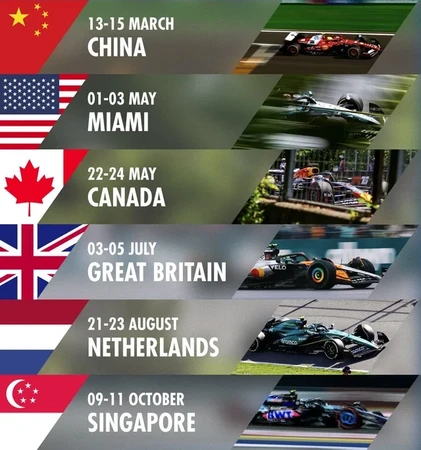
Each Formula One season has 24 race weekends, which means they race at 24 different venues throughout the world. In 2026, these races will be held across 21 different countries, with Spain and the United States being the only countries to host more than one event.
**Note: Since the time of writing, the Bahrain and Saudi Arabian races were cancelled due to the Iran War, thus shortening the season to 22 races in 19 countries.**
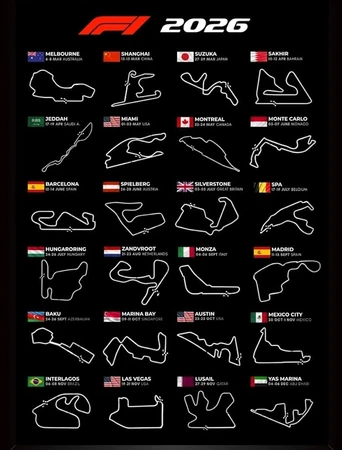
Some circuits on the calendar have been hosting races for years and years and are very famous, like Monza in Italy, Silverstone in the United Kingdom, or Monaco in (you guessed it) Monaco. Others are brand new events invented entirely by the Formula One group, such as the Las Vegas street circuit, or the new Madring track in Spain.
An F1 venue can either be a purpose-built raceway, such as Suzuka in Japan, or it can be a street track, such as the Marina Bay Circuit in Singapore. In 2026, nine of the Grands Prix are held on street circuits and the rest at permanent raceways. But what exactly makes a track a street circuit?
Well, the most obvious part is that a street circuit often uses public roads to form the majority of the track. These will be closed off and lined with walls, tyres, and barriers, but they're still roads. However, this isn't really what defines a 'street circuit'. It's actually based on how permanent they are. For instance, the Miami Grand Prix isn't actually held on a road per se, it's held on internal tracks around the carpark of the Hard Rock Stadium. But since the track basically vanishes for the whole year and is rebuilt at race time, it's a 'street circuit', even though it's not on normal roads that you could drive on at other times.
Some street circuits do include permanent infrastructure. The Jeddah Corniche Circuit, where the Saudi Arabian Grand Prix is held, has a permanent pit lane, garages, and a giant banked corner at Turn 13 that isn't open for people to drive on. But once again, since half the track gets packed away each off-season, it's a temporary track and therefore a street circuit.
Permanent raceways, on the other hand, are exactly what they sound like: race venues that are 100% there all year round. The majority of the F1 season is raced at tracks like these. Just because they're all permanent tracks doesn't mean they're all the same, however- there can be a lot of variety. Just compare the Circuit of the Americas in Texas to somewhere like Spa, home of the Belgian Grand Prix, or the Red Bull Ring in Hungary. That's a big part of what makes each race exciting, driving on a totally different track.
The Teams
As of the 2026 season, there are eleven teams competing in Formula One, known as constructors.
Each of the eleven constructors builds and runs two cars. The team is responsible for designing and developing almost every aspect of the car, from the shape of the bodywork to all the electronics onboard.
One thing that all the teams don't have to produce is their engines, or power units. Some teams produce their own engines in-house, and some buy their engines from other producers. Teams that build their own engine are known as works teams. The current works teams are Mercedes, Ferrari, Audi, and Red Bull. The other teams are known as customer teams, and they largely buy their engines from either Mercedes or Ferrari.
Currently, Aston Martin is the only customer team to use an engine from someone other than Mercedes or Ferrari, as they are using a Honda power unit. Cadillac plans to begin building their own engines from 2029.
| Team | Engine Provider |
|---|---|
| Mercedes | Mercedes |
| McLaren | Mercedes |
| Alpine | Mercedes |
| Williams | Mercedes |
| Ferrari | Ferrari |
| Haas | Ferrari |
| Cadillac | Ferrari |
| Red Bull | Red Bull Powertrains / Ford |
| Racing Bulls | Red Bull Powertrains / Ford |
| Audi | Audi |
| Aston Martin | Honda |
Each of the teams are assigned a cost cap, set at $215 million for 2026, which must cover all team operations for the season. Most of this cost goes toward the car development and making new parts. However, the 'Big Four' teams (that's Mercedes, Ferrari, Red Bull, and McLaren), are often able to far outperform the smaller teams due to their sheer scale and their retention of experienced engineers and staff.
This may not always be the case, though: Aston Martin has been spending an enormous amount of money to buy designers, engineers, and build a state-of-the-art development plant in the UK. It hasn't paid off yet, they're still one of the slower teams, but perhaps soon they could be up to the level of the bigger teams.
**At the time of writing I had no idea just how badly AM would perform this season. They are the slowest team on the grid by a long way and are underperforming considerably. Still though, if they keep up this development they could improve in a few years time.**
The Drivers
Right, now it’s time to talk about the drivers. Each team
has two cars and thus two main drivers for the season, which for the 2026
season makes 22 drivers on the grid. Each team also has a reserve driver in
case one of the main drivers gets injured, as well as a test driver who, as far
as I’ve seen, doesn’t usually do much on a race weekend.
Each team is required to field a junior driver four times across the season, twice in each car. This means that during the First Practice sessions, sometimes either the reserve driver or the test driver will be on track instead of one of the main drivers.
Each driver is allowed to choose a number between 2-99 to
race under. Starting from 2026, drivers also have the option to change their
race number if they want, provided no other driver has raced under it within
the last two years. Max Verstappen used this option to change his race number to '3' for the 2026 season.
The number 1 is reserved for the World Champion and no
other driver may use it, however the World Champion doesn’t have to adopt the
number 1 if they don’t want to. Currently, World Champion Lando Norris races under the number 1, but Lewis Hamilton famously chose to continue using number 44 during his tenure as WC.
| Name | Number |
|---|---|
| Lando Norris | 1 |
| Oscar Piastri | 81 |
| Max Verstappen | 33 |
| Isack Hadjar | 6 |
| George Russell | 63 |
| Kimi Antonelli | 17 |
| Charles Leclerc | 16 |
| Lewis Hamilton | 44 |
| Carlos Sainz | 55 |
| Alex Albon | 23 |
| Liam Lawson | 30 |
| Arvid Lindblad | 41 |
| Sergio Perez | 11 |
| Valterri Bottas | 77 |
| Oliver Bearman | 87 |
| Esteban Ocon | 31 |
| Fernando Alonso | 14 |
| Lance Stroll | 18 |
| Nico Hulkenberg | 27 |
| Gabriel Bortoleto | 5 |
| Pierre Gasly | 10 |
| Franco Colapinto | 43 |
The Cars
Now let's discuss the best part about F1: the cars.
All the cars must be built to comply with a specific set of regulations. This is the ‘formula’ part of Formula One. Every season, some minor adjustments are made to the formula, with major modifications happening roughly every 10-15 years.
The 2026 season is one of those major adjustments, introducing a slew of changes to the regulations, so it’s a pretty exciting time. Let me explain some of the basics about the new car.
This season’s vehicles are smaller and lighter than the previous ones, clocking in at 5.5 metres long, 1.9 metres wide, and weighing a minimum of 770 kilograms. They are run by all-new power units and fuelled by a new sustainable fuel. Though we haven’t seen the new cars run for very long (at the time of writing), their top speeds are thought to be about 400 kilometres per hour, thanks to simulations.
On the front and back wings of the car (you know, the classic spoilers all F1 cars have), there are new moving sections that can be tilted up and down by the driver to change the airflow over them, decreasing drag to speed up on the straights or increasing grip to make a perfect corner.
However, the biggest new feature is the battery management. There are two new driving modes, ‘Boost’ and ‘Overtake’, which provide more energy to the power unit when activated by the drivers. While Overtake mode can only be used when a driver is close enough to the car ahead, Boost can be used at any time during the race. However, since these modes draw extra energy from the battery, drivers must keep a close eye on how much power they are using.
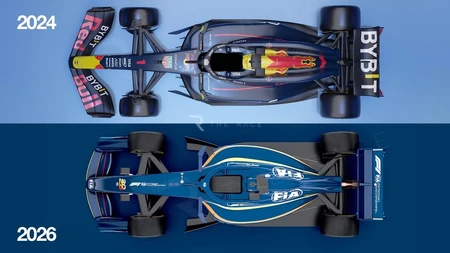
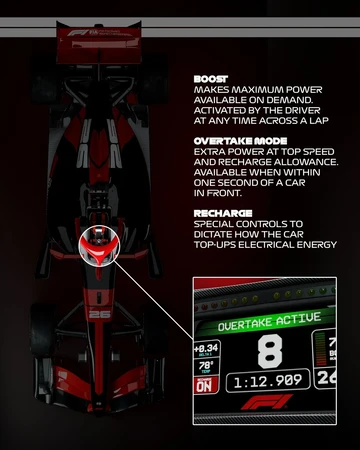
Since I wrote this section, there have been three races (the Australian, Chinese, and Japanese Grands Prix). We've seen these new cars performing, or failing to perform in some cases, and let me tell you: this whole new battery situation is changing things a lot. If a driver manages his battery correctly, he can simply pull out and press his Boost button, then blast away down a straight section and overtake the car ahead without even trying. The term for this is superclipping and a lot of people don't like seeing it in races.
That being said, there are also some good aspects of the new regulations, and even with the current Mercedes dominance (so far), there has still been some very good racing. McLaren struggled to get their cars into the first two races, but once they sorted out their issues in Japan, they showed that they're just as much on the pace as Ferrari, so we can expect some good battles there as well.
Outro
The Miami Grand Prix is this weekend, so go watch it if you can, or better yet, watch the race highlights afterwards. They're much shorter and only show the exciting bits, which saves a lot of time. We might be three races into the season, but there's still plenty of action that can happen, so go make some predictions for the remainder of the 2026 Formula One season in the comments! Or ask me more questions, I'll be happy to answer what I can.
In "The Cars" section, there's no unit for the weight of the cars & there's no period between 770 & they.
(P.S.: I'll start work on the blog)
Just a small correction, I think. In the first paragraph under "Tracks" you've written "wall" presumably you meant "world".
id only miss like sq1, but still
nice blog