
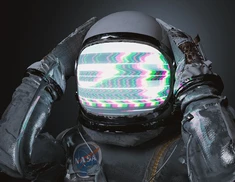
Real Life Glitches - Part 2
Last updated: Friday April 11th, 2025
Report this blog
If you haven’t already read part 1 of this blog, I recommend checking it out first here to get familiar with some of the more common glitches that people have experienced in what might be a simulated reality. In that first post, I went over some strange but relatively well-known phenomena that could be signs the world around us isn’t quite as stable or real as it seems.
In this second part, I’ll be diving even deeper into the weird stuff. These next glitches are a little more bizarre, a little less explainable, and honestly, a little harder to ignore once you’ve heard about them. Whether you believe in the simulation theory or not, some of these experiences are just too strange to completely write off. I hope you enjoy reading!
Doppelgängers
This first glitch is one that has haunted folklore, creeped into urban legends, and even made its way into real historical accounts. It’s the phenomenon of seeing your doppelgänger, a perfect double of yourself, often appearing without explanation and under eerie circumstances. While some claim these sightings are harmless or even amusing, others believe they are a sign of impending doom. One of the most famous cases comes from Abraham Lincoln himself, who reportedly saw a double of his own reflection in a mirror shortly after being elected president. In the vision, Lincoln saw two versions of himself one being pale and ghostlike. His wife took it as an omen that he would not survive his second term. Not long after, he was assassinated proving his wife correct.
Traditionally, doppelgänger stories are brushed off as hallucinations, tricks of the light, or misidentifications. Psychologists suggest these events could be related to stress, fatigue, or neurological issues, especially in cases involving mirrors or reflective surfaces. In folklore, doppelgängers have long been viewed as spiritual or supernatural omens, often tied to death or disaster. But despite the range of explanations, the fact that so many people across time and cultures report eerily similar experiences is hard to completely dismiss.
Now imagine if this world were a simulation. What if doppelgängers are the result of a rendering error—an accidental duplication of a character model, like when a video game glitches and two identical NPCs spawn in the same room? Perhaps in moments when the simulation is under strain or being altered, the system accidentally pulls data from the wrong version of you, resulting in a brief encounter with your own duplicate. These moments may not be meant to happen at all. Maybe the simulation tries to correct them quickly, but not always fast enough.
That would explain why doppelgänger sightings often feel so unnatural, why they linger in your mind long after they’ve passed, and why they sometimes come with a deep sense of unease. If these aren’t hallucinations but visual bugs in the system, then seeing yourself could be a warning not from fate, but from the underlying structure of reality itself. And just like Lincoln, maybe that pale double isn’t a ghost or a vision, maybe it’s a hint that the simulation knows what’s coming, even if you don’t.
Disappearing Object Phenomenon
This next glitch is something that sounds minor at first, but it can be deeply unsettling when it happens to you. It’s the experience of objects vanishing without explanation, only to reappear later in places you already searched multiple times. You might set your keys down on the kitchen counter, check five times and see nothing, only for them to show up in plain view minutes later in the exact same spot. It can happen with wallets, phones, jewelry, or even larger items, things that could not have just slipped through a crack or been overlooked. People often brush it off as forgetfulness, but when it happens more than once, it starts to feel like reality is rewriting itself around you.
The common explanation is simple human error. Our memories are flawed, we get distracted, and we often misplace things without realizing it. Some suggest that stress or tiredness makes us less observant, causing us to miss what is right in front of us. While that may be true in some cases, it does not account for the moments where multiple people search the same area and see nothing, only for the missing item to appear in plain sight later. These are the moments that feel like something else is at play.
If we think of our world as a simulated environment, then disappearing objects might be a result of delayed rendering. In digital systems, things do not always load properly, especially when the focus shifts quickly. Maybe the item was there the whole time, but the simulation failed to display it to your consciousness. Or perhaps the item had to be removed temporarily whether for correction, recalibration, or some purpose we cannot begin to guess. When the conditions are right, it pops back into place, as if it had never left.
What makes this glitch so unsettling is that it plays with your trust in your own perception. It creates a moment where you are forced to question whether reality is stable at all. If simple, everyday objects can vanish and return without explanation, what else around us might not be as solid as it seems? And if someone or something is in control of when and where things appear, we may only be seeing the parts of reality we are meant to see, exactly when we are meant to see them.
Missing Time
This next glitch is one that can leave you feeling deeply disoriented. It is called missing time, and it refers to the strange experience of suddenly realizing that a large chunk of time has passed without any memory of what happened. You might be driving home and what felt like a few minutes later you are already parked in your driveway with no memory of the route. Or you check the clock, blink, and somehow an hour has passed when it should have only been a few minutes. It feels like you were skipped forward in time, like someone pressed fast forward without your permission.
People often explain this away as zoning out, daydreaming, or being in what is called a flow state. The brain can sometimes shift into autopilot during repetitive tasks, and when that happens you may not consciously register what is going on around you. In other cases, stress or fatigue might be to blame. But there are moments where the time lost does not line up with what you were doing, and no matter how hard you try, you cannot recall anything that would explain the gap.
If life is a simulation, then missing time might be more than a mental lapse. It could be a system update, a reset, or a skipped sequence that you were never supposed to notice. Maybe the simulation pauses certain processes or fast-forwards through sections that are deemed unimportant, assuming you will not remember the difference. The problem is that sometimes the seams show. Your body stays on the track, but your awareness falls out of sync.
These moments leave behind an eerie silence, like a scene in a movie that was cut too quickly. It makes you wonder how much of your life is really being lived, and how much is being edited without your knowledge. Missing time might not be about forgetting, it might be about not being present for something you were never supposed to witness in the first place.
Sleep Paralysis
This next glitch is the closest a person can get to a nightmare while still technically awake. It is called sleep paralysis, and it happens when your mind wakes up before your body does. You are aware of your surroundings, you can see your room, hear sounds, and feel the weight of the moment but you cannot move. Even worse, most people report seeing shadowy figures in the room with them, hearing voices, or feeling a heavy presence pressing down on their chest. It often feels more real than a dream, and far more disturbing.
Scientists explain sleep paralysis as a misfire between the brain and body during the sleep cycle. When you sleep, your brain turns off muscle movement to keep you from acting out your dreams. Sleep paralysis occurs when you regain consciousness before your body gets that signal to wake up. The hallucinations are often blamed on lingering dream imagery bleeding into your waking awareness. In this view, it is just a sleep glitch in your biology not something to take seriously beyond its frightening effects.
But what if this experience is not just a glitch in your body, but in reality itself? If the world is a simulation, sleep paralysis could be the moment your consciousness becomes aware of something it was never meant to see. Maybe those shadowy figures are not hallucinations at all. Maybe they are entities involved in the background of the simulation, visible only during a moment when your awareness breaks free from the normal rules. Your body is frozen, not because it is still asleep, but because the simulation does not want you moving while it recalibrates.
The fear that people feel during sleep paralysis is not just because they cannot move. It is because something feels wrong on a deeper level, like reality is cracked open just enough to reveal something we are not supposed to understand. And if that is the case, then sleep paralysis might not be a nightmare at all, it might be a rare moment of waking up during an update.
Spontaneous Human Combustion
This last glitch is one of the most mysterious and disturbing on the list. It is called spontaneous human combustion, and it refers to the rare and unexplained phenomenon where a person appears to burst into flames without any clear external source of ignition. In many of these cases, the fire damages very little of the surrounding area, and the body is reduced to ash in a way that even modern cremation equipment would struggle to achieve. There are sometimes signs of slow burning and melted furniture nearby, but often no clue as to how the fire started or why it burned so selectively.
Traditional explanations range from undetected sources of flame like cigarettes to chemical reactions involving body fat and clothing. Some researchers suggest that under very rare conditions, a body could sustain a slow burn that consumes it over time. Still, the details do not fully add up. Fires hot enough to reduce a body to ash usually damage everything around them, and yet in many of these cases the surroundings remain intact. That makes this phenomenon feel less like science and more like a mystery no one has solved.
If reality is a simulation, then spontaneous human combustion might be what happens when something goes seriously wrong in the system. It could be an error in rendering, a corrupted file, or even an intentional removal of a character. The fire might not be a physical flame at all but the visual representation of a process meant to erase a person from the simulation. If the code that holds their physical form glitches or is deleted, the result could look like combustion from our limited point of view.
What makes this glitch especially chilling is that it feels final. There is no warning, no explanation, and no control. It is a reminder that even the laws of nature can suddenly and violently break down. If the simulation can simply erase someone like this, what else could it be hiding? And how would we know if it ever decided to do the same to us?
Thanks for reading part two of this blog. Whether these glitches are strange coincidences or signs of something deeper, they’re worth paying attention to. The more we look at the edges of our reality, the more cracks start to show. I appreciate you taking the time to explore these ideas with me. Keep an eye out because if you’re paying attention you may just be able to find a glitch or two yourself.
Anyway, thank you very much!