State Overview - Florida
First published: Friday May 15th, 2026
Report this blog
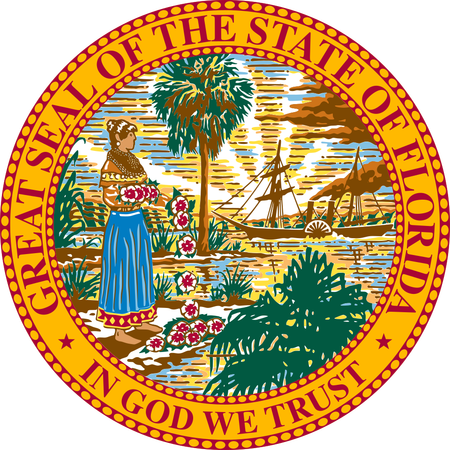
Overview
Basic Overview
Florida was admitted to the Union on March 3, 1845, becoming the 27th state.
Florida ranks 22nd in size with an area of 65,758 sq miles.
Florida has a median household income of $77,700 ranking 30th.
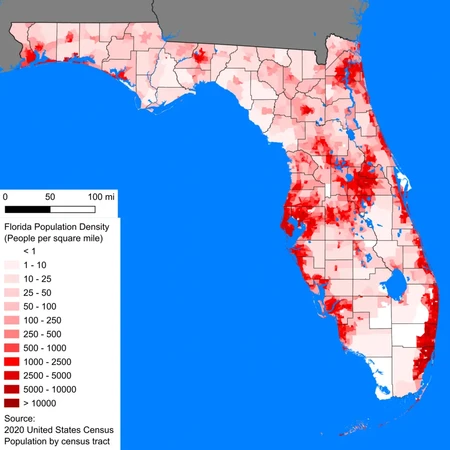
Florida has a population of 23,462,518, ranking 3rd for population.
Demonym of Florida people is Floridian or Floridan.
Government Overview
Florida's government is more Republican than Democratic. Florida voted red in the last 3 presidential elections, last voting a Democrat in 2012. Florida is a Likely Republican state in the presidential elections and was last called a swing state in 2016.
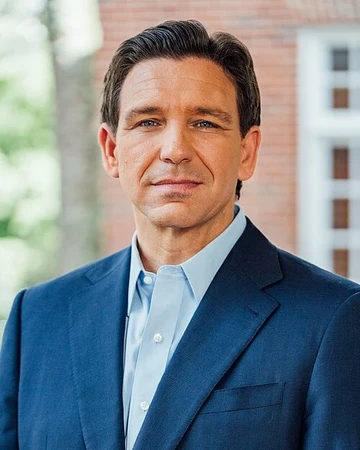
Governor - Ron DeSantis (R)
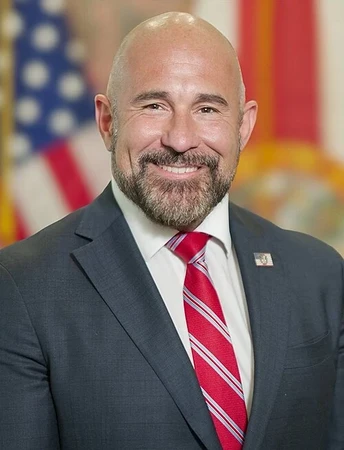
Lieutenant Governor - Jay Collins (R)
-----------------------------------------------------------
Senators: Rick Scott (R), Ashley Moody (R)
House Delegation: 20 Republicans and 8 Democrats
Subdivision Overview
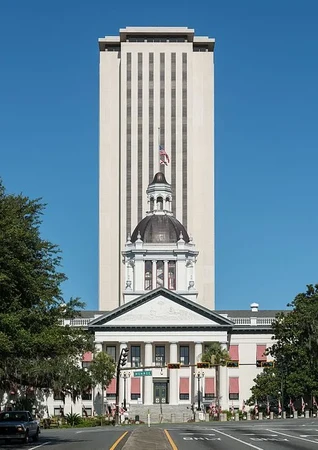
Florida is divided into 67 counties with the most populous county being Miami-Dade (~2.7 million). Florida's most populous city is Jacksonville. Tallahassee is Florida's capital.
Florida had 2 capitals before Tallahassee. St. Augustine and Pensacola were both capitals of Florida at the same time from 1763 to 1821.
History
Europe Arrives
In 1513, Spaniard Conquistador Juan Ponce de León was the first European to arrive in the Florida Peninsula. He named the region La Florida for its abundance of flora and Pascua Florida, the Spanish term for the Easter season. Juan Ponce de Leon was also famously looking for the Fountain of Youth, which he never found. 26 years later in 1539, Hernando de Soto sailed along the coast of Florida searching for a deep harbor for his ship to land. He described the Florida coastline as a thick wall of red mangroves.
During the 1520s, an estimated 700,000 Native Americans lived in Florida, however, by 1700, due to disease and violence, only 2,000 Native Americans were in Florida. In 1559, the Spanish founded a settlement in present-day Pensacola, but by 1561 it was completely abandoned. Another settlement was founded not by the Spanish, but by the French. This French settlement was named Fort Caroline and was in Duval County. Fort Caroline was destroyed by the Spanish shortly after.
In 1565, a successful settlement was founded in Florida by the Spanish. St. Augustine is recognized as the oldest city (Founded by Europeans) in the continental United States. This began the Spanish conquest of Florida. King Charles II of Spain issued a decree freeing all slaves who escaped to Florida and by 1683, St. Augustine had an all-black militia unit defending Florida.
After the French and Indian War (7 Years War), Spain traded Florida to Britain in exchange for Havana, Cuba. Spain also gained Louisiana from France as compensation. Florida did not join the colonies during the American Revolution and stayed loyal to the British. Spain regained Florida after Britain lost the American Revolution.
US Involvement
After the American Revolution, Americans, primarily of English and Scots Irish descent, began moving to northern Florida. This action by the Americans was technically not allowed by the US Government, however, the US Government lacked the power to guard and police the border. These people began mixing with the already existing British population. These people were called Florida Crackers.
The American settlers gained a strong foothold in Florida and resented Spanish rule. The British, who also had a major presence in Florida, had also resented the Spanish leading to a revolt in 1810. They established the Republic of West Florida in modern-day Louisiana. US President James Madison annexed parts of West Florida, proclaiming it was part of the Louisiana Purchase. Spain continued to dispute the area with the United States and several coups were operated in the area for years.
Native Americans & Statehood
Traditionally, historians argued that the Seminole Indians, based in East Florida, began raiding Georgia settlements and offering safe havens for runaway slaves. The United States Army then began campaigning in Florida against the Seminoles. This included the most famous example, the First Seminole War, during which Andrew Jackson led the US Army. However recent historians now describe that after the US gained independence, Georgia settlers increased pressure on Seminole Lands, and skirmishes led to the First Seminole War.
In 1819, the United States purchased Florida from Spain as part of the Adams-Onis Treaty. The territories of East and (part of) West Florida were merged to create the Florida Territory in 1822. In 1830, Andrew Jackson signed the Indian Removal Act which forced the Seminoles to move to the Indian Territory (Oklahoma).
On the second to last day of John Tyler's presidency on March 3, 1845, Florida was admitted to the Union, becoming the 27th state. Florida was admitted as a slave state and was no longer a safe haven for runaway slaves.
Civil War & Reconstruction
After Florida was admitted as a slave state, settlers established large cotton plantations in North Florida. In 1860, Florida's population was 140,424, 44% of the population was enslaved. In 1861, nearly delegates in the Florida Legislature approved secession. Florida declared themselves to be a "Free and Independent nation" and then joined the Confederacy. Florida contributed little to the Confederate Army, only mustering 15,000 troops. But what it lacked in troops and manufacturing, Florida made up in providing salt and beef to the Confederate troops.
Florida's largest battles during the Civil War were the Battle of Olustee and the Battle of Natural Bridge, which were both Confederate wins, however these battles did not help the Confederacy as they happened too late in the war. Following the Civil War, Florida's congressional representation was forcibly restored in 1868. In 1876, after Reconstruction ended, white Democrats regained control of Florida and established a new constitution which disfranchised most blacks and many poor whites.
20th & 21st Centuries
During the Roaring 20's, Florida experienced economic prosperity which stimulated tourism. In 1925, the Seaboard Air Line broke the FEC's southeast Florida monopoly on trains and railroads. In 1926 and 1928, devastating hurricanes tore through Florida, which was followed by the Great Depression in 1929. Florida did not recover from these events until World War II when the United States began producing mass amounts of military equipment for the war effort.
Before the 20th century, Florida was the least populated state in the South. Their population was roughly 528,000 people, and after the Great Migration, around a fifth of Florida's population left the state. Disfranchisement of African Americans persisted until the Civil Rights Movement gained Federal Legislation in 1965 to force protection of their constitutional suffrage and rights. Many protests occurred in Florida against Racial Segregation in the 60s.
Florida became a refuge for Cubans after Fidel Castro took control of Cuba and created a brutal communist regime. These refugees arrived at Freedom Tower which gave the tower the name the "Ellis Island of the South"
As of the 2020 census, Florida has a population of around 21 million making Florida the 3rd most populated state in the United States. Florida continues to attract people from other US States and people looking into retirement. In 2017, Hurricane Maria devastated Puerto Rico. After the hurricane passed, hundreds of thousands of Puerto Ricans moved to Florida to rebuild their lives.
Fun Facts
- Air Conditioning was invented in Florida
- Gatorade was invented in Florida
- Florida is the only place where alligators and crocodiles live together
- Florida hosts the John F. Kennedy Space Center which has launched the Apollo spacecrafts
- Florida is struck with around 1.2 million lighting bolts every year
- The "Mullet Toss" is a festival where Floridians throw dead fish into Alabama
Pictures of Florida