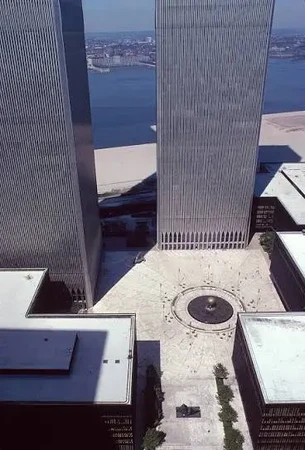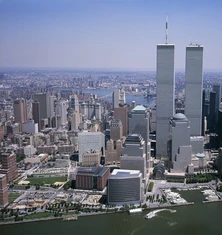
Original World Trade Center During Construction
First published: Wednesday April 22nd, 2026
Report this blog
Before Construction
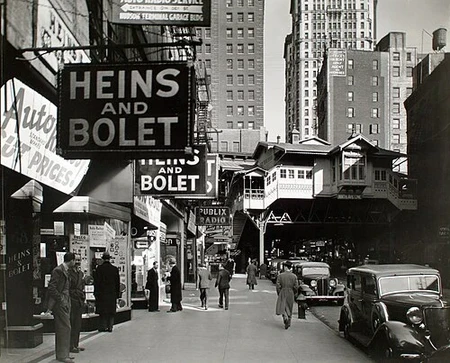
When the World Trade Center was being designed, there was a district where the World Trade Center would be. Radio Row. It was full of electric shops. Located where the World Trade Center was later built. It existed primarily from the 1920s to 1966, covering about 13 blocks, with its hub around Cortlandt, Dey, and Fulton Streets near the Hudson River. The area was demolished in 1966 for the construction of the World Trade Center.
Fast Facts
Construction began on August 5, 1966.
They were designed by Minoru Yamasaki.
In 1974, Philippe Petit tightrope-walked between the towers; in 1977, George Willig climbed the exterior. Daredevils!
There was a mall underneath the World Trade Center.
Construction and Completion
As I said, Radio Row was demolished before the construction. Construction was from 1966-1973. Since I'm generous, I'll do 1966, but then skip to 1970.
On August 3, just before the groundbreaking, a critical agreement was reached between the Port Authority and New York City regarding "Payments in Lieu of Taxes" (PILOT), allowing construction to proceed without further legal delays from the city government. Workers began the complex task of protecting and relocating essential utilities, including phone cables and the existing Hudson Tubes (now PATH) subway tunnels, which remained operational even as the surrounding earth was removed. Site preparation and below-grade excavation commenced immediately following groundbreaking to reach the bedrock 65–70 feet below street level. The first concrete for the foundation was poured in September 1966. In November 1966, work officially began on the perimeter slurry wall. This 3,500-foot-long reinforced concrete wall was designed to keep the Hudson River out of the excavation site.
On March 16, 1970, a truck struck a propane tank at the site, causing an explosion that injured six workers. On October 19, 1970, the North Tower officially overtook the Empire State Building as the world's tallest building. This occurred when workers installed a 38-foot-tall wall section on the 100th floor, reaching a height of 1,254 feet. Even as the top floors were being completed, the first tenants moved into the North Tower on December 15, 1970. The final piece of steel was hoisted into place on December 23, 1970, during a traditional topping-out ceremony. At this point, the tower stood at its full roof height of 1,368 feet.
In 1971, the World Trade Center complex saw the South Tower reach its full height and the opening of critical transportation infrastructure.
On July 19, 1971, the South Tower (2 WTC) held its topping-out ceremony as the final piece of structural steel was hoisted into place. It reached a roof height of 1,362 feet, exactly six feet shorter than its northern twin.
With both towers topped out, they briefly shared the title of the tallest buildings in the world before being surpassed by Chicago's Sears Tower in 1973.
In September 1971, the first tenant moved into the South Tower. By late 1971, the entire complex already housed 111 tenants with approximately 1,800 employees.
The new World Trade Center PATH station opened in 1971. This allowed the original Hudson Terminal (located beneath the site) to be decommissioned so that final excavation and construction could proceed in that area.
By this year, the towers were essentially finished on the outside, with work shifting heavily toward interior finishing and mechanical systems. Thousands of workers remained on-site daily to install elevators, electrical systems, and plumbing for the 110 floors of each building.
In 1972, the World Trade Center transitioned from a construction site to a functioning commercial hub as the North Tower reached completion and the South Tower welcomed its first occupants.
While the final steel had been placed in 1970, the North Tower was officially considered completed in 1972 as interior finishing and mechanical systems were finalized.
The first tenants moved into the South Tower in January 1972.
The Northeast Plaza Building (5 World Trade Center), a nine-story low-rise office building, officially opened in March 1972.
Construction on the Southeast Plaza Building (4 World Trade Center) began in mid-1972 following the demolition of the remaining old Hudson Terminal south building.
The final 22-story building of the former Hudson Terminal was demolished in 1972 to clear space for the completion of the complex's plaza buildings.
By the end of 1972, the Twin Towers dominated the Manhattan skyline and were nearing their formal dedication, which occurred the following April. Most of the primary office space was occupied or undergoing final "fit and finish" for a growing list of global tenants.
In 1973, the World Trade Center officially transitioned from a massive construction project into a global landmark and a fully operational commercial hub.
The complex was officially dedicated on April 4, 1973. The ceremony was attended by the governors of New York (Nelson Rockefeller) and New Jersey (William T. Cahill), though the mayor of New York City was notably absent.
The 5-acre public square, later named the Austin J. Tobin Plaza, was inaugurated on the same day as the Twin Towers.
At the time of their dedication, the Twin Towers were the tallest buildings in the world—the North Tower at 1,368 feet and the South Tower at 1,362 feet. They held this title until the Sears Tower in Chicago surpassed them later that same year.
While tenants had been moving in since early 1972, 2 World Trade Center reached official completion status in 1973.
The U.S. Customs House (6 World Trade Center), an eight-story building on the northwest corner of the site, was completed in 1973.
By the end of 1971, there were already 111 tenants; by 1973, the complex was a "vertical city" housing approximately 50,000 workers and welcoming 80,000 visitors daily.
Upon completion of the Twin Towers in 1973, the total construction cost to the Port Authority was approximately $900 million.
Despite the grand opening, the towers remained controversial. Critics like Ada Louise Huxtable called them "banality grown huge," while supporters saw them as a "monument to modernity".
Almost immediately after opening, the towers began appearing in media and postcards, quickly becoming the most recognizable feature of the Manhattan skyline.