
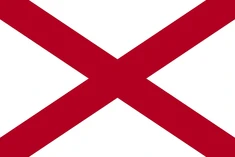
A Random Fun Fact About Alabama's Counties A-F
Last updated: Sunday April 26th, 2026
Report this blog
WHERE HAVE I BEEN?
Hello everybody! It's been a while since I made my last blog (last one was July 9 last year 😭). Unfortunately, this one is not a Counties Overview (I know that some of you were highly anticipating this only to be disappointed). I've been really procrastinating a lot and school just doesn't really make this any better.
This project was something I've been working on last year but I got bored (very early on). Then, after digging through my old files, I found this so I just thought, eh, let's make a blog out of it. And after 100%-ing the All 3,143 Counties of the United States Quiz, that was my cue and motivation to make this blog.
So without further ado, let's go!
COUNTIES COVERED IN THIS BLOG
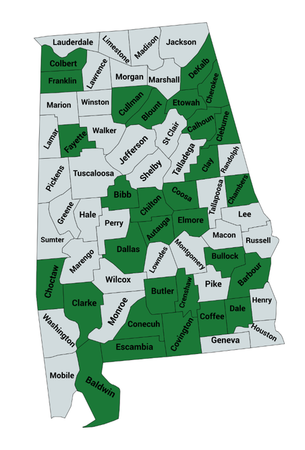
Fun Facts About Alabama's Counties
AUTAUGA - The meaning of "Autuaga" is somewhat debated, but the most accepted meaning is pure water or clear water, coming from Atagi, an Alibamu village located on Autauga Creek.
BALDWIN - From 2010 to 2020, it was Alabama's fastest growing county, with a population growth of 27.2% throughout that timespan.
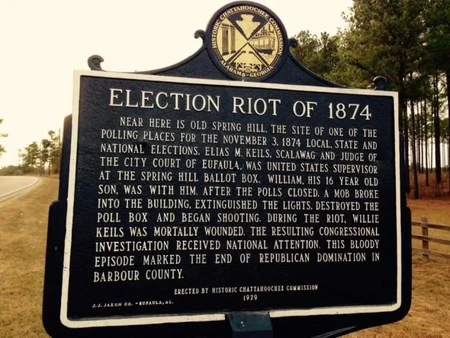
BARBOUR - On Nov. 3, 1874, African Americans were electing Republican candidates to office, but members of a paramilitary group supporting the Democratic Party called the White League weren't too happy about this. So, the White League used firearms to attack these African Americans at the polls. An estimated 15-40 African Americans died and 70 others were wounded in what is known as the Election Massacre of 1874 (aka Election Riot of 1874 or Coup of 1874). Following this event, many Democrats silenced witnesses by auctioning them off for up to $2 dollars a month to not say anything. When the events were brought to court, the rioters were not blamed by the grand jury, but rather the "militant" Black Republicans were blamed for the tense atmosphere.
BIBB - Bibb County is one of the few counties in Alabama whose name was changed. From its establishment in 1818 to December 1820, it was known as Cahawba County, coming from the Cahaba River, which comes from a Choctaw word meaning water above.
BLOUNT - It is known as the Covered Bridge Capital of Alabama, as it has the most covered bridges still standing in the state with a grand total of... three.
BULLOCK - According to data from the PIAAC (Program for the International Assessment of Adult Competencies) from 2013-2017, 45% of the population scored below Level 1 literacy (which is about the skill of a 5-7 year old).
BUTLER - In the 1800s, the county had mineral springs where locals believed the water had therapeutic values. Locals believed the water could cure fatigue, digestive issues, and "nervous problems." The springs however fell into obscurity as modern medicine was developed.
CALHOUN - Originally was named Benton County after Thomas H. Benton, an enslaver and political ally of John C. Calhoun, a vehement defender of slavery. By the mid 19th century, Benton's views had changed and Benton realized that slavery was wrong. On January 29, 1858, pro-slavery Alabamians objected Benton's change of heart and renamed the county after Calhoun instead.
CHAMBERS - Pat Garrett, famous for killing the outlaw Billy the Kid, was born in Chambers County on June 5, 1850.
CHEROKEE - You can find the remains of what used to be Turkey Town, named after Little Turkey, a Cherokee chief. Much of the original site remains underwater due to the damming of the Coosa River.
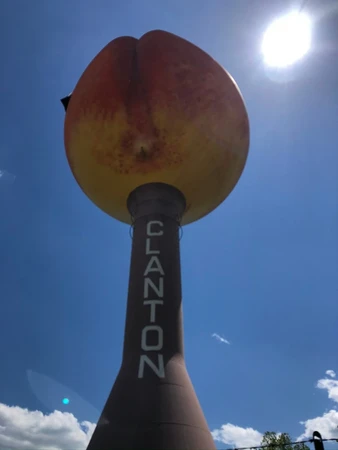
CHILTON - It's well-known for its peaches, growing 80% of Alabama's peaches. It even hosts an annual Peach Festival where a "Peach Queen" is crowned. Also, in Clanton, Chilton's county seat, you can find a massive water power shaped like a peach.
CLARKE - In 1881, a black man named Tony Pace and a white woman named Mary Cox were arrested near Clarke County for violating Alabama's anti-miscegenation (basically no interracial) laws. The case Pace v. Alabama ruled that such laws were constitutional, and this ruling would stay for a while until 80 years later when the Supreme Court rejected the ruling.
CLAY - It was the last completely dry (meaning it prohibited the sale of alcohol) county in the state. On March 1, 2016, a vote permitted the sale of alcohol in the cities of Ashland and Lineville.
CLEBURNE - Cheaha Mountain, Alabama's highest peak, is located in Cleburne County. Cheaha Mountain stands at 2,317 ft (706 m) above sea level.
COFFEE - In the city of Enterprise, you can find the Boll Weevil Monument, erected in 1919 to show appreciation to the boll weevil. Why? It forced farmers to switch from growing cotton to peanuts, which then taught the farmers to diversify their crops, making the county richer.
COLBERT - Famous blind and deaf author Helen Keller was born in Tuscumbia, Colbert County.
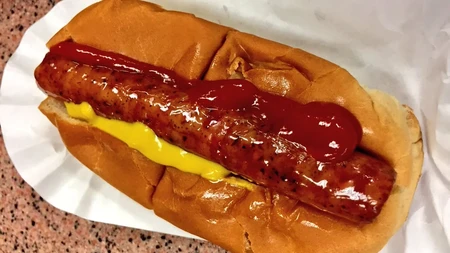
CONECUH - The birthplace of the Conecuh sausage, a brand of hickory smoked pork sausage. The sausage became a local staple and the company that makes it produces 35,000-40,000 pounds of it a week.
COOSA - In Rockford, Coosa's county seat, you can find the old Coosa County Jail (which is now a museum). It's the oldest surviving jail made of stone in the state.
COVINGTON - Named after Leonard Covington, a brigadier general who died in the War of 1812. In 1868, it was renamed "Jones County" to honor Josiah Jones, an attorney. However, Josiah Jones himself was not happy about this change and wanted the name to be changed back. Thus, the name "Jones County" only lasted for two months.
CRENSHAW - Luverne, the county seat of Crenshaw County, calls itself the "Friendliest City in the South", a slogan you can find in the city's welcome signs. So, if you need a friend, come on down to Luverne.
CULLMAN - Quite the story here. It was organized primarily by German-American immigrants who sought to revolutionize agricultural practices in the South. The main founder was a guy named Johann Gottfried Cullmann, who, in the midst of bringing settlers to Cullman, the would-be-county-seat of Cullman County, was stabbed in the head by an angry local (the local wasn't happy about the new settlers coming in). Somehow, Cullmann survived the attack but it did leave a lifelong scar in his head. Because of the German settlers, Cullman County hosts some of the largest Oktoberfest celebrations in Alabama.
DALE - Home to Fort Rucker, the primary home of U.S. Army Aviation, and it also houses one of the largest military helicopter collections in the world, with over 160 of them.
DALLAS - The county produced so much cotton (more than ANY OTHER county in the state) by the 1860s that there needed to be a lot of workers, especially enslaved ones. In fact, Dallas county slaveowners on average had seventeen enslaved workers (much higher than Alabama's average of 10-13). 16% of Dallas County's white population owned slaves at that time.
DEKALB - The county seat of the county, Fort Payne, had an epic nickname. Can you guess what it was? It's... the "Official Sock Capital of the World." During the 20th century, the W.B. Davis Hosiery Mills began operations processing cotton to produce socks and legwear. By the beginning of the 21st century, the hosiery company in Fort Payne had produced more than half of the socks made in the U.S.. However, by the early 2000s, a massive and efficient center for sock production was made in Datang, China, where raw materials and hosiery machines were also being made. Another advantage that the Datang manufacturer had was that it was close to a local supplier, so the wait time for a replacement was much less than in Fort Payne. As American retailers began to source their products from China, Fort Payne was revoked of their title as "Sock Capital of the World" and it was given to Datang instead. Fort Payne just couldn't keep up with Datang's speed and effiency, and soon the company slowly collapsed. Now, Fort Payne is home to a Hosiery Museum, celebrating the legacy of their massive industry that is now gone.
ELMORE - Wetumpka, the county seat, is the home of "Alabama's greatest natural disaster." About 80 million years ago, a meteorite hit the area and left a 5 mile (8 km) wide impact crater. Scientists estimate that the energy released by the impact was over 175,000x the energy of the bomb that dropped on Hiroshima.
ESCAMBIA - Esther Blake, the first woman in the United States Air Force, was born in Escambia County.
ETOWAH - It is the smallest county in Alabama, but because of its somewhat large population (~103,000 residents), it ranks 8th in population density of all the Alabamian counties. So that's something for Etowah.
FAYETTE - Golden Eagle Syrup, a syrup brand, was founded in 1928 by Victor and Lucy Patterson in Fayette, Alabama.
FRANKLIN - The town of Phil Campbell is home to Dismals Canyon, one of the only places in the world where you could find a "dismalite," a bioluminescent larva that emits a blue-green light.
EPILOGUE
Well, that was Part 1 of that. I don't plan to make a full series on this with EVERY state, but I may do something like this for fun from time to time. So, I hope you enjoyed this blog. County Overviews #11 will be coming out somewhere around this month (maybe), and I'll try to commit to completing it. But that's all I have for now. Goodbye everyone and have an awesome day!
Edit: Errors to the map have been fixed.
Unfortunate for the blog to contain A-FAwesome blog! Very interesting to learn about Alabama counties A-F