

Space Science #1
Blog by
Last updated: Monday October 14th, 2024
Report this blog
Last updated: Monday October 14th, 2024
Report this blog
+7
The food of space...
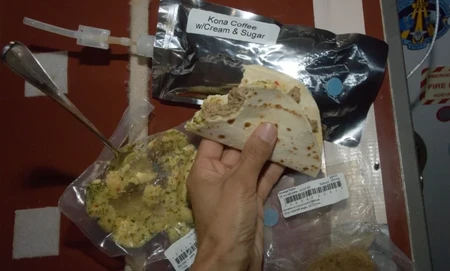
Astronaut eating a Tortilla sandwich with pouched coffee.
The yummy crunchy sandwiches, croissants, baguettes, bagels, schnitzels, donuts—all these food items are among the most eatable and lovable food items on earth. But that's not the case when it came to space; the International Space Station (ISS) has a very different and specified menu for the astronauts.
Every extra gram costs hundreds of dollars in transporting these food rations to ISS. Firstly, they are dehydrated, which makes the food items light weight and increases their shelf life. Then the foods are packed in airtight pouches in a contamination-free environment, and at last they are delivered with the help of special space capsules.
Many alternatives have been adopted in space foods to cope with conditions onboard the ISS, such as: tortillas are used instead of breads as they don't make crumbs, which eventually float across the station and can cause problems; freeze-dried ice creams are consumed instead of conventional ice cream as they don't require refrigeration, etc. Whereas fresh fruits are also delivered regularly to provide mental support to the crew. As per the regulations, they must be eaten within three days of delivery.
All five space agencies (ESA, NASA, Roscosmos, CSA, and JAXA), which handles the ISS, cater different meals to their astronauts. The crew can also handpick their food choices prior to the missions. From early explorations till now, the space food technology has evolved exponentially. NASA has also developed a dedicated wing for space food, whose purpose is to manufacture, develop, and research about these foods. The European Space Agency (ESA) has also deployed a specially designed espresso machine at the ISS named 'ISSpresso', which provides hot coffee, tea, and water to the astronauts.
There are several classifications in space foods, such as beverages (B), fresh food (FF), thermostabilized (T), rehydratable (R), and irradiated (I). All these foods have to meet strict guidelines for consumption, even though many worldwide foods are included in the menu, but there are also some banned foods in space, like any type of crispy pizza, fresh milk, cookies, soft drinks, seasonings, etc. due to their respective complications.
Every extra gram costs hundreds of dollars in transporting these food rations to ISS. Firstly, they are dehydrated, which makes the food items light weight and increases their shelf life. Then the foods are packed in airtight pouches in a contamination-free environment, and at last they are delivered with the help of special space capsules.
Many alternatives have been adopted in space foods to cope with conditions onboard the ISS, such as: tortillas are used instead of breads as they don't make crumbs, which eventually float across the station and can cause problems; freeze-dried ice creams are consumed instead of conventional ice cream as they don't require refrigeration, etc. Whereas fresh fruits are also delivered regularly to provide mental support to the crew. As per the regulations, they must be eaten within three days of delivery.
All five space agencies (ESA, NASA, Roscosmos, CSA, and JAXA), which handles the ISS, cater different meals to their astronauts. The crew can also handpick their food choices prior to the missions. From early explorations till now, the space food technology has evolved exponentially. NASA has also developed a dedicated wing for space food, whose purpose is to manufacture, develop, and research about these foods. The European Space Agency (ESA) has also deployed a specially designed espresso machine at the ISS named 'ISSpresso', which provides hot coffee, tea, and water to the astronauts.
There are several classifications in space foods, such as beverages (B), fresh food (FF), thermostabilized (T), rehydratable (R), and irradiated (I). All these foods have to meet strict guidelines for consumption, even though many worldwide foods are included in the menu, but there are also some banned foods in space, like any type of crispy pizza, fresh milk, cookies, soft drinks, seasonings, etc. due to their respective complications.
NASA spends almost 22.6 million dollars on space foods every year; approx. $15,000 dollars are spent on delivering just one kilogram of food to space. Every year, the food is delivered six to ten times over a span of 40 to 60 days. The agency also sells derivatives of these space foods for common people through gift shops and Army Surplus stores.
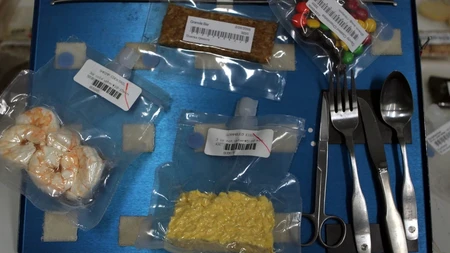
A typical breakfast menu at space.
I hope you like the blog.
Thank You,
SPVK
Also you have to excersize 2 hours a day
The average answer for "How much of the USA's annual budget is spent on NASA?" is ~25%.
The average answer for "How much of the USA's annual budget should go to NASA?" is ~5%.
The true percent of the USA's budget allocated to NASA is 0.5% -- 10x lower than average Americans think ought to be spent on NASA activities, and 50x lower than people seem to think NASA gets. NASA has a huge public perception problem: people think they're funded at insane levels, and in reality barely receive anything, budget-wise, compared to the regular expenditures of the US federal government. This funny little mix-up about how much NASA spends on astronaut food is an excellent example of the kinds of numbers people are willing to believe, extremely falsely, about the budget.