

The Vehicle which revolutionized Space travel
First published: Saturday August 17th, 2024
Report this blog
The Space Shuttle
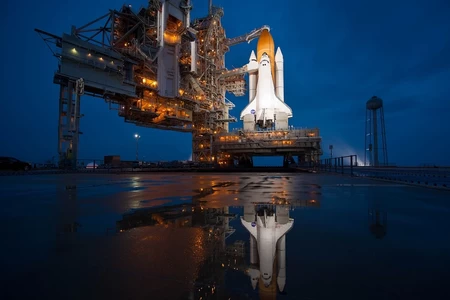
The Space Shuttle was an exceptional achievement for mankind that revolutionized space travel. It was a spacecraft designed to transport astronauts, equipment, and parts of the International Space Station. It was designed and operated by the American space agency National Aeronautics and Space Administration (NASA). The Space Shuttle was one of two spacecraft to carry astronauts into space and take them back; the other was the Russian Soyuz spacecraft.
The Space Shuttle retired in July 2011 after thirty years of service; during its service time, it carried 355 astronauts and completed 133 missions.
To be clear, the term "space shuttle" refers to the entire structure, which consisted of two solid rocket boosters, a massive orange external fuel tank for the main engines, and a space shuttle orbiter that carried crew.
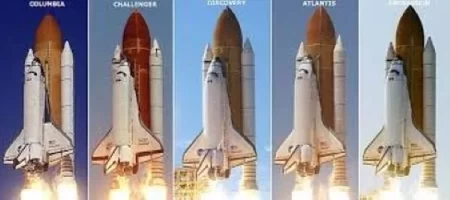
A year after the first manned moon landing, in 1969, work on the shuttle's architecture began. The construction of the space shuttle started in 1974, and the first test orbiter, the "Enterprise," which was used for training and test flights, rolled out in 1977. The Columbia, the first fully operational orbiter, was finished in 1979 and delivered to the Kennedy Space Center (KSC). Four more shuttle orbiters were delivered over the course of the next twelve years: Discovery, Atlantis, Endeavour, and Challenger.
All of the shuttle missions were launched from launch pads 39A and 39B at KSC, Florida. During the launch many things happen simultaneously. Before ten seconds to takeoff there was a hydrogen buroff test to ensure that no hydrogen is leaking, Now the two solid rocket boosters (SRBs) power up, and after two minutes they detach from the main body. After detachment, they splash down into the ocean, where they are recovered for future missions. At this time, the shuttle uses the fuel from the large external tank continuously for eight minutes; after this, the external tank also detaches and burns up in the atmosphere due to high resistance. Now the shuttle orbiter is controlled by the two OMS motors (each with separate fuel tanks) to give it the last push into the orbit. When the mission is completed the orbiter re-enters into the earth's atmosphere with tremendous amount of heat generated due to resistance, to avoid any burn-up the orbiter's base is shielded by numerous silica tiles, when the shuttle is near the runway the landing gears are opened and the mission is finished successfully.
During the span of thirty years 135 missions were flown, but two of them (Challenger and Columbia) suffered accident resulting in death of all crew members.
Currently, the only spacecraft capable of transporting astronauts to and from space is the Russian Soyuz. In addition, the new space giant SpaceX is developing its Crew Dragon spacecraft to reduce NASA's reliance on Roscosmos for astronaut transportation.
Last but not the least, the Space Shuttle is considered one of most complicated vehicle with over 2.5 million moving parts.
Thank You,
SPVK
I Hope you like the blog. This time I tried to experiment with new topic, please let me know in the comments about the blog. If you like my work please support by subscribing and commenting about topics and more.
I don't know what webpage you got your information from, but it needs to be updated. SpaceX's Crew Dragon was first flown with astronauts on board four years ago in 2020, NASA astronauts haven't flown on Soyuz since then. The Polaris Dawn mission will be launching on the Dragon on August 26th, with the Crew-9 Dragon launch slated for September 24th.
Aside from that you're pretty accurate, and this blog was a good overview of the Shuttle use and history.