
Siskiyou Chronicles I
First published: Tuesday August 12th, 2025
Report this blog
The State of Jefferson Secessionist Movement
What is the State of Jefferson
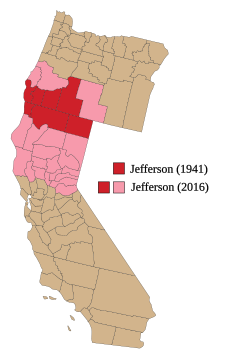
The State of Jefferson was a proposed 49th state that would include far northern California counties and Southern Oregon Counties. Specifically the California counties of Del Norte, Siskiyou, Modoc, and the Oregon counties of Curry, Josephine, Jackson, and Klamath.
Initial movements
Motivation behind the movement
Many people in the region believed that their counties were underrepresented in their respective state governments. Another big complaints was roads. In 1941, the towns were linked by bad roads, rough dirt roads, or in several cases, no roads at all. Several of these roads were impassable in the winter months. Another major complaint was the fact that these counties were rich in resources such as gold, copper, timber, cattle, and agriculture. Many locals believed the profits flowed north or south to the state capitals and were never reinvested back into the region. Locals also felt that the laws being made in their respective states were laws and budgets being written for San Francisco, Los Angeles, and Portland, not for the rural towns of Jefferson. These towns were also quite far away from their capitals, Yreka (Siskiyou County's Seat) would be a day's drive over long and winding roads from Sacramento. The towns of the region were more connected across state lines then they were to their capitals.
The State of Jefferson Movement
In October, 1941, the largest and most well-known movement was started by the mayor of Port Orford, Oregon, Gilbert Gable. On the night of December 2, 1941, Gilbert Gable and San Francisco Chronicle travel columnist Stanton Delaplane sat down for a session of drinking and brainstorming a publicity push for the Jefferson Movement. It worked and publicity for the movement shot up overnight, however Gilbert Gable died of a heart attack the next day. Whether his death was a result of the heavy drinking the prior night is still up to debate. Gable's supporters appointed local judge John Childs as governor on December 4. That Thursday, supporters staged a highway blockade on U.S. Route 99 (now I-5). On Thursday, December 27, these supporters armed with hunting rifles (mostly for show) stopped cars and handed out "Proclamation of Independence" leaflets which stated:
You are now entering Jefferson, the 49th State of the Union.
Jefferson is now in patriotic rebellion against the states of California and Oregon.
This State has seceded from California and Oregon this Thursday, November 27, 1941. Patriotic Jeffersonians intend to secede each Thursday until further notice.
For the next hundred miles as you drive along Highway 99, you are traveling parallel to the greatest copper belt in the far West, seventy-five miles west of here.
The United States government needs this vital mineral. But gross neglect by California and Oregon deprives us of necessary roads to bring out the copper ore.
If you don't believe this, drive down the Klamath River highway and see for yourself. Take your chains, shovel and dynamite.
Until California and Oregon build a road into the copper country, Jefferson, as a defense-minded State, will be forced to rebel each Thursday and act as a separate State.
December 7, 1941, the day that will live in infamy.
On December 7, 1941, the Japanese bombed Pearl Harbor which drew attention away from the Jefferson Movement as America needed unity. The movement had faded away into history. However, the ideals of the movement still very much resonate with locals, and the motivations that drove the original movement are still very much a problem in the region. The roads are better now, but still not great, laws are still being made with the big cities in mind, and the towns and cities of Siskiyou county still have much more in common with the towns and cities just across the Oregon border. Proposals for a State of Jefferson continued after the war, though none of them gained as much traction as the 1941 movement.
Symbols of the State of Jefferson
The name Jefferson (after Thomas Jefferson) was selected by a newspaper contest ran by the Siskiyou Daily News. Some other contenders included "Mittelwestcoastia," "Orofino," "Bonanza,"
"Del Curiskiyou," Siskardelmo," "New West," "New Hope," "Discontent." Out of these options Jefferson was the clear winner, although the State of Discontent would have made a great state name.
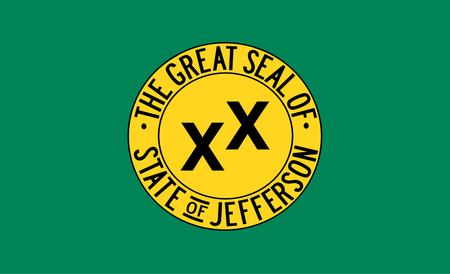
The state flag pictured above depicts a gold mining pan with two black Xs representing how the state had been double-crossed by both Salem and Sacramento. This flag is still seen often in Siskiyou County by supporters of a modern State of Jefferson.
The state capital would likely have been Yreka, CA, due to Senator Randolph Collier's support of the movement.
The state motto used during the 1941 movement was "Liberty and Justice for all"
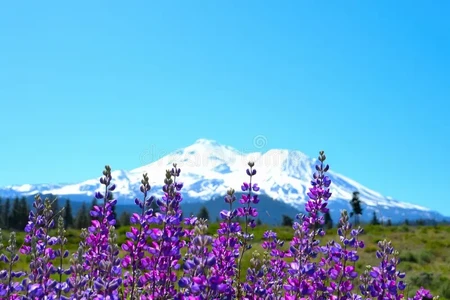
The state flower would have been either the California Poppy, or the Oregon Grape, or perhaps a hybrid "two-flower emblem" However, I think a good choice for the state flower would be Lupine as it is found all across the region
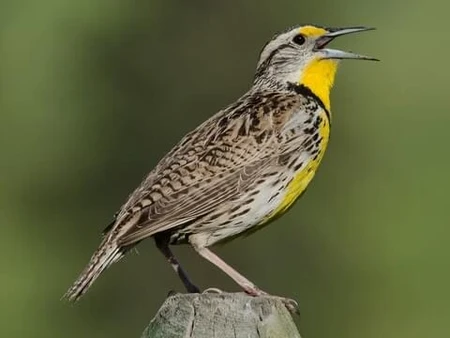
The state bird was proposed to be the Western Meadowlark, however there are several good contenders such as the Mountain Bluebird, Steller's Jay, Bald Eagle, Golden Eagle, American Dipper, or the Varied Thrush.
The state tree was proposed to be the Douglas Fir, but if the state wanted a more globally recognizable tree they may have gone with the Coastal Redwood.
A Modern Day State of Jefferson
If the State of Jefferson were to be created today it would likely include several more counties as pictured in the map at the beginning. With the original 1941 counties it would have a population of 484,727, which is 100k less than the population of Wyoming. However, with the counties in the modern day proposals it would have a population of 3,138,324, making it the 33rd state in population just above Arkansas, giving it 4 representatives. It would be a predominantly Republican state, with only a few Democrat counties. It would contain 3 national parks, those being Redwood, Lassen Volcanic, and Crater Lake National Parks.
Siskiyou Chronicles II
The second blog will likely be about Senator Randolph Collier who influenced the interstate system. I will try to post it next weekend if I have enough time to write it.