
Other Capital Origins ~ Part One
First published: Tuesday February 11th, 2025
Report this blog
Introduction
Well, I've written about the origins of Capital Cities, Second Cities, and US state Capitals, and I was wondering "What next?". Then I thought about the UK and its constituent countries and it was a bit of a light bulb moment. I've not done our other capitals like Cardiff and Edinburgh. But just two cities doesn't make a blog, (Well, it does, but not a very good one!) so a little research was needed. It turns out that there are quite a few "capitals" that I haven't written about. The British Isles alone has six, Denmark has two, France has a few, and so on.
I don't know yet how many episodes this blog series will have, so I'm just going to label each one as Part One, Part Two, Par.....you get the idea! I have a rough idea of the direction I'm going to take, I will start in the UK (Channel Islands to be exact) and then work my way around the world but in the opposite direction to the Capital Cities Blog, just for a change.
So anyway, let's set off on our journey starting in La Manche as it is called in France.....
St. Helier ~ Jersey
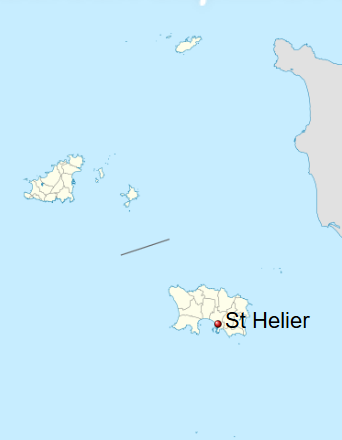
Jersey is what is called a Crown Dependency of the United Kingdom. This means they are largely independent but rely on the British government for defence amongst other minor things. St. Helier is the largest town and seat of the island's government. The town, or at least the land beneath it, was inhabited by the romans as part of their occupation of Gaul. There has been a settlement there ever since, although at times little more than a fishermans village.
During the Second World War, the Channel Islands were the only part of the UK to be occupied by the Nazi forces. There is much evidence on the island of this time, including hospitals, and lookout posts. Nowadays, Jersey is a tourist island and minor tax haven, and as such car ferries ply their trade between the islands, France, and the United Kingdom, as well as flights from various airports each day.
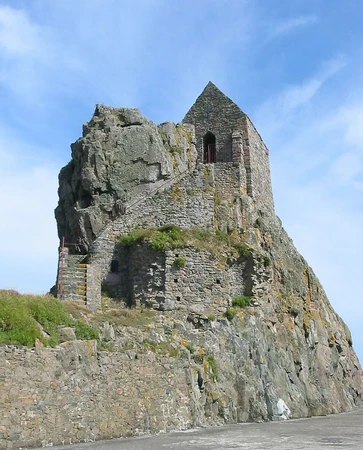
The name of St.Helier derives from the name of a Belgian hermit that made Jersey his home in the 6th century. He lived in a small hermitage on an islet in the bay. From his viewpoint, Helier could see the sails of approaching raiders and would signal to the fishermen who would then take refuge in the centre of the island. Helier was sainted following his beheading by pirates in 555AD.
ST. HELIER = NAMED AFTER HELIER, A BELGIAN HERMIT AND SAINT.
St. Peter Port ~ Guernsey
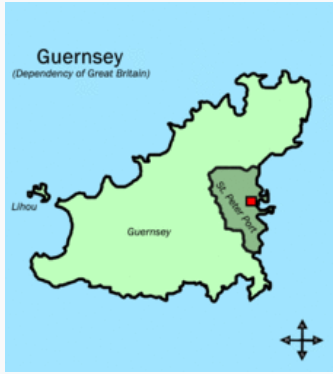
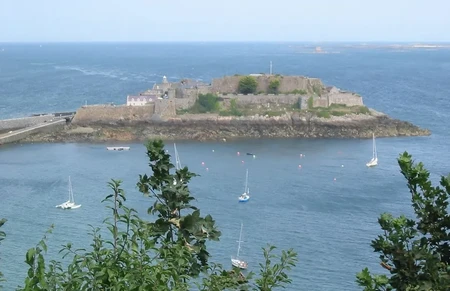
Like Jersey, Guernsey is a Crown Dependency of the United Kingdom, and also like Jersey, this island was occupied by Nazi forces during World War II. Almost the entire population of the island was evacuated to mainland UK prior to the invasion, however over 1,000 residents were relocated by the Nazis to camps in southern Germany.
It is known that there has been a trading post and village on the site of St. Peter Port since before Roman times, although its name is unknown. Nowadays, people living on the island refer to the town as simply "town" and residents are known as "les Villais" (the townspeople).
There are some smaller islands in the Channel Island group (Alderney and Sark are two of the larger of the smaller isles, if that makes sense), although these are administered from Guernsey and don't have their own capital.
It is fairly obvious that the town takes it's name from Saint Peter and the fact that it is a port, and this is exactly it's derivation.
ST. PETER PORT = A PORT NAMED AFTER ST. PETER
Cardiff ~ Wales
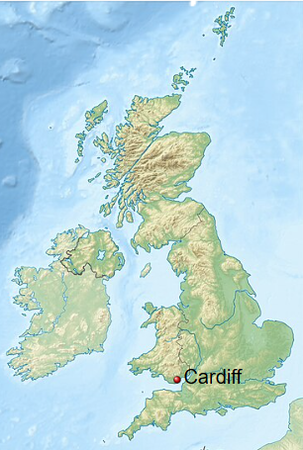
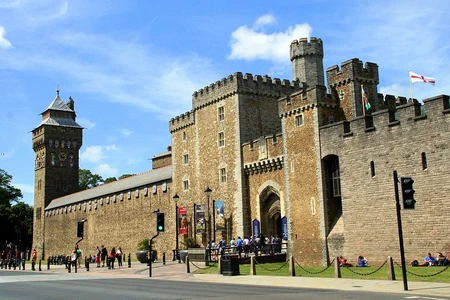
Cardiff is the capital and largest city in the Principality of Wales, a part of the United Kingdom. It is the seat of the devolved Welsh Parliament, known as the Senedd Cymru in Welsh. It was a small town in the early 19th century until the increase of coal mining in the region caused its expansion into the city it is today. However, Cardiff was a base for the Roman Empire, the city's castle is built upon the remains of a Roman fort, in fact some of the structure of the old fort has been incorporated into the castle.
Cardiff is the anglicized version of the city's Welsh name which is Caerdydd. This can be split into two sections, Caer- and -dydd. The two "d"s in the name are pronounced as an "f" in Welsh. The name comes from a post Roman Brythonic language and means "The fort of the Taff" and refers to the Roman fort alongside the river that flows through Cardiff, the River Taff. Caer is Welsh for "fort" and dydd is a form of the word Taff.
CARDIFF = FORT ON THE TAFF
Douglas ~ Isle of Man
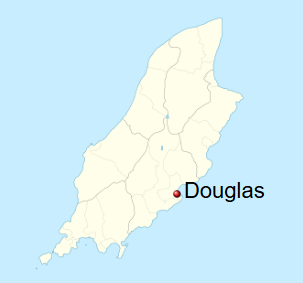
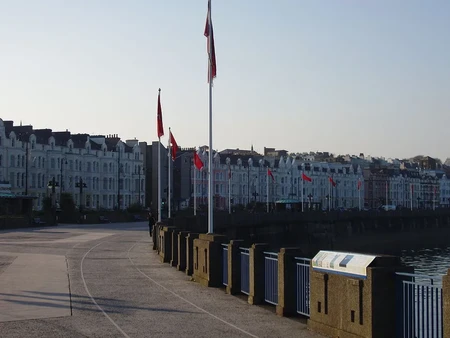
Douglas is the capital and seat of government of the Isle of Man, situated in the middle of the Irish Sea with Scotland to the North, Ireland to the West, England is East and Wales to the South. The government is called the Tynwald and it is claimed, mainly by the Tynwald itself, that it is the oldest continuous parliament in the world. The island held a 1,000 year celebration in 1979, however there doesn't seem to be any firm evidence that the Tynwald started in 979. Tynwald incidentally derives from the Old Norse word Þingvǫllr meaning the "meeting place of the assembly".
You would be forgiven for thinking that the name of the capital, Douglas, comes from a person, but you would be wrong. It is actually derived from the Proto-Celtic language word duboglassio, where dubo means "black / deep" and glassio means "water / river" so the town gets its name from a nearby river.
DOUGLAS = DEEP BLACK RIVER
Belfast ~ Northern Ireland
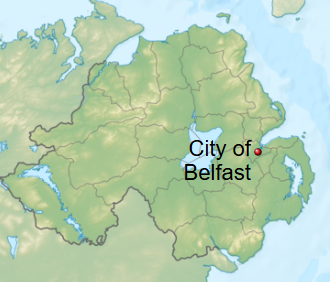
The history of Belfast is complex, from the Irish rebellion of 1798 right up to "The Troubles" of more recent times, Belfast has seen more than it's fair share of violence. The Europa Hotel in Belfast had the dubious honour of being known as "The Most Bombed Hotel in the World", it was targeted 36 times between 1971 and 1994, but now stands as a symbol of regeneration and peace.
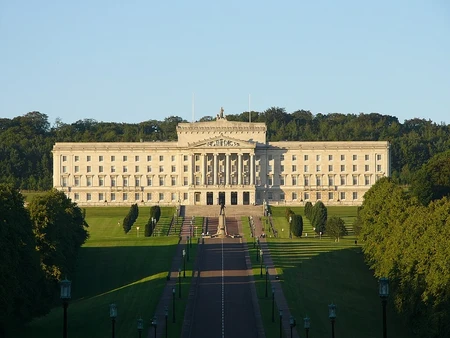
The seat of the Northern Ireland parliament is situated at Stormont Castle, purpose built in 1932 to hold the newly formed government. Although the legislature is currently run from there it also has had a chequered past, with government passing back to London several times.
The name Belfast derives from Irish language words, Béal Feirste meaning "Mouth of the Farset. Farset is the name of a river that was on land near the first settlement. Farset is an anglicized version of Feirste, and refers to a sandbar or tidal ford.
BELFAST = MOUTH OF THE RIVER FARSET
Edinburgh ~ Scotland
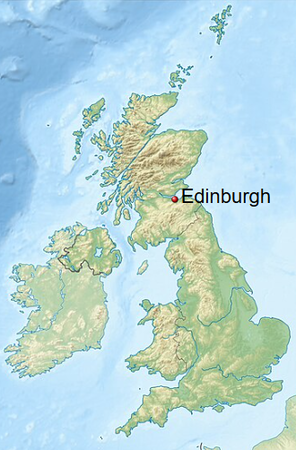
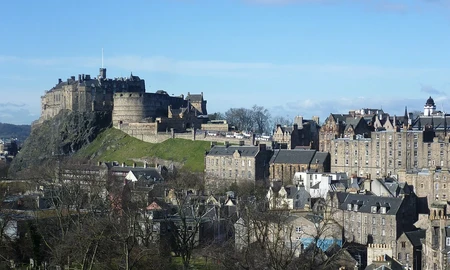
Edinburgh has the nickname of "Auld Reekie" a Scots term that means "Old Smoky". Nowadays the name is probably unjustified with legislation in place to create a cleaner city and environment in general. But in days gone by the smoke from household fires could be seen floating above the city for over twenty miles. In the novel, The Abbot, written by Sir Walter Scott in 1820, one of the characters states "yonder stands Auld Reekie—you may see the smoke hover over her at twenty miles' distance". The name is thought to originate from a laird, or land-owner, that used to regulate his children's bedtime to the appearance of smoke from the tenements in Edinburgh.
The name of Edinburgh can be split into two halves, Edin- and -burgh, burgh obviously means town and is used in many places worldwide, it's a variation of -borough or simply -burg. The Edin part of the name derives from the name of the region in the early Middle Ages, Eidyn, a word in the extinct language Cumbric. It's origin is unknown but is thought to be a name of a person or tribe.
EDINBURGH = EIDYNS TOWN
Tórshavn ~ Faroe Islands
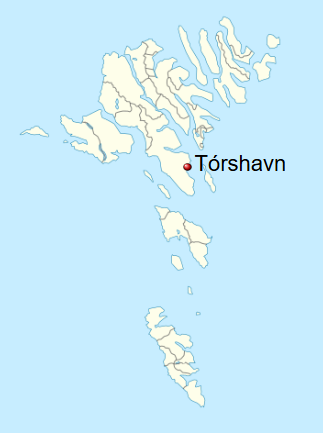
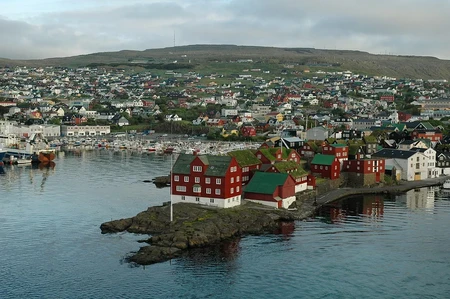
The Faroe Islands are an autonomous territory of Denmark, with their own government and laws. There is archaeological evidence that the islands were settled as far back as the 4th century, possibly by Irish monks. The Norse established their parliament there in 850, making Torshavn their capital and sole trading point of the islands. This meant that nothing could be bought or sold unless it was in Torshavn. This rule was abolished just over a thousand years later in 1856! Torshavn is connected to Denmark and Iceland by ferry, and several cruise ships visit each year.
You may have already worked out the etymology of Torshavn, -havn or -haven means exactly what it says, a haven or in actual fact a harbour. Tors- can be worked out when you consider the early settlers in the islands, not the Irish monks, but the Norse or Vikings. Tor is their name for Thor, you know, the God with the hammer!
TORSHAVN = THORS HARBOUR
Nuuk ~ Greenland
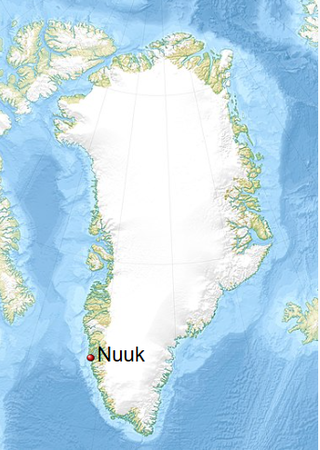
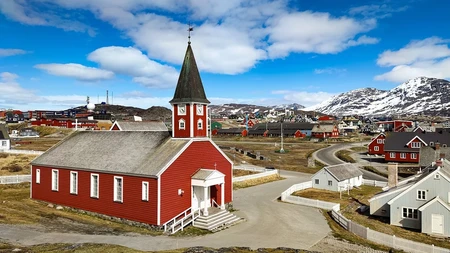
Greenland is the other autonomous territory of Denmark, despite President Trump's thoughts on the matter, at least for now, it is still part of Denmark. Incidentally, Greenland or Grǿnland as it was in the Norse language, was named as such in the hope of attracting settlers to a pleasant land rather than the icy island it was. Nuuk, the capital, was first settled in 1728, although at that time it was called Godthåb which is Danish for "Good Hope". The city is just a few kilometres further north than Reykjavik, making it the world's northernmost capital.
In 1979, home rule for Greenland gave the local parliament the chance to rename the capital in the local language. Nuuk is Greenlandic for "Cape", and was chosen for the city's location at the end of the Nuup Kangerlua fjord.
NUUK = CAPE
Saint Pierre ~ St. Pierre and Miquelon
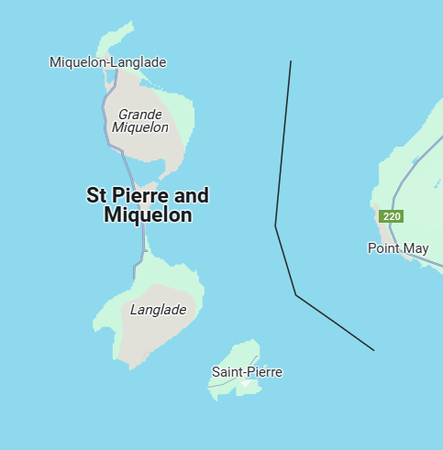
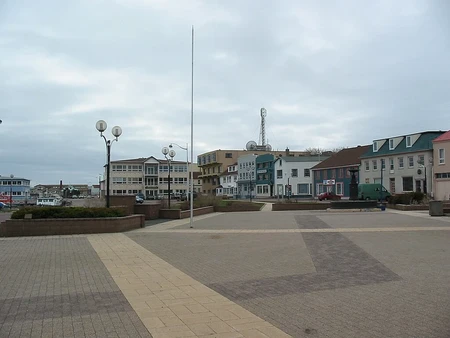
Saint Pierre and Miquelon is a French Overseas Collectivity with a semi-autonomous government that elects it's own deputy to France's National Assembly. The archipelago of eight islands is all that remains of the vast territory that was New France, covering much of eastern Canada and as far south as Louisiana. The islands were explored by Portuguese explorers in 1520 who named them ilhas das Onze Mil Virgens meaning "Islands of Eleven Thousand Virgins", although this was more to do with the day of landing on the feast day of St.Ursula and her virgin companions, rather than a representation of any indigenous residents.
In 1670, a French officer annexed the islands after discovering French fishermen encamped there. He named them St.Pierre and Miquelon after St. Peter, the patron saint of fishermen. Miquelon, by the way, derives from the Basque version of Michael.
SAINT PIERRE = NAMED AFTER SAINT PETER
Hamilton ~ Bermuda
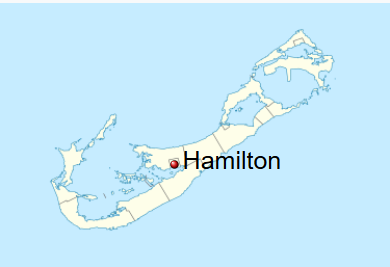
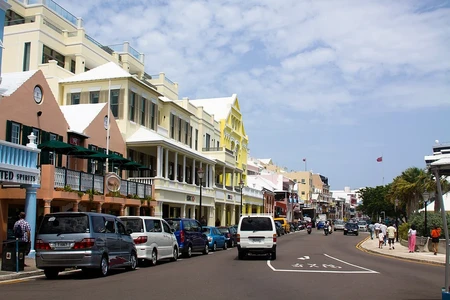
Bermuda is an Overseas Territory of the United Kingdom, it lies in the North Atlantic just over 1,000km from the nearest point on the US mainland. Bermuda is named after the Spanish explorer, Juan de Bermudez, who discovered the archipelago in 1505. But that's not why we're here is it.
The capital of Bermuda is Hamilton, and it's population of less than a thousand residents makes it one of the smallest capitals anywhere in the world. The city was founded in 1790 and named after the Governor, Henry Hamilton, when the government offices were moved from St. Georges in 1793.
HAMILTON = NAMED AFTER HENRY HAMILTON
Summary
That will do for the first in this series. I'm just going to pick and choose which capitals I do for now.
You may have noticed that I missed out Canada, there is a reason for this. Most of the province capitals are named after people and are fairly obvious, Regina for example is named after Queen Victoria (Regina being Latin for "Queen"). I am however, thinking of writing a blog about the origins of Canada's province and territory names along with their capitals as a one off, so watch this space. I may also do selected other countries, but I don't want to get bogged down doing every first level capital, that would get extremely tedious.
You may have also noticed this is a little shorter with only ten entries, that's just to do with my time. It takes longer to research smaller places and cities, I found that out with my Second City Origins blog series. So I thought I would limit myself to ten entries in each blog, making each one readable in a shorter time, and easier to make I think. Plus it adds my blog count up quicker, although I doubt I will be able to catch Astana up.
Anyway, where to next? Well there are a plethora of non sovereign nations and territories around the Caribbean Sea, each with its own capital, so let's hop on a cruise ship as it leaves Bermuda and head on down to our first stop, the British Overseas Territory of the Turks and Caicos Islands....
A good idea, which I think you haven't already done is 10 biggest cities of each country.
Also, yeah, you may catch up to Poirot, but Astana... I don't think so
I think this current series may run on a bit, I've got the entries for part two and three listed and I've only just got out of the Caribbean.
I'm only 11 behind Poirot so you never know, but then I'm only 22 behind Astana. We'll see.
But I'd be guessing you like to actually finish all of your series, so you wouldn't be satisfied with cherry-picking between countries. Although, blogs like those on the cities of France or Germany would really be enjoyable!
Anyway, it is your choice obviously, I am just trying to give you some sort of inspiration. I mean who knows, you may get an entirely new idea from reading this very comment lol
Anyhow, this current series is basically capitals of not recognised countries, right?
Lastly, the rate Astana is going right now is pretty much crazy, despite the fact that all her blogs have great quality!
This current series is non-recognized, overseas territories and such-like.
Yeah and Astana is definitely on a roll!
Interestingly, the given name Douglas seems to have the same etymology. Originally referring to an Irish clan, it must've become a first name somewhere down the road.
Maybe you're due to make the capitals iceberg? ;)
Interesting about the name, I suppose that makes sense.
Nope, I'm gonna leave the iceberg to the professionals, I couldn't even hope to compete with that blog series.
Thanks for producing such consistently good blogs, by the way