
Featured Quizzes
User Quizzes
Create Quiz
Data and Charts
Word Search
Flash Cards
Badges and Games
About JetPunk
Message Board
Random Quiz
Dark Mode
Famous Mathematician by Theorem - Statistics
General Stats
- This quiz has been taken 130 times
- The average score is 5 of 16
Answer Stats
| Hint | Answer | % Correct |
|---|---|---|
| Given a right triangle, then the sum of the squares of the short sides equals the square of the long side. | Pythagoras | 98%
|
| There exist no non-trivial integer solutions to the equation an + bn = cn for n>2. | Pierre de Fermat | 77%
|
| The sum of the numbers of vertices and faces minus edges of a polyhedron equals 2. | Leonhard Euler | 49%
|
| Any consistent formal system F within which a certain amount of elementary arithmetic can be carried out is incomplete. | Kurt Gödel | 41%
|
| There are infinitely many prime numbers. | Euclid | 40%
|
Given two differentiable functios u and v we have  | Gottfried Wilhelm Leibniz | 32%
|
Let ω be a smooth (n-1)-form with compact support on an oriented, n-dimensional manifold-with-boundary M, where ∂ M is given the induced orientation. Then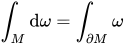 | Sir George Gabriel Stokes | 27%
|
| Given a finite group G and a subgroup H, then the order of G is the product of the order of H and the index of H ind G. | Joseph-Louise Lagrange | 22%
|
| Given a normal and separable field extension L/K, then any subgroup of the group of isomorphisms of L fixing K corresponds to a field extension L/F, where F is a field extension of K. | Evariste Galois | 17%
|
| Given a surjective group-homomorphism f: H → G, then the induced homomorphism f ' : H/Ker(f) → G is an isomorphism. | Emmy Noether | 16%
|
| The integers are integrally closed. | Carl Friedrich Gauß | 15%
|
| Given and endomorphism f of a finite dimensional vectorspace and let P be its chracteristic polynomial. Then P(f) = 0, the zero endomorphism. | William Hamilton and Arthur Cayley | 11%
|
Consider J an ideal in the polynomial ring in n variables over an algebraically closed field. Let V(J) be the vanishing locus of J in the affine n-space and I(M) the vanishing ideal of a algebraic set M in affine n-space. Then 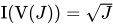 | David Hilbert | 9%
|
| Every riemannian manifold can be isometrically embedded into real n-space for some natural number n. | John Nash | 4%
|
| In any partially ordered set, every totally ordered subset is contained in a maximal totally ordered subset. | Felix Hausdorff | 1%
|
| When the sides meeting at each vertex of a triangle are extended by the length of the opposite side, the six endpoints of the three resulting line segments lie on a circle whose centre is the incentre of the triangle. | John Conway | 1%
|
No matching quizzes found
Score Distribution
Percent of People with Each Score
Percentile by Number Answered
Your Score History
You have not taken this quiz
New and Popular