
Featured Quizzes
User Quizzes
Create Quiz
Data and Charts
Word Search
Badges and Games
About JetPunk
Message Board
Random Quiz
Dark Mode
Cellular & Molecular Biology: ABP101Y1 Practice Test
This quiz is an exact replica of the multiple choice section of the Unit Test
Note that the order of questions and options will shuffle every time
Rate:
Last updated: November 7, 2024
You have not attempted this quiz yet.
More quiz info >>
| First submitted | November 7, 2024 |
| Times taken | 48 |
| Average score | 30.8% | Report this quiz | Report |
26:00
The quiz is paused. You have remaining.
Copied!
Scoring
You scored / = %
This beats or equals
% of test takers
also scored 100%
The average score is
Your high score is
Your fastest time is
Keep scrolling down for answers and more stats ...
1. Which of the following events occurs during the transition from the Gl phase to the S phase of the cell cycle?
The nuclear envelope begins to break down in preparation for mitosis.
Chromosomes condense and become visible under a microscope.
The cell undergoes cytokinesis, resulting in two daughter cells
The cell assesses DNA integrity and prepares for DNA replication.
2. Which of the following statements about genetic editing technologies is incorrect?
Genetic editing is a promising technique for the treatment of genetic disorders, but it is unlikely to be available in clinical settings in the near future.
Genetic editing is a precise technique that has the potential to introduce changes to the DNA sequence without affecting other parts of the genome.
Genetic editing has the potential to treat genetic disorders by correcting mutations at the DNA level, with some treatments already available.
Genetic editing can be used to modify the genomes of plants to enhance yield and resistance to diseases.
3. Given the genetic sequence TCAGGAATGTCTACTAGCGCGCTGTAAAAT, what is the sequence of amino acids that would be translated?
(Note: In order to add the photo I had to put it as an option, It is NOT the right answer)
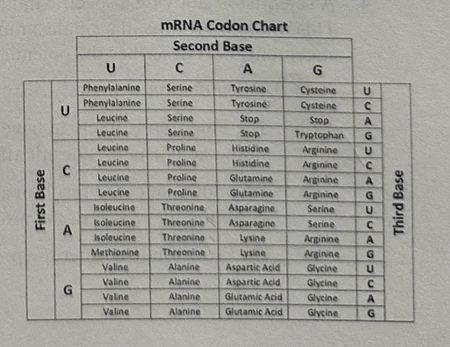
Methionine - Serine - Threonine - Serine - Alanine - Arginine - Leucine - Asparagine
Serine - Glycine - Methionine - Serine - Threonine - Serine - Alanine - Arginine - Leucine
Methionine - Serine - Threonine - Serine - Alanine - Arginine - Leucine
Serine - Threonine - Serine - Alanine - Arginine - Leucine
4. Which of the following statements about the Human Genome Project (HGP) is incorrect?
The HGP was completed in 2003, 13 years after its inception.
The HGP successfully mapped and sequenced all human proteins.
The HGP provided insights that have advanced our understanding of genetics and disease.
The HGP was an initiative that involved collaboration between many countries and research facilities.
5. The discovery of base pairing was a fundamental aspect of understanding the structure of DNA. Which of the following statements accurately reflects the contributions to this discovery?
The discovery of base pairing was solely based on the chemical properties of the nucleotides.
Erwin Chargaff's research established that the amounts of A and T are always equal, as well as the amounts of C and G, leading to the identification of base pairing.
Rosalind Franklin's X-ray diffraction data was integral to determining base-pairing rules as it showed the structure of the four nucleotides.
Watson and Crick determined the base pairing rules based on Chargaff isolation of the four nucleotides.
6. Sickle cell anemia is a genetic disorder caused by a mutation in the hemoglobin gene. Which of the following statements about sickle cell anemia is true?
It is caused by a deletion mutation that removes several nucleotides from the hemoglobin gene.
People with sickle cell anemia typically have an increased ability to carry oxygen due to the abnormal shape of their red blood cells.
Individuals with sickle cell anemia have red blood cells that can assume a rigid, crescent shape under low oxygen conditions, leading to blockages in blood vessels.
Sickle cell anemia can provide some resistance to dengue fever, which is an advantage in certain regions.
7. Which of the following statements accurately distinguishes between somatic cells and germ cells?
Somatic cells divide by meiosis to produce identical daughter cells, while germ cells undergo mitosis to generate gametes for reproduction.
Somatic cells undergo mitosis for growth and repair, while germ cells undergo meiosis to produce gametes, resulting in genetic diversity.
Both somatic and germ cells primarily undergo mitosis, with meiosis occurring only in specialized germ cells.
Germ cells are responsible for all bodily functions and growth, while somatic cells are involved solely in reproduction.
8. A population of flowering plants has developed a mutation that affects petal color. The mutation leads to vibrant red petals instead of the typical yellow. Researchers observe the following outcomes:
• Pollinators, particularly hummingbirds, are more attracted to the red flowers, resulting in increased pollination rates and higher seed production.
• The red petals make the flowers more visible to herbivores, leading to increased damage to the plants in some areas.
• The plants with red petals show no difference in drought tolerance compared to those with yellow petals
Based on the information provided, which of the following statements most accurately describes the nature of the mutation?
The mutation is harmful because it increases susceptibility to herbivores, potentially reducing overall fitness.
The mutation is beneficial because increased pollination rates and seed production are more important for plant survival and growth than predation.
The mutation is neutral because it does not affect drought tolerance, which is a critical survival trait.
The mutation is mostly beneficial because of overall increased pollination rates and seed production whereas the increase in damage is only in some areas.
9. Which of the following statements correctly describes cell checkpoints in the cell cycle?
The Gl checkpoint checks for the presence of sister chromatids before the cell enters mitosis.
Cell checkpoints ensure that the cell cycle progresses smoothly by monitoring cell membrane damage and ATP production.
The M checkpoint, also known as the spindle checkpoint, ensures that all chromatins are properly attached to the spindle apparatus before proceeding with cell division.
The G2 checkpoint verifies that DNA replication has been completed accurately and assesses for DNA damage before the cell enters mitosis.
10. A team of scientists discovers a novel entity in a deep-sea hydrothermal vent. It exhibits unique features that have left the scientists perplexed as to whether to classify it as an organism. Which of the following statements would be true if proven?
If the entity is found to contain RNA similar to known viruses, it would indicate that it is definitely an organism.
If the entity is composed mostly of nitrogen-hydrogen bonds, it would support its classification as a living organism.
If the entity demonstrates self-replication and metabolic activity, it would support the classification as a living organism.
If the entity doesn't interact with its external environment but can maintain its internal environment, it would provide evidence for its classification as an organism.
11. Which of the following statements correctly describes the roles and characteristics of microtubules, intermediate filaments, and microfilaments in the cytoskeleton?
Microtubules are the thinnest components of the cytoskeleton and primarily provide structural support to the plasma membrane.
Microtubules facilitate intracellular transport and cell division, while microfilaments are involved in muscle contraction and cell movement.
Intermediate filaments are involved in cell motility and shape changes, while microfilaments play a key role in maintaining the integrity of the nuclear envelope.
All three components are dynamic structures that constantly change their length and organization based on the cell's metabolic state.
12. In an experiment, a reaction occurs when organic compounds are burned, resulting in the release of a gas. The characteristics of the gas are as follows:
• It is colorless and has a slightly sour taste.
• It does not support combustion and can extinguish flames
Based on this data, what gas do you predict was released during the reaction?
Oxygen
Hydrogen
Carbon dioxide
Nitrogen
13. A scientist is studying a specific mutation in a gene that encodes a protein involved in cell signalling. This mutation results in a single amino acid substitution in the protein. Which of the following statements best describes the potential impact of this mutation on the protein's function?
The mutation could result in a gain-of-function, which would only occur if the substitution is in an important region of the protein.
The mutation may alter the protein's function depending on the substituted amino acid.
The mutation will likely disrupt the protein's structure, leading to loss of function.
The mutation is likely to have a neutral effect on the protein's function because altering just one amino acid usually doesn't affect protein structure.
14. During DNA replication, several enzymes play crucial roles in ensuring the accurate duplication of genetic material. Which of the following statements correctly describes the enzymes involved in the DNA replication process?
Helicase unwinds the DNA double helix, while DNA polymerase synthesizes new DNA strands by adding nucleotides complementary to the template strand.
Helicase is responsible for repairing any errors during DNA replication, while DNA polymerase synthesizes new DNA strands.
DNA polymerase unwinds the DNA double helix, while helicase synthesizes new DNA strands by adding nucleotides to the growing chain.
Both helicase and DNA polymerase work together to add nucleotides to the growing DNA strand without the need for a template.
15. Mutagens are agents that can cause changes in the DNA sequence of an organism. They can be classified into several categories based on their origin and mechanism of action.
Which of the following statements about mutagens is true?
Physical mutagens, like ultraviolet (UV) radiation, always lead to single nucleotide substitutions in the DNA sequence.
All mutagens lead to harmful mutations, which always result in cancer or genetic disorders.
Chemical mutagens, such as those found in tobacco smoke, primarily cause mutations by inducing errors during DNA replication, causing predictable mutations.
Biological mutagens, such as certain viruses, can integrate their genetic material into the host DNA, potentially leading to mutations.
16. Which of the following statements is correct regarding the processes of mitosis?
Telophase involves the separation of chromatins into individual chromosomes, which then re-condense into chromatid.
In metaphase, chromosomes are uncoiled and exist as chromatin, allowing for gene expression.
During prophase, chromatin condenses into chromosomes, which consist of two sister chromatids joined at the centromere.
During prophase, chromatid condenses into chromosomes, which consist of two sister chromatins joined at the centromere.
17. Which of the following statements best reflects a key concept of cell theory and its historical context?
The study of embryos led to the development of cell theory.
All living organisms share identical cellular structures and functions.
All cells contain genetic material that is inherited from the parent cell.
The discovery of cells was facilitated by the invention of the microscope in the 17th century.
18. Why did scientists study proteins before DNA in the context of heredity and cellular functions?
Proteins were visible traits and more accessible for observation, allowing scientists to easily correlate them with phenotypic characteristics.
Proteins were the only biomolecules known at the time, leading scientists to conclude they must carry all hereditary information.
The structure of proteins was simpler than that of DNA, making them easier to analyze and manipulate in experiments.
Scientists believed that proteins were not involved in cellular functions, so they focused solely on nucleic acids for understanding heredity.
19. A patient is diagnosed with a type of cancer characterized by uncontrolled cell proliferation. Genetic testing revealed confusing results as multiple mutations in genes involved in the cell cycle and cell proliferation were uncovered.
Based on this information, what type of gene is likely to be the cause of the cancer?
An oncogene
A tumor suppressor gene
A DNA repair gene
An apoptosis-related gene
20. Which of the following statements about the components of eukaryotic cells is incorrect?
The lysosomes contain digestive enzymes that break down waste materials and cellular debris.
The cell wall regulates the movement of substances in and out of the cell, functioning like a protective membrane.
The Golgi apparatus is responsible for packaging and modifying proteins for transport, not for their synthesis.
The mitochondria are known as the "powerhouse of the cell," as they are responsible for producing ATP through cellular respiration.
21. Which one of the following best describes the role of hydrogen bonds in DNA structure.
Hydrogen bonds are relatively weak bonds that stabilize the double helix by forming base pairs between complementary nucleotides.
Hydrogen bonds are strong covalent bonds that stabilize the double helix by forming base pairs between complementary nucleotides.
Hydrogen bonds link the sugar and phosphate groups, providing structural integrity to the DNA backbone.
Hydrogen bonds allow for the replication of DNA by creating a flexible connection between the two strands.
22. Which of the following best distinguishes the functions of the rough ER, smooth ER, and ribosomes within a eukaryotic cell?
The rough ER is involved in the synthesis of proteins, while the smooth ER is important for lipid synthesis.
Ribosomes synthesize all types of biomolecules, including lipids, carbohydrates, and nucleic acids, while the rough and smooth ER facilitate this synthesis.
The rough ER synthesizes and modifies proteins, while the smooth ER synthesizes lipids
The smooth ER is primarily responsible for producing ribosomes, which then associate with the rough ER to initiate protein synthesis.
23. Which of the following statements about unicellular and multicellular organisms is incorrect?
Prokaryotic cells are unicellular while eukaryotic cells are multicellular.
Multicellular organisms have cells that can specialize for different functions, whereas unicellular organisms do not have specialized cells.
Unicellular organisms perform all necessary life processes within a single cell, while multicellular organisms are made up of many cells that can specialize for different functions.
Unicellular organisms are typically simpler in structure than multicellular organisms, which have complex systems and interactions among cells.
24. Which of the following statements correctly describes a type of mutation?
Translocation involves the reversal of a DNA segment within a chromosome.
Inversion is the process where a segment of DNA is copied, resulting in extra genetic material.
Duplication refers to the addition of a nucleotide, leading to a frameshift mutation.
Translocation occurs when a segment of DNA from one chromosome is transferred to a different chromosome.
25. A 55-year-old patient presents with a mass in the breast. A biopsy is performed to test the cellular contents of the mass. Which of the following statements would most strongly suggests that the mass may be cancerous?
The cells in the mass demonstrate a rapid growth rate but are incapable of dividing in the absence of growth factors.
The cells in the mass have a high degree of differentiation and resemble normal breast tissue, responding appropriately to surrounding growth signals.
The cells in the mass demonstrate a slow growth rate but are capable of dividing in the absence of growth factors.
The cells in the mass exhibit atypical features, including irregular shapes and sizes.
26. Which of the following statements accurately distinguishes prokaryotic cells from eukaryotic cells based on their structural and genetic characteristics?
Eukaryotic cells reproduce solely through binary fission, while prokaryotic cells can reproduce both sexually and asexually.
Prokaryotic cells have their genetic material contained within a membrane-bound nucleus, while eukaryotic cells have their genetic material freely located in the cytoplasm.
Eukaryotic cells can contain multiple linear chromosomes, while prokaryotic cells typically have a single circular chromosome.
Prokaryotic cells use mitochondria for energy production, whereas eukaryotic cells rely on chloroplasts for ATP synthesis.
Save Your Stats
Your Next Quiz

Almost the easiest quiz on JetPunk!

Beat the clock to unscramble the names of these countries. The answers change every time you play!

20 random countries have been removed from the map of the world! Can you identify them in 3 minutes?

Can you select the cities which can be found in Italy, without choosing any which are not?
Comments
No comments yet
New and Popular