
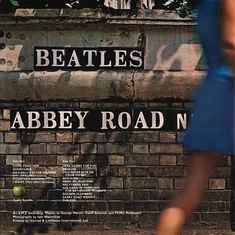
The Hidden Beatles Song
Blog by
Last updated: Friday November 7th, 2025
Report this blog
Last updated: Friday November 7th, 2025
Report this blog
+5
This blog shall provide an overview of the final song on the Beatles' 1969 album Abbey Road, titled "Her Majesty". It is adapted from the Wikipedia article on the song that I wrote, but the style and content have been altered greatly.
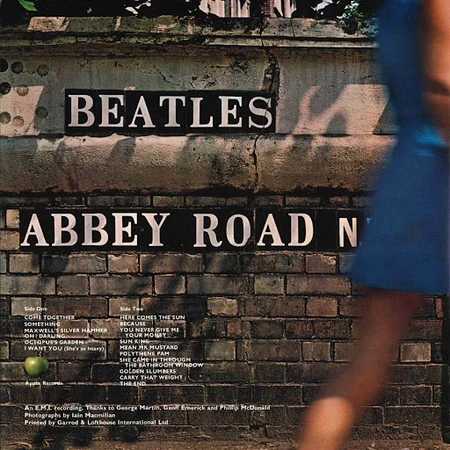
The reverse of the original album cover: notice that "Her Majesty" is not listed
Overview
As Abbey Road comes to a solemn close with the couplet, "And in the end, the love you make / Is equal to the love you take," woven with a sublime orchestral melody, we are led into twenty seconds of silence. Then, a shrill note reawakes our ears, and a song lasting all of 23 seconds passes before our eyes in an instant. This song, "Her Majesty" is the last track on the last album the Beatles recorded together, [1] and it is the shortest track they ever released. [2] The original sleeve of Abbey Road does not include "Her Majesty" in its tracklist; some writers, in fact, deem it one of the first ever hidden tracks. [3] With less than a million streams on Spotify, "Her Majesty" is one of the most obscure Beatles songs, perhaps the most. Rarely has it been covered. [4]
Background
Paul McCartney wrote many silly, old-fashioned vaudevillian songs during his latter years with the Beatles. He tended to perform these solo with a simple piano or guitar accompaniment, as if he were in a theater before a Victorian lower or middle-class audience. Some are quite profound: the persona in "When I'm Sixty Four" expresses eagerness, if uncertainty, about what will become of him when he ages, while some are rather depthless: "Ob-La-Di, Ob-La-Da" tells the story of two people who meet up at the marketplace and start life anew together; the latter was christened as "granny music" by John Lennon. [5] "Her Majesty" somewhat suits the "granny music" category, and Paul never took it very seriously: "I was just writing this little tune. I can never tell, like, how tunes come out. I just wrote it as a joke." [6] However, he does adorn it with trademark British wit and playful irreverence:
Her majesty's a pretty nice girl
But she doesn't have a lot to say.
Her majesty's a pretty nice girl
But she changes from day to day.
I wanna tell her that I love her a lot,
But I gotta get a belly full of wine.
Her majesty's a pretty nice girl,
Someday I'm gonna make her mine.
Oh yeah, someday I'm gonna make her mine.
Recording
Paul wrote "Her Majesty" around late 1968 at his Scotland farm. [7] He demoed it in January 1969, during the Get Back sessions for what would become Abbey Road and Let It Be. [8] The band didn't pay much attention to it, and the demoed version would prove nearly identical to the final version. [9] A few months later, while alone at the studio, he recorded "Her Majesty" in three takes and called it a day. In what Mark Lewisohn deems the simplest of recording sessions, Paul sang the song's nine verses live to his acoustic guitar accompaniment: [10] just under 23 seconds worth of material. "Her Majesty" was to be included in the Abbey Road medley between "Mean Mr. Mustard" and "Polythene Pam". [11] It was an afterthought. [12]
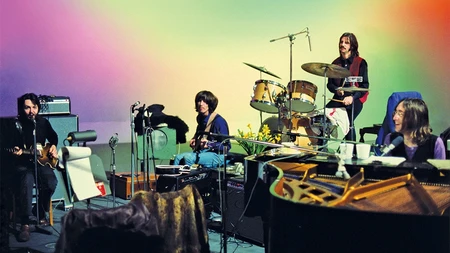
The Beatles during the early-1969 Get Back sessions (L-R: Paul, George, Ringo, John)
However, when Paul heard his work again in July, he judged it unfit for the medley. He told the sound engineer John Kurlander to throw "Her Majesty" away. But Kurlander had been instructed never to discard a Beatles recording, so he had to find a way to squeeze it in Abbey Road. [13] Therefore, he slipped it into the end of the album, after "The End", and attached twenty seconds of tape (silence) before it. [14] Paul later heard Abbey Road in its entirety, and when "Her Majesty" played out, he reportedly liked it: "The Beatles always picked up on accidental things. It came as a nice surprise there at the end," recalls Kurlander. [15] And so "Her Majesty", a throwaway track once condemned to nothingness, made Abbey Road.
However, there is an issue. We may recall that it was to be placed between two other songs in the Abbey Road medley ("Mean Mr. Mustard" and "Polythene Pam"), and, as only a rough edit was made, their closing notes were snipped out and inserted in the subsequent song. Thus, the closing note of "Mustard" is to be found in "Her Majesty", that of "Her Majesty" is in "Pam", and that of "Pam" is in "She Came In Through the Bathroom Window". If this order were kept, nothing would sound out of place. However, "Her Majesty" was moved to the end, which slightly interrupts the medley's flow and makes "Her Majesty" sound rather odd, as it begins with a crashing note (that of "Mustard", and ends abruptly, with its final note missing (being in "Pam"). [16] What's more: Kurlander noticed this issue, and yet he didn't solve it. Why? Paul told him: "Never mind, it's only a rough mix, it doesn't matter." [17] When he changed his mind about the song, the issue may have been forgotten, or they didn't care.
Interpretation
Because "Her Majesty" lasts a great 23 seconds, we'd think very little has been written about it. However, because "Her Majesty" is a Beatles song, quite a bit has been written about it. Alan W. Pollack composed a detailed musical analysis of the song, as he did with all Beatles songs, but it won't be discussed here given its technical nature. Therefore, we'll say a few words about the lyrics. Paul once said of "Her Majesty": "It was quite funny because it's basically monarchist, with a mildly disrespectful tone, but it's very tongue in cheek. It's almost like a love song to the Queen." [18]
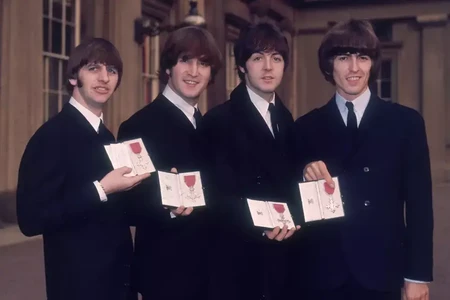
The Beatles with their MBEs (bestowed on them by the Queen) in 1965
Kenneth Womack describes it as a "gentle acoustic paean" to Elizabeth II, and other writers have suggested that Paul wrote it in tribute to her. [19] After all, Paul was quite fond of Elizabeth, saying that "[she] was just like a mum to us [Beatles]", and even once admitting that he had a crush on her as a child. [20] Still, "Her Majesty" comes across as quite ungracious. Rolling Stone Brasil has, in fact, questioned whether the lyrics are attacks on Elizabeth, [21] but this is unlikely. Paul wrote it as a joke, and he himself leans toward monarchism. [22] He rarely wrote political songs and never did as a Beatle; [23] as a solo artist, he wrote two that I can think of: "Give Ireland Back to the Irish", and "Big Boys Bickering", the latter being one of the only solo songs in which he says fuck (he says it six times).
Final thoughts
We have discussed the background, recording process, and lyrical content of "Her Majesty", but we have not yet assessed it. Is it any good? Here, I will speak for myself, and I invite you all to listen to the track—preferrably, the whole of Abbey Road, if you have 47 minutes to spare—and form your judgment. Personally, I like "Her Majesty": it is a witty song, and Paul pulls off quite an impressive performance on the guitar; even though it's only 23 seconds long, there are thirteen chords, according to one transcription. Some writers have also praised "Her Majesty" for tempering the end of the album and providing a touch of humour following "The End". [24] I agree with them. In my view, it's better to chuckle than to cry after a musical performance, especially when one considers that Abbey Road was the last album the Beatles recorded together.
Another point of interest regarding "Her Majesty" concerns the Beatles community, or fanbase. In 2009, MTV Networks released a version of the song for the video game The Beatles: Rock Band that allowed one to play the song's missing last note, which was left behind in "Polythene Pam". Fans did not like this at all; they insisted that the note remain missing. [25] It says a lot about the Beatles as cultural symbols when an error in the editing process becomes an icon.
Notes
[1] Turner, 200; While Let It Be was the last studio Beatles album to be released, it was the second-to-last to be recorded.
[2] Harry, 304
[3] Rogers; Womack § "Her Majesty"
[4] McGuinness
[5] Guesdon & Margotin, 50
[6] Guesdon & Margotin, 603
[7] Everett, 269: location; Winn, 304: date
[8] Pollack
[9] Everett, 269; Pollack
[10] Lewisohn, 178
[11] MacDonald, 354
[12] Davies, 199
[13] Lewisohn, 183
[14] MacDonald, 354–355
[15] Lewisohn, 183; see also: Guesdon & Margotin, 602–603
[16] Lewisohn, 183; Riley, 336
[17] Guesdon & Margotin, 602
[18] Guesdon & Margotin, 603
[19] Womack 2014 § "Her Majesty": quote; Guesdon & Margotin, 603; Harry, 304: tribute
[20] Turner, 200
[21] Rolling Stone Brasil
[22] Ibid.
[23] The nearest Paul wrote to a political song as a Beatle was "Blackbird", a civil rights anthem, but civil rights was more of a social matter than a political one, or, at most, a sociopolitical matter. (see Guesdom & Margotin, 476) George and John did write some political songs: "Taxman", "Piggies", and "Revolution", for example.
[24] Riley, 336
[25] Kane
Bibliography
- Davies, Hunter (2016). The Beatles Book. London, England: Ebury Publishing, especially p. 199.
- Editorial staff (7 May 2020). "Beatles: a música 'Her Majesty' era um ataque à Rainha Elizabeth II?" [Beatles: Was the song 'Her Majesty' an attack on Queen Elizabeth II]. Rolling Stone Brasil (in Brazilian Portuguese).
- Everett, Walter (1999). The Beatles As Musicians: Revolver Through the Anthology. New York City, New York: Oxford University Press, especially p. 269.
- Guesdon, Jean-Michel; Margotin, Philippe (2013). All the Songs: The Story Behind Every Beatles Release. New York City, New York: Black Dog & Leventhal Publishers, especially pp. 602–603.
- Harry, Bill (1992). The Ultimate Beatles Encyclopedia. Great Britain: Virgin Books, especially p. 304.
- Kane, Yukari Iwatani (21 October 2009). "Finding Closure in The Beatles: Rock Band". Wall Street Journal.
- Lewisohn, Mark (1988). The Beatles Recording Sessions. New York City, New York: Harmony Books, especially pp. 178, 183.
- MacDonald, Ian (2005). Revolution in the Head: The Beatles' Records and the Sixties (2nd revised ed.). London, England: Pimlico (Rand), especially pp. 384–385.
- McGuinness, Paul (26 September 2025). "'Abbey Road' Cover Versions: The Beatles' Classic Album Reimagined". uDiscoverMusic.
- Pollack, Alan W. (2000). "Notes on 'Her Majesty'". Soundscapes.
- Riley, Tim (2002). Tell Me Why – The Beatles: Album by Album, Song by Song, the Sixties and After. Cambridge, Massachusetts: Da Capo Press, especially pp. 221, 336.
- Rogers, Jude (25 January 2015). "Manna for fans: the history of the hidden track in music". The Guardian.
- Turner, Steve (2005). A Hard Day's Write: The Stories Behind Every Beatles Song. New York City, New York: Harper Paperbacks, especially p. 200.
- Winn, John C. (2009). That Magic Feeling: The Beatles' Recorded Legacy, Volume Two, 1966–1970. New York City, New York: Three Rivers Press, especially p. 304.
- Womack, Kenneth (2014). The Beatles Encyclopedia: Everything Fab Four. ABC-CLIO: Greenwood.
_________________________________________________________________________________