

The Bombing of Hiroshima - Was it justified?
Last updated: Monday February 24th, 2025
Report this blog
This blog was supposed to be published on 06.08.2024. Unfortunately, this was not possible due to time and personal reasons.
The Bombing of Hiroshima - Was ist justified?
One of the two largest weapons of mass destruction was used 79 years ago. Three days later, another one was used.
To this day, these are the only uses of the atomic bomb - but they still leave their mark on us today.
In this blog, we will have a look on the first use of the nuclear bomb - the Bombing of Hiroshima - and if it was justified.
What happened?
It's a quiet morning in Hiroshima. So far, Hiroshima has been spared from US air strikes. Shortly before eight o'clock, the Japanese military spots two foreign airplanes in the sky. In order to save fuel and airplanes, such small crews are no longer shielded.
But at 8:15 a bomb is dropped from the plane. About 45 seconds later, the bomb hits. 70,000 to 80,000 people are killed instantly. A new disease emerges: Acute radiation sickness. It is estimated that a total of 90,000 to 166,000 people die as a result.
After that, a new discussion is flared up.
Supporters
Less casualties than in Operation Downfall
The aim was to force Japan to surrender. A plan was the Operation Downfall. It was a plan to invade especially the mainland of Japan. Estimates for this operation show that there would be a lot more victims than with a nuclear bomb. The figures in relation:
Estimates for the Operation Downfall:
US-Victims:
- Army Service Forces: 1,7 to 4 million casualties (400,000-800,000 deaths)
- On a conference with President Truman: 250,000 to 1 Million deaths
Japanese Victims:
- Millions of soldiers
- High resistance in the nation (with many deaths of the japanese people)
Victims in Hiroshima:
- Former population: 350,000
- deaths: 140,000 (Estimates)
- Many long-term deaths because of the bomb
Also supporters say the surrender of Japan (that was fastly possible because of the nuclear bomb) saved many more lives, e.g. in China, where many war crimes took place.
Japan's leaders refused to surrender
Surrending was in Japan socially and culturally despised. An opposition to war was not seen gladly, because it would call the military weak.
Japan didn´t managed it to find a minamous support of the Japanese cabinet, so surrending was not possible without the agreement of the military that is also in this cabinet.
Japan also worked on a nuclear bomb
There was only a slow progress, but Japan also worked on it´s own nuclear bomb. An U-boat of Germany was on the way to send materials to Japan. However, it is known that the poorly coordinated Japanese project was considerably behind the US developments in 1945, and also behind the unsuccessful German nuclear energy project of WWII.
Opponents
Militarily unnecessary
Opponents of the atomic bombings on Hiroshima and Nagasaki argue they were unnecessary. Assistant Secretary Bard and other military leaders believed that Japan would have surrendered through conventional bombings and a naval blockade. The 1946 United States Strategic Bombing Survey supported this, concluding Japan would have surrendered by the end of 1945 without the atomic bombs or Soviet entry.
The Bombing was a war crime
Opponents argue that the bombing was a massive war crime. The bomb wasn´t only against soldiers, but also in conscience that thousands of civil people would die.
Immoral
Opponents of dropping the atomic bombs on Hiroshima and Nagasaki argue that the decision was deeply immoral. They point out that the bombs targeted civilians, killing and injuring tens of thousands of innocent people. The immediate destruction and prolonged suffering caused by radiation injuries, burns, and psychological trauma inflicted inhumane suffering on survivors, known as Hibakusha.
On JetPunk
JetPunk Poll to this topic
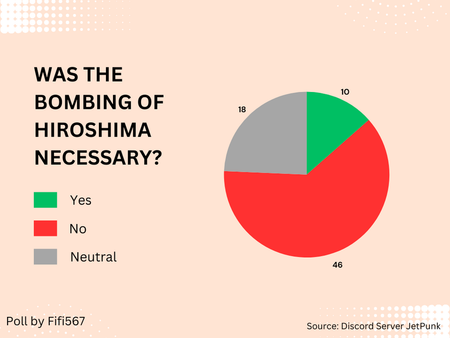
Statements from the JetPunk Discussion Group
Sources
Thank you for reading, subscribing and comment!

