

The Mississippi Delta
First published: Wednesday July 17th, 2024
Report this blog
Geography
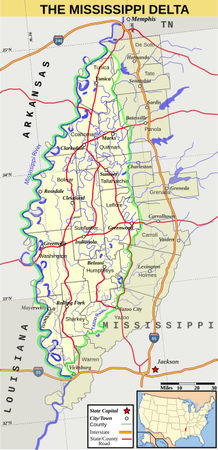
Despite its name it is not a delta of the Mississippi River. The shifting river delta at the mouth of the Mississippi on the Gulf Coast lies some 300 miles south of this area. Instead, the Mississippi Delta is part of an "Alluvial" plain, created by regular flooding of the Mississippi and Yazoo rivers over millenniums. The climate is humid subtropical, with short mild winters, and long, hot and wet summers.
The land is flat and contains some of the most fertile soil in the world. It is two hundred miles long and seventy miles across at its widest point, encompassing approximately 4,415,000 acres, or 7,000 square miles of alluvial floodplain. On the east, it is bounded by bluffs extending beyond the Yazoo River.
The Delta includes all or part of the following counties: Washington, Western DeSoto, Humphreys, Carroll, Issaquena, Western Panola, Quitman, Bolivar, Coahoma, Leflore, Sunflower, Sharkey, Tate, Tunica, Tallahatchie, Western Holmes, Western Yazoo, Western Grenada, and Warren. I gave links to each county so you can research it in particular
Demographics
In the 21st century, about one-third of Mississippi's African American population lives in the Delta, which has many black-majority state legislative districts. Much of the Delta is included in Mississippi's 2nd congressional district, represented by Democrat Bennie Thompson
Chinese immigrants began settling in Bolivar County and other Delta counties as plantation workers in the 1870s, though most Delta Asians families migrated to the magnolia state between the 1900s and 1930s. Most of these immigrants worked to leave the fields, becoming merchants in the small rural towns. As these have declined, along with other Delta residents ethnic Chinese have moved to cities or other states. Their descendants represent most of the ethnic Asian residents of the Delta recorded in censuses. While many descendants of the Delta Chinese have left the Delta, their population has increased in the state.
The Mississippi Delta received waves of immigration from three areas which have provided many of America's immigrants: China, Mexico, and Italy. The Italians of the Mississippi Delta took with them elements of Italian cuisine to the region, and possibly most importantly, elements of Southern-Italian music such as the mandolin, which became a part of the music of the Mississippi Delta Blues. Mexican immigrants to the Mississippi Delta greatly influenced the cuisine of the Mississippi Delta, leading to the development of one of the Deltas most famous culinary inventions, the Delta style tamale, also called the hot tamale
Economics
For more than two hundred years, agriculture production in the Natchez area and indigo in the lower Mississippi. French yeomen settlers, supported by extensive families, had begun the back-shattering process of clearing the land to establish farms. European settlers in the region attempted to enslave local Native Americans for hard labor, though this proved unsuccessful as they frequently escaped. By the 1700's century, the settlers had switched to importing enslaved Africans instead as a source of labor. In the early years of European colonization, enslaved African laborers brought critical knowledge and techniques for the cultivation and processing of both rice and indigo. Thousands of Africans were captured, sold and transported as slaves from West Africa to North America.
The invention of the cotton gin in the late 1700's profitable the cultivation of short-staple cotton. This type could not be grown in the upland areas of the South, leading to the quick development of King Cotton throughout what became known as the Deep South. The demand for labor drove the domestic slave trade and more than one million African American slaves were forced by sales into the South, taken in a forced migration from families in the Upper South. After continued European-American settlement in the area, Congressional passage of the Indian Removal Act of 1830 got rid of Native American claims to these lands.
The Five Civilized Tribes and others were mostly removed west of the Mississippi River, and European-American civilization expanded at a fast rate in Georgia, Alabama, Mississippi, Louisiana, and Texas. In the areas of greatest cotton cultivation, whites were far outnumbered by their slaves.
Many slaves were transported to Delta towns by riverboat from slave markets in New Orleans which became the fourth largest city in the country by 1840. Other slaves were transported downriver from slave markets at Memphis and Louisville others were carried by sea in the coastwise slave trade. By this time, slavery had long been established as a racial caste. African Americans for generations worked the commodity plantations, which they made extremely profitable. In the opinion of Jefferson Davis, typical of that of Mississippian whites of his day, Africans being held in slavery reflected the will of Providence, as it led to their Christianizing and to the improvement of their condition, compared to what it would have been had they remained in Africa. According to Davis, the Africans "increased from a few unprofitable savages to millions of efficient Christian laborers."
By the early 19th century, cotton had become the Delta's premier crop, for which there was high international demand. Mills in New England and New York also demanded cotton for their industry, and New York City was closely tied to the cotton trade. Many southern planters traveled so commonly there for business that they had favorite hotels. From 1822 cotton-related exports comprised half of all exports from the port of New York City. In 1861 Democratic mayor Fernando Wood called for secession of New York City because of its close business ties to the South. Eventually the city joined the state in supporting the war, but immigrants resented having to fight when the wealthy could buy their way out of military service.
Comparing cotton's preeminence then to that of oil today, Historian Sven Beckert called the Delta "a kind of Saudi Arabia of the early 1800's."
Demand for cotton remained high until well after the American Civil War, even in an era of falling cotton prices. Though cotton planters believed that the alluvial soils of the region would always renew, the agricultural boom from the 1830s to the late 1850s caused extensive soil exhaustion and erosion. Lacking agricultural knowledge, planters continued to raise cotton the same way after the Civil War.
Political environment
Delta politics was dominated by Democrats during the post-Civil War era, though areas of resistance from blacks and whites remained throughout the era. Some of these Southern Democrats resorted to using fraud, violence, and intimidation to regain control of the state legislature in the late 19th century. Civic groups such as the Red Shirts in Mississippi were active against Republicans and blacks, sometimes using violence to suppress their voting for state candidates. But many blacks continued to be elected to local offices, and there was a biracial coalition between Republicans and Populists that briefly gained state power in the late 1880s.
To prevent this from happening again, in 1890 the Mississippi state legislature passed a new constitution which effectively disenfranchised most blacks by use of such devices as poll taxes, literacy tests, and grandfather clauses withstood court challenges. If one method was overturned by the courts, the state would come up with another to continue exclusion of blacks from the political system. Unable to vote, they could not participate on juries. The state passed legislation to impose racial segregation and other aspects of Jim Crow
This system of oppression was maintained with violence and economic boycotts into the years of increasing activism for civil rights, as blacks worked to regain their constitutional rights as citizens. The Delta counties were sites of fierce and violent resistance to change, with blacks murdered for trying to register to vote or to use public facilities. African Americans were not able to exercise their constitutional rights again until well after their successes in the Civil Rights Movement and gaining passage of the Voting Rights Act of 1965.
Music
The Delta is strongly associated as the place where several genres of popular music originated, including Delta blues and rock and roll. The mostly Black sharecroppers and tentant farmers lives marked by poverty and hardship but they expressed their struggles in music that became the beat, rhythm and songs of cities and a nation.
I hope you enjoyed my documentary of the Mississippi Delta I've been running low on ideas recently so you can give me some in the comments
Just a small criticism, but could do with a few more pictures to spread out the blog a little.