
The Problem With Sanctions: Part 1 - Syria
First published: Thursday August 14th, 2025
Report this blog
What is the most used weapon in the 21st century?
Tanks? No.Fighter Jets? No.
Drones? No.
The answer is, Sanctions.
It seems pretty ironic, but after more than 5100 years since the start of civilization, humans have finally started to focus on using weapons that do not cause bloodshed and deaths.
The above sentence may seem right. But there is one flaw: "weapons that do not cause bloodshed and deaths".
You may ask what's wrong in the statement. And you are not the only one to.
To explain the undesired consequences of Sanctions, we will start with a fairly recent example of sanctions being imposed to topple a regime.
The Syrian Crisis
Syria has been subjected to sanctions for decades, beginning in 1979 when the United States designated it a State Sponsor of Terrorism. However, that’s not the focus here. This blog will explore more recent examples of sanctions to provide a clearer, more practical understanding of their impact today.
Caesar Syria Civilian Protection Act (2020) and EU sanctions
The Caesar Syrian Civilian Protection Act and the EU sanctions were imposed on Syria with the intention to topple the regime of Syrian dictator Bashar al-Assad.
Although the sanctions played a role in toppling the regime, they had severe consequences on the Syrian people.
I will be breaking down these sanctions into smaller parts to analyse the effects of these sanctions more effectively.
1. Arms Embargoes: Often considered the most important part of sanctions, Arms Embargoes are a complete ban on exporting any weapons or military equipment to Syria.
These were aimed at reducing the military capabilities of the Dictatorial regime, which they did, but they also reduced the anti-terrorist capabilities of the military, which are crucial, as Syria is located in the Levant, one of the hotspots of terrorism.
2. Oil and Energy Sanctions: A ban on importing Syrian oil and energy and prohibition on investment in Syria's oil and gas sector.
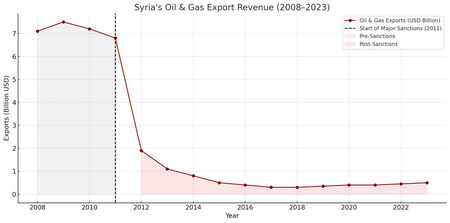
When the sanctions were imposed, 65-70% of Syria's exports were Oil and Gas, out of which more than 90% was exported to the EU. Sanctioning these was a huge hit to Syria's economy.
The nation tried to shift to other sources like Agriculture and Tourism. But Syrian land did not provide ideal conditions for agriculture, and nobody would want to visit a war-torn nation on a holiday. These, and many other attempts failed to generate enough revenue to fuel development.
Here's a graph that shows the sharp drop in Syrian Oil and Gas exports.
3. Trade Embargoes: Trade embargoes are a ban or a severe restriction on Imports and Exports with Syria.
Syria's international trade is responsible for keeping Syria's economy afloat. The largest export is Oil, followed by Agricultural Produce and Textiles. The EU is the largest importer of Syrian textiles and agricultural produce. Restrictions on these would cripple Syria's trade value.
While imports were also hit hard, they fell at about the same rate at which the exports fell. This kept the trade deficit steady, but hit the economy in aspects like development.
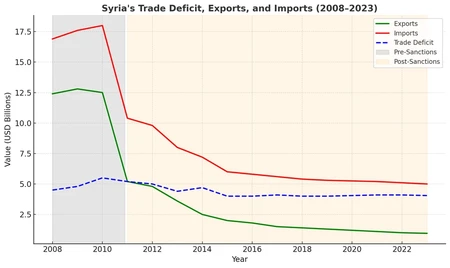
The above graph shows how sanctions affected Syrian trade.
4. Financial and Banking Restrictions: Prohibition on doing business with the Syrian Central Bank or certain Syrian commercial banks and international institutions and private investors were banned from providing credit, loans, or capital.
These sanctions prevent any Bank or Organization to invest in the Syrian economy. This is a major drawback for Syria, as it prevents development. Investments play a crucial role in a nation's development and economic stability. It prevents many forms of international support from reaching Syria, worsening the condition of the people and economy.
Summary:
Sanctions were partially successful in reducing the power of the regime, but the consequences were extreme. Here are some examples:
Growing Black Markets: Sanctions restricted much of Syria’s formal trade in weapons and other goods, inadvertently fueling the growth of black markets and illicit trade routes. This has become a major concern, as these underground networks have expanded, facilitating the increased flow of weapons and drugs into and out of the country.
Although established and regulated arms trade routes were cut off, weapons still found their way into Syria through black markets. Economic sanctions further fueled this trend, as poverty created conditions where illicit trade became more appealing, with many willing to engage in it to meet basic financial needs.
Overcompliance: Sanctions often provide humanitarian exemptions, which help much needed humanitarian aid reach Syria. The aid is crucial for Syria, because when a state is in a state of civil war, humanitarian aid prevents loss of lives due to famines and other wartime problems.
Most of the aid is send by NGOs led by the UN and other private organizations.
Due to the fear of the strict penalties that are imposed because of having relations and trade with Syria, many organizations try to remove any relation with Syria, although it is exempted under the sanctions. This phenomenon is very common and leads to the reduction of humanitarian aid inflow to Syria, worsening the conditions there.
Here are some graphs that show the side effects of sanctions being imposed on Syria:
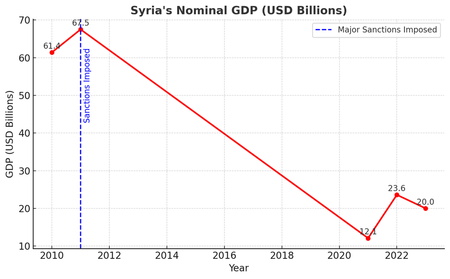
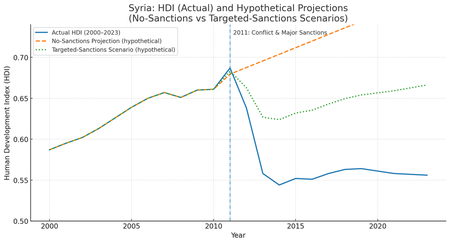
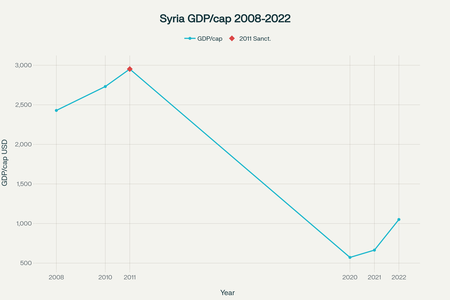
*Data collected from verified sources. Graphs made using generative AI.
Gini Index: (0 = perfect wealth equality, 100 = perfect wealth inequality)
The dramatic drop from 40.4 (2009) to 26.6 (2022) indicates shrinking inequality, but this likely reflects overall economic collapse, with many losing income, rather than improved equality.
Here are some images showing the contrast between Syria before and after the war.
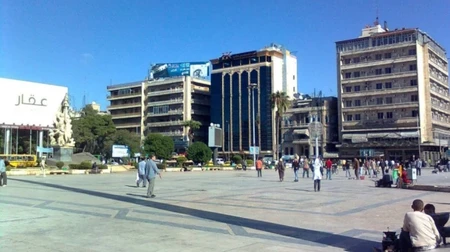
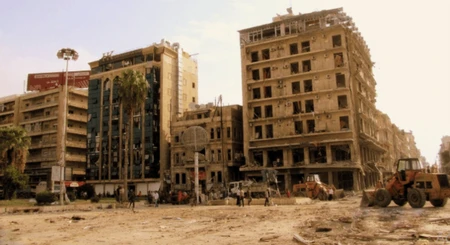
Sanctions don’t directly cause this damage; instead, they create conditions that make recovery nearly impossible, prolonging and deepening the crisis.
Western countries imposed sanctions on Syria, contributing to the devastation of homes, devaluation of currency, rising hunger, deepening poverty, and more. Yet, when Syrian citizens flee and migrate to these very nations seeking basic human rights, they often face alienation. Many are blamed for destroying the nation, while it is overlooked that these same nations played a role in the destruction of the Syrians’ homes in the first place.
It is important to note that these are not direct consequences of sanctions — they stemmed from the Civil War. However, sanctions magnified these problems and crippled any chance of recovery.
Liked the article? Share your thoughts in the comments. This piece is part of a series exploring the real-world impact of sanctions. Next, we’ll turn to Cuba, followed by Venezuela.
Coming up: The Problem With Sanctions: Cuba
I agree that sanctions hurt the citizens of that country. But sanctions are supposed to be used as a restriction method to restrain the development of the country for whatever reasons.
Sanctions aren't meant to help the country. While the people of that country will likely also receive drawbacks, the government will too. And that is usually the point.
That's what I was trying to say in the article.
Suggesting that arms embargo stopped terrorists when Assad regime called all rebel groups terrorists doesn't make much sense and lacks insight.
I will ignore the bias as it does not hide it and clearly focuses specifically on the bad sides, glassing over saction pros.
Solid 5/10 read and 8/10 compared to RUB nowadays.
This article was based on the research I did in my 2nd Model UN, where I was appointed as the representative of Syria. So the content is taken from my speeches, and there are some gaps in the resources, as I focused on these years in the speeches.